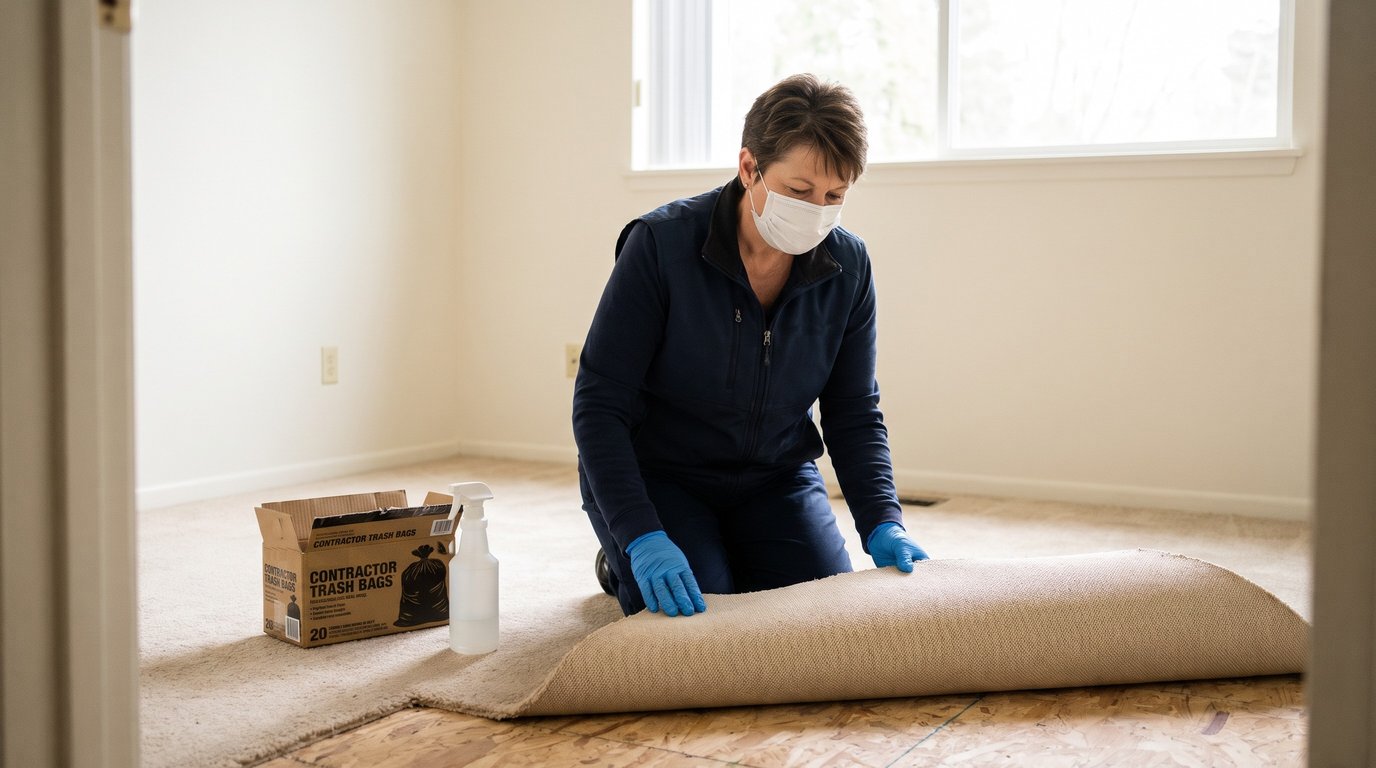
Under OSHA's bloodborne pathogens rule, urine and feces are not regulated biohazards unless they have visible blood in them. OSHA put that in writing in 1993. The health risk is different: urine from a healthy person is usually low risk, but feces can carry norovirus, hepatitis A, salmonella, E. coli and C. diff. Wear gloves, treat feces as infectious, and disinfect with a bleach mix of 5 to 25 tablespoons per gallon of water, left on for at least 5 minutes. Large amounts, anything soaked into floors, or any blood is a job for a professional.
Search by ZIP code for cleanup companies near you, then call one directly.
What OSHA says
OSHA's Bloodborne Pathogens Standard (29 CFR 1910.1030) covers workers' exposure to blood and to a list it calls "other potentially infectious materials," or OPIM. The body fluids on that list are semen, vaginal secretions, five internal body fluids, amniotic fluid, saliva in dental procedures, "any body fluid that is visibly contaminated with blood," and all body fluids when you cannot tell them apart. Urine and feces are not on the list by name.
In a letter dated January 26, 1993, OSHA named both: "Urine, feces, sweat, tears, nasal secretions, and vomitus which are not visibly contaminated with blood are not considered to be 'other potentially infectious materials.'" A 2007 letter repeats it for urine: "Urine that does not contain visible blood is not regarded, under the standard, as blood or other potentially infectious material (OPIM)."
Three things change that answer:
- Visible blood. Then the fluid is OPIM. The 1993 letter says workers who handle linens "soiled with urine that contains visible blood would be occupationally exposed."
- Fluids you cannot tell apart. The standard covers "all body fluids in situations where it is difficult or impossible to differentiate between body fluids."
- Work, not home. The standard "applies to all occupational exposure." It sets duties for employers. It does not cover you cleaning your own home.
Our guide to OSHA bloodborne pathogen rules covers what employers must do when the standard applies. For other materials, see what counts as a biohazard.
Urine: usually low risk
Cornell University's safety office has a reference sheet on human feces and urine. On urine, it says: "Human urine is typically not hazardous. It can be potentially hazardous if there is visible blood or if it originates from an individual with a urinary tract infection." It still says urine "should be treated with universal precautions."
Urine is not sterile, though. Healthy urine "always has trace quantities of bacteria and other germs," the Cleveland Clinic says, at levels that "are typically harmless for most people."
Animal urine is a separate question. The CDC says the bacteria that cause leptospirosis "are spread through the urine (pee) of infected animals" and "can survive in contaminated water or soil for weeks to months." Rodents, pets and animal hoarding are in our animal waste cleanup guide.
Human urine turns into a bigger job with volume and time: a mattress, carpet or subfloor soaked over weeks or months, in a hoarded home, or in a rental after a tenant moves out.
Feces: the riskier of the two
Cornell's sheet lists no germs for urine. For feces it lists more than a dozen. Among them:
| Germ | What the source says |
|---|---|
| C. diff | "C. diff germs spread from person to person in poop." Its spores can "live for months or years on surfaces and in the soil" (CDC). |
| Norovirus | On Cornell's list for feces. The CDC's norovirus cleanup steps begin "After someone vomits or has diarrhea." |
| Hepatitis A | On Cornell's list for feces. The CDC says it spreads "when someone ingests the virus, even in very small amounts." |
| Salmonella, Shigella, Campylobacter, E. coli O157:H7, Cryptosporidium | On Cornell's list for feces. |
| HIV, hepatitis B, hepatitis C | Only when blood is visible: "visible blood in feces may indicate the presence of bloodborne pathogens" (Cornell). |
C. diff needs a plan of its own. "Finding C. diff germs in the home is not unusual, even when no one in the home has been ill with C. diff infection," the CDC says. The CDC also points to special products that kill it. They are in the cleanup section below.
Can your boss make you clean it up?
Store, restaurant, library and hotel workers ask this online, and a common reply is that OSHA lets anyone without special training refuse. OSHA's letters do not say that. Urine and feces without visible blood are outside the bloodborne pathogens standard, so that standard gives no right to refuse and does not require its training for the job. With visible blood, the standard applies, and the employer has to follow it.
Hotels were the subject of the 1993 letter. OSHA wrote that it "does not generally consider housekeeping staff in non-health care facilities to have occupational exposure," but that "it is the employer's responsibility to determine which job classifications or specific tasks and procedures involve reasonably anticipated contact with blood or other potentially infectious materials."
Food businesses have a rule of their own. The FDA Food Code (section 2-502.11, 2026 edition) requires "written procedures for EMPLOYEES to follow when responding to vomiting or diarrheal events that involve the discharge of vomitus or fecal matter onto surfaces." Our vomit guide has more on the Food Code and its editions.
How to clean up urine or feces safely
These are the CDC's steps for "after someone vomits or has diarrhea." Use them for feces. For urine, Cornell's advice to use universal precautions means the same gloves-first approach.
Rubber or disposable.
Use paper towels, and put them straight into a plastic trash bag.
Mix 5 to 25 tablespoons of household bleach (5% to 8%) per gallon of water, or use an EPA-registered product against norovirus as its label says. Leave bleach on for at least 5 minutes.
This comes after the disinfectant has had its time.
Soap and water, for at least 20 seconds (Cornell).
The CDC says hospitals use special cleaning products to kill C. diff, and "you can also use one of these products at home." Those products are on EPA's List K. EPA says it reviewed lab data showing they "kill Clostridioides difficile (C. diff) spores." Follow the label, which often says to clean first and then disinfect. The CDC also says to wash laundry with chlorine bleach "if you can safely do so without damaging items," and that washing your hands with soap and water "is the best way to prevent the spread of C. diff from person to person."
Never mix bleach with ammonia or any other cleaner. The CDC warns the mix "can release vapors that may be very dangerous to breathe in." Open a window, and make a fresh batch each day.
Carpet, mattresses and couches
The CDC's bleach advice is for hard, nonporous surfaces. For norovirus on carpet and upholstery, health agencies point to steam at set temperatures. The numbers are in our vomit guide. If urine or feces has soaked through to the carpet pad, the mattress core or the subfloor, have a professional look at it.
When to call a professional
One accident on a tile floor is a gloves-and-bleach job. These usually are not:
- Urine or feces soaked into carpet pad, a mattress, a subfloor or drywall.
- A hoarded home, or one where animals lived for a long time. Our hoarding cleanup cost guide explains the levels.
- A rental a tenant left with waste on the floors. See cleanup for landlords and our landlord guide.
- A sewage backup. Our first-hour guide covers what to do before the plumber gets there, and the sewage cleanup guide covers the rest.
- Any blood in it, or a death that went unnoticed for some time. See our unattended death cleanup guide.
Before you hire, ask which disinfectant the company uses, and whether EPA lists it for that germ. Ask what they will remove instead of clean, and how they dispose of it.
As of November 7, 2026, our directory lists 1,088 companies for sewage cleanup, 396 for hoarding cleanup and 1,611 for odor removal.
Frequently Asked Questions
Is urine a biohazard?
Under OSHA's bloodborne pathogens rule, no, unless it has visible blood in it (OSHA letters, 1993 and 2007). Cornell's safety office calls human urine "typically not hazardous," with two exceptions: visible blood, or urine from someone with a urinary tract infection.
Is poop a biohazard?
Human feces is not a regulated biohazard under OSHA's rule unless blood is visible (OSHA letter, January 26, 1993). It can still carry germs such as norovirus, hepatitis A, salmonella and C. diff (Cornell; CDC), so wear gloves and disinfect after you clean it up.
Is urine a bloodborne pathogen?
No. Urine is not on OSHA's list of "other potentially infectious materials" unless it is "visibly contaminated with blood." OSHA confirmed that for urine in a 2007 letter.
Is urine sterile?
The Cleveland Clinic says no: healthy urine "always has trace quantities of bacteria and other germs," at levels that are "typically harmless for most people."
Does urine or feces need to go in a biohazard bag?
At home, the CDC says to put the paper towels in a plastic trash bag. At work, OSHA wrote in 2007 that urine containers "that do not contain visible blood would not be required to be discarded in biohazard-red labeled containers." Anything with visible blood falls under the standard's waste rules.
Is dog poop a biohazard?
The CDC says "dog poop can carry germs that make people and animals sick," and that it "should be picked up, even in your own yard." Wash your hands afterward, "even if you use a bag."
Is cat urine dangerous to humans?
For cats, the CDC warns about toxoplasmosis, which people catch by "accidentally consuming the parasite through contact with cat feces (poop) or contaminated soil." Its advice: "change the litter box daily." The bacteria that cause leptospirosis "are spread through the urine (pee) of infected animals" (CDC). For a home with years of pet urine in the floors, see our animal waste guide.
Sources: OSHA, Bloodborne Pathogens Standard, 29 CFR 1910.1030; OSHA letter of interpretation, the hotel/motel industry and the bloodborne pathogens standard (Jan. 26, 1993); OSHA letter of interpretation on urine containers (Jan. 29, 2007); Cornell University EHS, Feces and Urine-Human (Dec. 26, 2024); CDC, How to Prevent Norovirus (Jan. 13, 2025); CDC, About C. diff (May 13, 2026); CDC, Preventing C. diff (Dec. 18, 2024); EPA, List K (June 3, 2026); CDC, Hepatitis A Basics (reviewed Oct. 27, 2026); CDC, Cleaning and Disinfecting with Bleach (Apr. 24, 2024); CDC, About Leptospirosis (Feb. 10, 2026); CDC, About Toxoplasmosis (Mar. 11, 2025); CDC, Dogs: Healthy Pets, Healthy People (June 15, 2026); Cleveland Clinic, Is Pee Sterile? (June 25, 2025); FDA, Food Code 2026, section 2-502.11.
Soaked in, or too much to clean yourself?
Find a sewage, hoarding or biohazard cleanup company near you. Free to search.