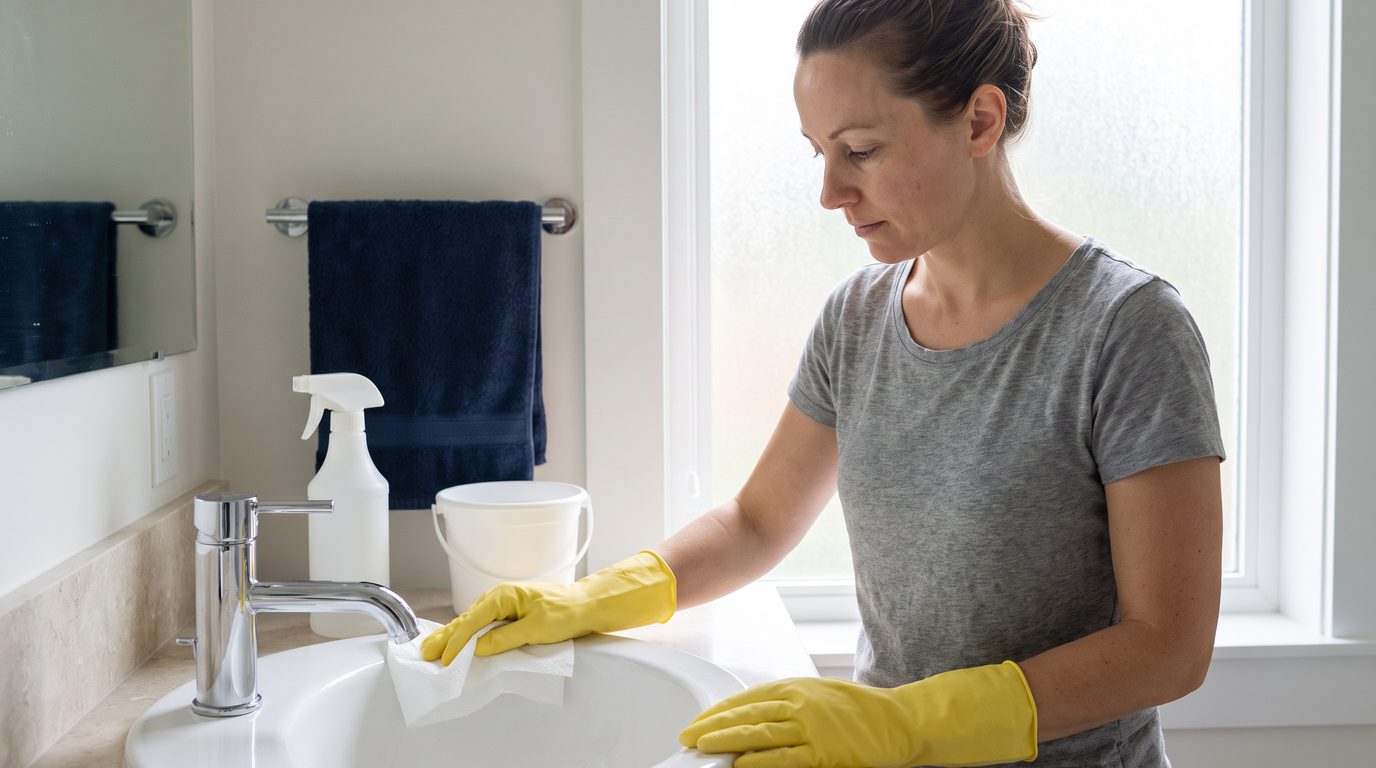
Norovirus can live on surfaces for days to weeks, the CDC says. A CDC guideline puts it at up to 21 to 28 days on a dry surface at room temperature, and about 12 days in carpet. Hand sanitizer, vinegar and many everyday cleaners do not kill it well. Bleach does: 5 to 25 tablespoons of household bleach in a gallon of water, left on for at least 5 minutes. So does any product on EPA's norovirus list (List G), used the way its label says. The common Lysol Disinfectant Spray is on that list and must stay wet for 10 minutes. Lysol and Clorox disinfecting wipes are not on it.
How long norovirus lasts on each surface
The CDC's outbreak page, dated April 22, 2026, says norovirus "can persist on surfaces for days or weeks and is resistant to many common disinfectants." The studies behind that line give these numbers:
| Where | How long it was found | What the study measured |
|---|---|---|
| Dry hard surfaces, room temperature | Up to 21 to 28 days (CDC healthcare guideline, 2011) | The CDC rates this evidence as low quality |
| Stainless steel, ceramic tile, countertop laminate | 0.5% to 3% of two human norovirus strains was still detectable after 42 days (Escudero et al., 2012) | The virus's genetic material, not live virus. A mouse norovirus tested beside it stopped being infectious after day 21 |
| Carpet | Up to 12 days, even with regular vacuuming (CDC guideline, citing a review of studies) | Low-quality evidence, per the CDC |
| Keyboards, computer mice, phones | Up to 72 hours (CDC guideline) | A cat virus used as a stand-in for norovirus |
| Dry surfaces in general | 8 hours to 7 days (Kramer et al., 2006) | A review that mixes human norovirus with the cat virus stand-in |
Look at the right-hand column before you trust any single number, ours included. Labs only recently found a way to grow human norovirus (Costantini et al., 2018), so most survival studies count the virus's genetic material or test a related virus that is easier to grow. A 2016 review of human norovirus studies by Cook and colleagues found the same pattern, and found the virus "resilient on carpets, Formica, stainless steel, polyvinyl chloride, and ceramic surfaces."
On hard surfaces, plan for weeks. Disinfect instead of waiting it out.
For hepatitis B, hepatitis C and HIV, see how long bloodborne viruses survive on surfaces.
How long to keep cleaning after someone is sick
People often ask when they can stop disinfecting once the last person feels better. The CDC's answer is about the person, not the countertop: "You are most contagious when you have symptoms of norovirus illness or during the few days after you feel better. However, studies have shown that you can still spread norovirus for 2 weeks or more after you feel better." A 2011 CDC report adds that the virus can be found in stool for an average of 4 weeks after infection.
What that means at home:
- Clean and disinfect right after each bout of vomiting or diarrhea, even while someone is still sick. The CDC says to "clean well and disinfect the entire area immediately."
- For 2 weeks after someone feels better, they can still spread it. Hand washing with soap and water matters most in that time, and so does disinfecting the bathroom they use.
Why a few germs are enough
"It only takes a few norovirus particles to make you and other people sick," the CDC says. Its 2011 report on norovirus outbreaks puts the infectious dose as low as 18 virus particles.
Vomiting helps it spread. In the CDC's words: "Tiny drops of vomit from a person with norovirus spray through the air, landing on surfaces or entering another person's mouth." Outbreak studies had long suggested this. In 2015, researchers at North Carolina State University built a machine that copies vomiting, loaded it with a stand-in virus that infects only bacteria, and caught some of that virus in the air (Tung-Thompson et al.).
Two outbreaks show what happens next:
- A concert hall, 1999. A concert-goer vomited in the auditorium and a men's restroom. More than 300 people got sick over 5 days. School children who sat on the same level the next day were 7.1 times more likely to fall ill than those seated elsewhere. The disinfectant used contained no bleach (Evans et al., 2002).
- A hotel, 1996. During a 5-month outbreak, investigators swabbed the building. The most positive samples came from carpets that had been directly soiled. Some came from spots above 1.5 meters (about 5 feet) that were unlikely to have been soiled directly (Cheesbrough et al., 2000).
The CDC counts 19 to 21 million norovirus illnesses, 109,000 hospital stays and 900 deaths in the US each year. Most of the deaths are adults 65 and older. About 2,500 outbreaks are reported each year, and they are most common from November to April.
What kills norovirus, and what does not
| Product | Does it work on norovirus? | Source |
|---|---|---|
| Chlorine bleach mixed with water | Yes. 5 to 25 tablespoons of household bleach (5% to 8%) per gallon of water, 1/3 cup to about 1 1/2 cups. Leave it on for at least 5 minutes. | CDC |
| Products on EPA List G | Yes, when used as the label directs. EPA reviewed lab data showing they kill norovirus. | EPA |
| Hand sanitizer | Not well. "Hand sanitizer does not work well against norovirus." Wash with soap and water for at least 20 seconds. | CDC |
| Rubbing alcohol | Not reliably. In a 2018 lab study on live human norovirus, alcohols "slightly reduced, but did not completely inactivate" it. Chlorine killed the most common strain type at as little as 50 ppm. | Costantini et al., 2018 |
| Vinegar | No evidence it works. No vinegar product is on List G. In a 2024 lab test, white and grain vinegar "did not significantly inactivate" the cat virus stand-in. | EPA; Hu et al., 2024 |
| Most ordinary cleaners | Check the label. A 2011 CDC report says products with phenolic or quaternary ammonium ("quat") compounds are less effective against norovirus. Some quat products did pass EPA's test and are on List G. | CDC MMWR 2011; EPA |
| Heat | Only high heat. Norovirus "can survive temperatures as high as 145°F." The heat methods health agencies give are a hot wash with a hot dryer, and steam. | CDC |
A vinegar maker paid for that study, and it still found vinegar did not work on the norovirus stand-in.
Never mix bleach with ammonia or any other cleaner. The CDC warns the mix "can release vapors that may be very dangerous to breathe in." Use regular unscented bleach, open a window, mix it in room temperature water, and make a fresh batch each day (CDC).
Does Lysol kill norovirus?
Some Lysol products do, and the familiar aerosol spray is one of them. As of EPA's List G update on June 3, 2026:
| Product | EPA Reg. No. | On List G? | Must stay wet for |
|---|---|---|---|
| Lysol Disinfectant Spray (EPA lists it as "Brace") | 777-99 | Yes | 10 minutes |
| Lysol All Purpose Cleaner | 777-66 | Yes | 10 minutes |
| Lysol Foaming Disinfectant Basin Tub & Tile Cleaner II | 777-71 | Yes | 10 minutes |
| Lysol Disinfectant Max Cover Mist | 777-127 | Yes | 10 minutes |
| Lysol Bleach Mold and Mildew Remover | 777-83 | Yes | 30 seconds |
| Lysol Disinfecting Wipes | 777-114 | No | - |
| Clorox Disinfecting Wipes | 5813-79 | No | - |
| Clorox Clean-Up Cleaner + Bleach | 5813-21 | Yes | 5 minutes |
| Clorox Disinfecting Bleach | 5813-111 | Yes | 5 minutes |
Notice the first row. The Lysol aerosol is on the list under another name, so searching EPA's list for "Lysol" misses it. Search by number.
The 10 minutes is part of the claim. EPA's list gives the time the surface should stay wet, so a quick spray that dries in a minute did not get the treatment EPA tested.
Check any bottle in 30 seconds
How to clean up after norovirus
These are the CDC's steps for after someone vomits or has diarrhea:
Rubber or disposable.
Throw them straight into a plastic trash bag. Get the mess off before you disinfect.
Use the bleach mix (5 to 25 tablespoons per gallon) or a List G product, as directed on its label. Leave bleach on the area for at least 5 minutes.
This second clean comes after the disinfectant has had its time.
Take off soiled clothes and bedding right away. Handle them without shaking. Wash with detergent and hot water on the longest cycle, then dry on the highest heat setting (CDC).
Soap and water. Hand sanitizer does not replace it.
Carpet, couches and things you cannot bleach
This is where home cleaning gets hard. Of the 392 products on EPA's List G, 380 are labeled only for hard, nonporous surfaces. The other 12 can be used as a laundry pre-soak. None is labeled for carpet or upholstery. A 2024 Clemson University study says it plainly: "there are no commercial antimicrobials against norovirus available for use on carpets" (Huang et al.).
Health agencies point to steam. Lift the vomit off with paper towels first, then steam:
| Source | Steam temperature and time |
|---|---|
| OSHA norovirus fact sheet; Iowa Department of Health and Human Services | 158°F for 5 minutes, or 212°F for 1 minute |
| North Carolina Division of Public Health | 170°F for 5 minutes, or 212°F for 1 minute |
In the Clemson tests on nylon carpet, steam cut two norovirus stand-ins by more than 99.9% in 15 seconds. It did better than all three disinfectants tested, even with those left on for 30 minutes. Check your steam cleaner's manual for the temperature it reaches before you count on it.
People also ask about wool, knitting, laptops and other things that cannot go in a hot wash or take bleach. We found no CDC method for these. Check whether the maker gives disinfecting steps, ask a professional, or throw it out if it was badly soiled.
When to call a professional
A single bout of vomiting on a tile floor is a bucket-of-bleach job. These usually are not:
- Vomit or diarrhea soaked into carpet, a mattress or upholstered furniture.
- A rental between guests. Short-term rental hosts often ask what to do when a sick guest checks out and the next one arrives the next day. See infectious disease cleanup for hotels and for property managers.
- An outbreak in a school, child care center or care home. The CDC says health care facilities are the most common setting for norovirus outbreaks in the US, and schools and child care centers see them often. See cleanup for schools and assisted living.
- A workplace with several sick employees. Our guide to infectious disease cleanup for businesses covers the OSHA side.
- A sewage backup.
Before you hire, ask which List G product the company uses on hard surfaces and how long it stays wet, and how it handles carpet and upholstery. A good answer names the product and the time.
As of October 19, 2026, 1,186 companies in our directory list infectious disease cleanup.
Frequently Asked Questions
How long does norovirus live on surfaces?
Days to weeks, according to the CDC. A CDC guideline puts it at up to 21 to 28 days on a dry surface at room temperature, though it rates that evidence as low quality. Disinfect instead of waiting it out.
Does Lysol kill norovirus?
Some Lysol products do. Lysol Disinfectant Spray (EPA Reg. No. 777-99) is on EPA's norovirus list, List G, and must stay wet for 10 minutes. Lysol Disinfecting Wipes (777-114) are not on the list as of June 3, 2026.
Does hand sanitizer kill norovirus?
Not well. The CDC says "hand sanitizer does not work well against norovirus." Wash your hands with soap and water for at least 20 seconds. Sanitizer can be used in addition, never instead.
Does bleach kill norovirus?
Yes. The CDC recommends 5 to 25 tablespoons of household bleach (5% to 8%) per gallon of water on hard surfaces, left on for at least 5 minutes. Wipe up the mess first.
Does vinegar kill norovirus?
There is no good evidence that it does. No vinegar product is on EPA's norovirus list, and in a 2024 lab test, white and grain vinegar did not significantly inactivate a norovirus stand-in.
How long should I keep disinfecting after norovirus?
Clean right after each episode, and keep up hand washing and bathroom cleaning for about 2 weeks after the last person feels better. The CDC says people can still spread norovirus for 2 weeks or more after they recover.
How long does norovirus live on clothes?
The sources we used give no number for clothing. Carpet held it for up to 12 days in the review the CDC cites, so wash soiled clothes and bedding right away: hot water, the longest cycle, and the highest dryer heat (CDC).
Can you get norovirus from carpet?
Carpet can hold it. In a 1996 hotel outbreak, the most positive samples came from carpets soiled by vomit or diarrhea (Cheesbrough et al., 2000), and the CDC guideline cites a review that found it in carpet for up to 12 days. Steam clean carpet at 158°F to 170°F for 5 minutes or 212°F for 1 minute (OSHA; state health departments).
Sources: CDC, Norovirus Outbreaks (Apr. 22, 2026); CDC, How Norovirus Spreads (Apr. 24, 2024); CDC, How to Prevent Norovirus (Jan. 13, 2025); CDC, Norovirus Facts and Stats (May 8, 2024); CDC, Guideline for the Prevention and Control of Norovirus Gastroenteritis Outbreaks in Healthcare Settings, Evidence Review (MacCannell et al., 2011); Hall AJ et al., "Updated Norovirus Outbreak Management and Disease Prevention Guidelines," MMWR 2011;60(RR-3); CDC, Cleaning and Disinfecting with Bleach (Apr. 24, 2024); EPA, List G: Registered Antimicrobial Products Effective Against Norovirus (June 3, 2026); EPA label record, Lysol Disinfecting Spray, Reg. No. 777-99 (2014); EPA label record, Lysol Disinfecting Wipes, Reg. No. 777-114 (2013); EPA label record, Clorox Disinfecting Wipes, Reg. No. 5813-79 (Jan. 27, 2026); Escudero BI et al., "Persistence and transferability of noroviruses on and between common surfaces and foods," J Food Prot 2012;75(5):927-935; Kramer A et al., "How long do nosocomial pathogens persist on inanimate surfaces?" BMC Infect Dis 2006;6:130; Cook N et al., "Persistence and Elimination of Human Norovirus in Food and on Food Contact Surfaces: A Critical Review," J Food Prot 2016;79(7):1273-1294; Costantini V et al., "Human Norovirus Replication in Human Intestinal Enteroids as Model to Evaluate Virus Inactivation," Emerg Infect Dis 2018;24(8):1453-1464; Hu W et al., "pH-dependent virucidal effects of weak acids against pathogenic viruses," Trop Med Health 2024;52:9; Tung-Thompson G et al., "Aerosolization of a Human Norovirus Surrogate, Bacteriophage MS2, during Simulated Vomiting," PLoS One 2015;10(8):e0134277; Evans MR et al., "An outbreak of viral gastroenteritis following environmental contamination at a concert hall," Epidemiol Infect 2002;129(2):355-360; Cheesbrough JS et al., "Widespread environmental contamination with Norwalk-like viruses (NLV) detected in a prolonged hotel outbreak of gastroenteritis," Epidemiol Infect 2000;125(1):93-98; Huang J et al., "Efficacy of three EPA-registered antimicrobials and steam against two human norovirus surrogates on nylon carpets with two backing types," Appl Environ Microbiol 2024;90(6):e0038424; OSHA, Noroviruses fact sheet; Iowa HHS, Norovirus (reviewed Apr. 2025); North Carolina Division of Public Health, Norovirus (updated Dec. 16, 2019).
More than a bucket of bleach can handle?
Infectious disease cleanup companies handle soaked carpet, mattresses, rentals between guests and outbreaks in schools, offices and care homes. Find one near you, free to search.