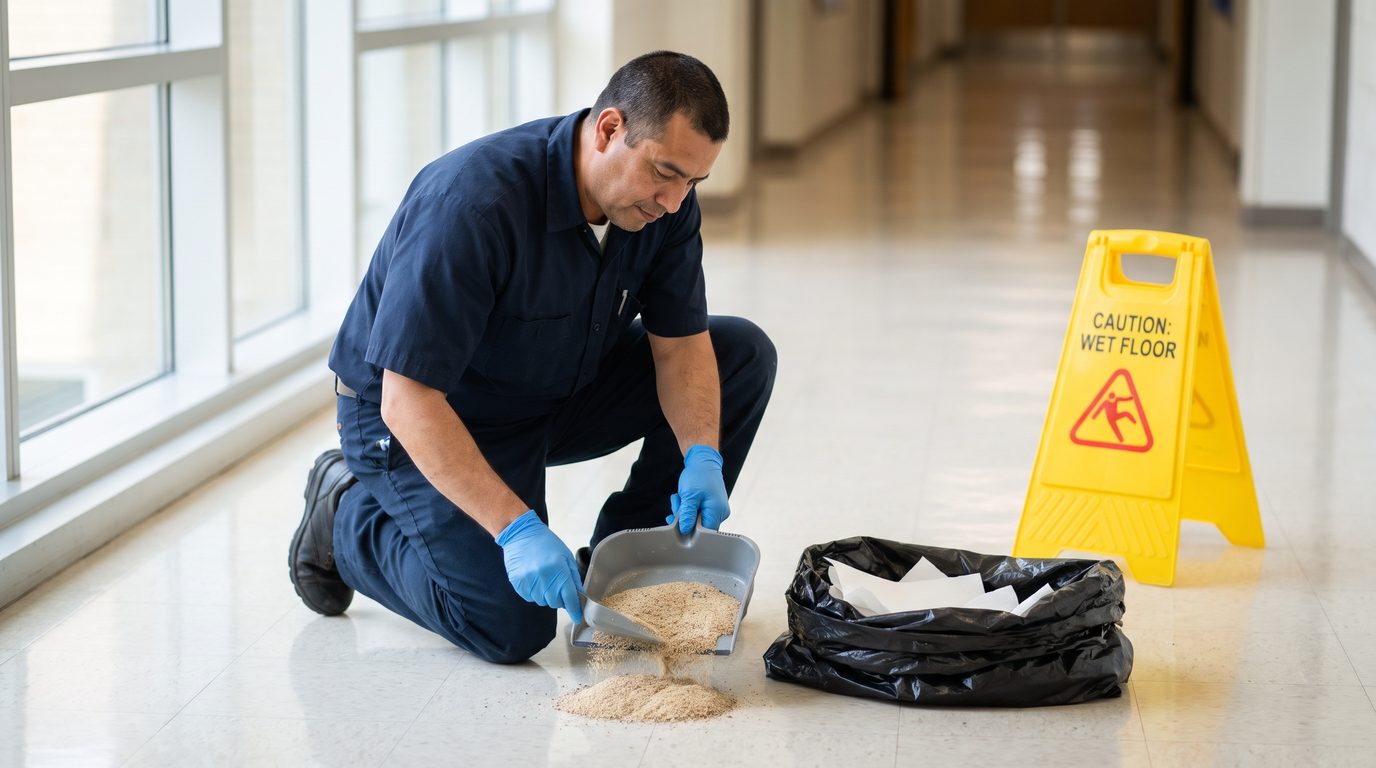
Under OSHA's bloodborne pathogens rule, vomit is not a regulated biohazard unless it has visible blood in it. OSHA put that in writing in 1993. The health answer is different: vomit can spread norovirus, and the CDC says tiny drops of it spray through the air and land on surfaces. So treat any vomit as infectious. Put on gloves, wipe it up with paper towels, then disinfect with a bleach mix of 5 to 25 tablespoons per gallon of water, left on for at least 5 minutes.
What OSHA says
OSHA's Bloodborne Pathogens Standard (29 CFR 1910.1030) covers workers' exposure to blood and to a list it calls "other potentially infectious materials." The body fluids on that list are semen, vaginal secretions, five internal body fluids, amniotic fluid, saliva in dental procedures, "any body fluid that is visibly contaminated with blood," and all body fluids when you cannot tell them apart. Vomit is not on the list by name.
OSHA answered the question directly in a letter dated January 26, 1993: "Urine, feces, sweat, tears, nasal secretions, and vomitus which are not visibly contaminated with blood are not considered to be 'other potentially infectious materials.'"
Two cases change that:
- Vomit with visible blood falls under the standard. The same letter says workers who handle linens "soiled with urine that contains visible blood would be occupationally exposed," and it treats urine and vomit the same way.
- Fluids you cannot tell apart count too. The standard says that when "differentiation between body fluid types is difficult or impossible, all body fluids shall be considered potentially infectious materials."
When the standard applies, the employer has duties: universal precautions, and protective gear "at no cost to the employee." Our guide to OSHA bloodborne pathogen rules covers the rest.
What the germs say
The OSHA answer is about workplace rules. It does not mean vomit is safe. "The germs most likely to be spread by vomit are noroviruses," the CDC says in its guidance for pools (June 6, 2025).
How it spreads is the problem. In the CDC's words: "Tiny drops of vomit from a person with norovirus spray through the air, landing on surfaces or entering another person's mouth." The FDA's 2026 Food Code says "good evidence exists for transmission due to aerosolization of vomitus," and that "one projectile vomiting incident can contaminate the environment with 300,000 viral particles."
It takes very few of them. A 2011 CDC report puts the infectious dose of norovirus as low as 18 virus particles, and the virus can last on surfaces for days or weeks. Our page on how long norovirus lives on surfaces has the numbers, surface by surface.
Distance matters. After a diner vomited in a restaurant, investigators found the share of people who got sick at each table went down the farther the table was from that person (Marks et al., 2000).
Legally, vomit is not a bloodborne pathogen hazard unless blood is visible. Medically, treat it as infectious every time. You cannot tell by looking whether it carries norovirus.
Can you get sick from cleaning up vomit?
You can, though the studies do not all agree, and being near someone when they vomit is the clearer risk.
| Study | What it found |
|---|---|
| Norovirus outbreaks at a residential treatment facility, Oregon, 2007 (CDC MMWR, 2009) | Staff who cleaned up vomit got sick more often: 59% (17 of 29) against 29% (34 of 117) of those who did not. After adjusting for other factors, their risk was 1.6 times higher. |
| Outbreak on a hospital elderly care unit, UK (Chadwick and McCann, 1994) | Nurses who cleaned vomit or feces from sick patients had no significant increase in risk. Being near patients who were vomiting, and the number of close contacts with sick patients, did raise it. |
| Restaurant outbreak (Marks et al., 2000) | The closer a table was to the diner who vomited, the more people at it got sick. |
The hospital study suggested that vomit spraying into the air was of major importance in how the infection spread on that unit. That fits the CDC's description.
What protects you:
- Disposable or rubber gloves (CDC).
- Lifting the vomit off carefully, without stirring it up. OSHA's norovirus fact sheet says to remove it "carefully to minimize airborne particles," using a double layer of absorbent material, and to put it in a sealed plastic bag.
- A disinfectant that works on norovirus. Many do not.
- Washing your hands with soap and water afterward. "Hand sanitizer alone does not work well against norovirus," the CDC says.
Can your boss make you clean it up?
Retail, restaurant and school workers ask this a lot online, and a common answer is that OSHA lets anyone without special training refuse to clean up vomit. That is not what OSHA's letters say. Vomit without visible blood is outside the bloodborne pathogens standard, so that standard gives no right to refuse the job and does not require its special training for it. Gloves still make sense: they are the first of the CDC's cleanup steps below.
Vomit with visible blood is different. Then the standard applies, and the employer has to follow it.
Restaurants and other food businesses have a rule of their own. The FDA Food Code, which "local, state, tribal, and federal regulators use ... as a model to develop or update their own food safety rules," says in section 2-502.11 of the 2026 edition (2-501.11 in the 2022 edition):
"A FOOD ESTABLISHMENT shall have written procedures for EMPLOYEES to follow when responding to vomiting or diarrheal events that involve the discharge of vomitus or fecal matter onto surfaces in the FOOD ESTABLISHMENT."
The 2026 edition also adds a rule (section 4-1002.11) that surfaces and equipment be disinfected when "contaminated with vomitus, fecal matter, blood, or any other bodily fluid that can lead to disease transmission." Which edition applies depends on what your state or county has adopted. If you work in food service and nobody has shown you the written procedure, ask for it.
Health care facilities, care homes included, are the most commonly reported setting for norovirus outbreaks in the US, and schools and child care centers see them often (CDC). See infectious disease cleanup for schools and hotels, and our guide to infectious disease cleanup for businesses.
How to clean up vomit safely
These are the CDC's steps for after someone vomits, with OSHA's note on removing it:
Rubber or disposable.
Wipe up the whole area with paper towels and put them straight into a plastic trash bag (CDC). Work slowly, so you do not splash it or send it into the air (OSHA).
Use 5 to 25 tablespoons of household bleach (5% to 8%) per gallon of water, or a product on EPA's norovirus list used as its label says. Leave bleach on for at least 5 minutes. Our norovirus page shows which common Lysol and Clorox products are on EPA's list.
This comes after the disinfectant has had its time.
Handle clothes and bedding without shaking them. Wash in hot water on the longest cycle, then dry on the highest heat (CDC).
Soap and water, at least 20 seconds. Hand sanitizer does not replace it.
Never mix bleach with ammonia or any other cleaner. The CDC warns the mix "can release vapors that may be very dangerous to breathe in." Open a window, and make a fresh batch each day.
Vomit on carpet, a couch or a mattress
The CDC's bleach advice is for hard, nonporous surfaces, and none of the products on EPA's norovirus list is labeled for carpet or upholstery. After you lift the vomit off, health agencies point to steam: 158°F for 5 minutes or 212°F for 1 minute (OSHA; Iowa Department of Health and Human Services), or 170°F for 5 minutes (North Carolina Division of Public Health).
Vinegar is a common home remedy for the stain and the smell. No vinegar product is on EPA's norovirus list, and in a 2024 lab test vinegar did not significantly inactivate a norovirus stand-in. The details are on our norovirus page.
When to call a professional
One episode on a tile floor is a gloves-and-bleach job. These usually are not:
- Vomit soaked into carpet, a mattress or upholstered furniture.
- Repeated vomiting in a school, care home, hotel or restaurant, where an outbreak may be under way.
- Vomit with blood in it at a workplace, where OSHA's bloodborne pathogens standard applies.
- A rental or guest room that has to be ready for the next person.
Before you hire, ask which disinfectant the company uses, whether it is on EPA's norovirus list, how long it stays wet, and how they handle carpet and upholstery.
As of October 30, 2026, 1,186 companies in our directory list infectious disease cleanup.
Frequently Asked Questions
Is vomit a biohazard?
Under OSHA's bloodborne pathogens rule, no, unless it has visible blood in it (OSHA letter, January 26, 1993). But it can carry norovirus, which spreads through tiny drops of vomit (CDC), so clean it up as if it is infectious.
Is vomit a bloodborne pathogen?
No. OSHA's standard lists the body fluids it covers, and vomit is not one of them unless it is "visibly contaminated with blood." The germ most likely to be spread by vomit, norovirus, gets in through the mouth (CDC).
Can you get sick from cleaning up vomit?
Yes, it can happen. In a 2007 Oregon outbreak, 59% of staff who cleaned up vomit got sick, against 29% of those who did not (CDC MMWR, 2009). A hospital study found no extra risk from cleaning and a clear risk from being near patients while they vomited (Chadwick and McCann, 1994).
How long is vomit contagious?
The germs can outlast the mess. The CDC says norovirus "can persist on surfaces for days or weeks." Wipe the vomit up, then disinfect the area.
Does vomit need to go in a biohazard bag?
At home, the CDC says to put the paper towels in a plastic trash bag. At work, vomit with visible blood falls under OSHA's bloodborne pathogens standard, which has its own rules for waste. Food businesses follow their written cleanup procedure.
Does hand sanitizer work after cleaning up vomit?
Not well. The CDC says "hand sanitizer alone does not work well against norovirus." Wash with soap and water for at least 20 seconds.
Do restaurants need a vomit cleanup plan?
Under the FDA Food Code, yes: section 2-502.11 (2026 edition; 2-501.11 in 2022) requires written procedures for employees responding to vomiting or diarrheal events. Your state or county decides which edition applies.
Sources: OSHA, Bloodborne Pathogens Standard, 29 CFR 1910.1030; OSHA letter of interpretation on body fluids (Jan. 26, 1993); OSHA, Noroviruses fact sheet (2008); CDC, Responding to Blood and Vomit in the Pool (June 6, 2025); CDC, How Norovirus Spreads (Apr. 24, 2024); CDC, How to Prevent Norovirus (Jan. 13, 2025); CDC, Norovirus Outbreaks (Apr. 22, 2026); CDC, Cleaning and Disinfecting with Bleach (Apr. 24, 2024); Hall AJ et al., "Updated Norovirus Outbreak Management and Disease Prevention Guidelines," MMWR 2011;60(RR-3); CDC, "Recurring Norovirus Outbreaks in a Long-Term Residential Treatment Facility, Oregon, 2007," MMWR 2009;58(25); Chadwick PR, McCann R, "Transmission of a small round structured virus by vomiting during a hospital outbreak of gastroenteritis," J Hosp Infect 1994;26(4):251-259; Marks PJ et al., "Evidence for airborne transmission of Norwalk-like virus (NLV) in a hotel restaurant," Epidemiol Infect 2000;124(3):481-487; FDA, Food Code 2026, sections 2-502.11 and 4-1002.11 and Annex 3; FDA, FDA Food Code; EPA, List G (June 3, 2026); Iowa HHS, Norovirus; North Carolina Division of Public Health, Norovirus.
An outbreak, or a mess soaked in?
Infectious disease cleanup companies handle soaked carpet and mattresses, and outbreaks in schools, care homes, restaurants and hotels. Find one near you, free to search.