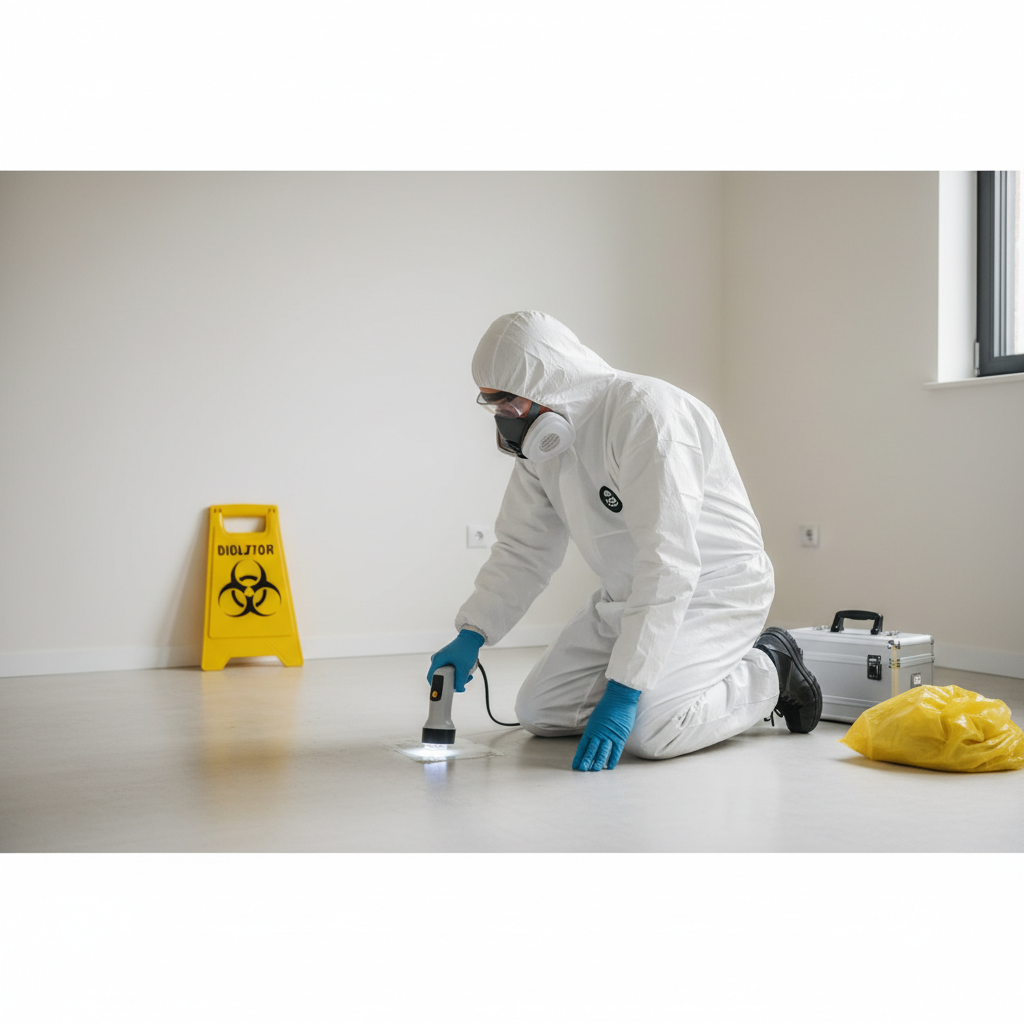
A biohazard is any biological material that poses a risk to human health, including blood, bodily fluids, sewage, sharps, and pathological waste. Under OSHA's Bloodborne Pathogen Standard (29 CFR 1910.1030), any workplace cleanup involving blood or other potentially infectious materials (OPIM) requires trained personnel with proper PPE. For homes and businesses, any scene involving more than a minor amount of blood, any unattended death, or any sewage backup warrants professional biohazard remediation from a certified company.
What Is a Biohazard? The Legal Definition
The term "biohazard", short for biological hazard, refers to any biological substance that threatens human health. While the word is used broadly in everyday language, federal agencies define it with regulatory precision.
OSHA's Bloodborne Pathogen Standard (29 CFR 1910.1030) defines the scope through the concept of "other potentially infectious materials" (OPIM), which includes:
- Human blood and blood products
- Semen, vaginal secretions, and cerebrospinal fluid
- Synovial, pleural, pericardial, peritoneal, and amniotic fluids
- Saliva in dental procedures
- Any body fluid visibly contaminated with blood
- Any unfixed human tissue or organ
- Cell or tissue cultures containing HIV or HBV
The standard also introduces the principle of Universal Precautions: an approach to infection control where "all human blood and certain human body fluids are treated as if known to be infectious for HIV, HBV, and other bloodborne pathogens." This is the foundation of all professional biohazard cleanup protocols.
Categories of Biohazardous Materials
Biohazards are classified into distinct categories based on the type of material and the level of risk. Understanding these categories helps you determine whether professional remediation is necessary.
| Category | Examples | Risk Level | Professional Cleanup Required? |
|---|---|---|---|
| Blood & Blood Products | Pooled blood, blood spatter, blood-soaked materials | High | ✓ Always |
| Bodily Fluids | Vomit, urine, feces, cerebrospinal fluid, amniotic fluid | High | ✓ Always |
| Sharps | Needles, syringes, scalpels, broken glass with blood | High | ✓ Always |
| Pathological Waste | Human tissue, organs, body parts | Severe | ✓ Always |
| Microbiological Waste | Cultures, specimens, vaccines (live/attenuated) | High | ✓ Always |
| Animal Waste | Carcasses, droppings (large accumulation), contaminated bedding | Moderate-High | Depends on volume |
| Sewage & Wastewater | Raw sewage backups, Category 3 water damage | Moderate-High | ✓ Always |
| Chemical Biohazards | Meth lab residue, fentanyl contamination, formaldehyde | Severe | ✓ Always |
OSHA Requirements for Biohazard Cleanup
OSHA's Bloodborne Pathogen Standard (29 CFR 1910.1030) is the primary federal regulation governing biohazard cleanup in workplaces. Any business, property manager, or employer who may encounter biohazardous materials must comply with these requirements.
| Requirement | What It Means | Who It Applies To |
|---|---|---|
| Exposure Control Plan | Written plan to eliminate or minimize employee exposure, reviewed and updated annually | All employers with reasonably anticipated exposure |
| Universal Precautions | Treat all human blood and OPIM as infectious: no exceptions | All workers handling biohazards |
| Engineering Controls | Sharps containers, self-sheathing needles, biohazard bags, and other physical barriers | All workplaces with sharps or blood exposure |
| Personal Protective Equipment | Gloves, gowns, face shields, respirators: provided at no cost to workers | All workers with exposure risk |
| Hepatitis B Vaccination | Free HBV vaccination offered within 10 days of assignment to at-risk duties | All employees with occupational exposure |
| Training | Initial training + annual refresher on hazard recognition, PPE use, and emergency procedures | All employees with occupational exposure |
| Recordkeeping | Medical records maintained for duration of employment + 30 years; training records kept 3 years | All covered employers |
| Labeling | Fluorescent orange/orange-red biohazard labels on all containers of regulated waste | All workplaces generating regulated waste |
OSHA defines regulated waste as: liquid or semi-liquid blood; items that would release blood if compressed; items caked with dried blood that could be released during handling; contaminated sharps; and pathological and microbiological wastes containing blood or OPIM.
EPA & DOT Regulations on Disposal and Transport
EPA: Waste Disposal Rules
At the federal level, the EPA does not directly regulate medical or biohazardous waste under a standalone law. As the EPA states: the agency "has not had authority, specifically for medical waste, since the Medical Waste Tracking Act (MWTA) of 1988 expired in 1991." Instead, medical waste is primarily regulated by state environmental and health departments.
Under the Resource Conservation and Recovery Act (RCRA), biohazardous waste is classified as non-hazardous solid waste, unless it also contains hazardous chemical components (such as chemotherapy drugs or certain solvents). Key disposal requirements include:
- Segregation: Biohazardous waste must be separated from general waste at the point of generation
- Containment: Red bags or containers with the biohazard symbol for infectious waste; rigid, puncture-resistant containers for sharps
- Treatment: Waste must be rendered non-infectious before landfill disposal: options include autoclaving (steam sterilization), incineration, microwave treatment, or chemical disinfection
- Documentation: Waste tracking manifests required in most states from generation through final disposal
DOT: Transporting Biohazardous Waste
The Department of Transportation, through PHMSA (Pipeline and Hazardous Materials Safety Administration), regulates the transport of infectious substances under 49 CFR Parts 171-180. Biohazardous materials are classified as Division 6.2, Infectious Substances.
Any company transporting biohazardous waste must comply with:
- Packaging: Triple-containment system, primary watertight container, secondary watertight container, and rigid outer packaging
- Labeling: DOT infectious substance labels (UN3291 for regulated medical waste)
- Shipping papers: Proper shipping name, hazard class, UN number, and emergency contact
- Driver training: HAZMAT employee training under 49 CFR 172 Subpart H
Certifications Every Biohazard Company Should Have
There is no single federal license required to operate a biohazard cleanup company. However, several industry certifications demonstrate that a company meets professional standards for safety, training, and quality. Here's how the three most important certifications compare:
| Certification | Issuing Body | Focus Area | Requirements | Renewal |
|---|---|---|---|---|
| ABRA Bio Recovery Technician (BRT) | American Bio Recovery Association | Biohazard & trauma scene cleanup | 40-hour training course, written exam, background check | Annual (continuing education) |
| IICRC S540 | Institute of Inspection, Cleaning and Restoration Certification | Trauma & crime scene cleanup standard | Prerequisite courses, exam, adherence to S540 Standard | Every 3-5 years (continuing education credits) |
| OSHA HAZWOPER (40-Hour) | OSHA (29 CFR 1910.120) | Hazardous waste operations & emergency response | 40 hours initial training covering hazard recognition, PPE, decontamination, emergency response | Annual 8-hour refresher |
| Bloodborne Pathogen Training | OSHA (29 CFR 1910.1030) | Handling blood & infectious materials | Initial training + annual refresher on BBP hazards, PPE, exposure response | Annual refresher required |
| EPA Lead-Safe Certification | EPA | Lead paint in pre-1978 buildings | 8-hour training course, firm certification | Every 5 years |
Trauma scenes, unattended deaths, suicide cleanup, hoarding remediation
The only certification specifically designed for biohazard and trauma scene cleanup. ABRA members follow a code of ethics and must demonstrate ongoing competence.
Crime scene cleanup, trauma restoration, blood cleanup in conjunction with water/fire damage
The IICRC S540 standard provides a consensus-based procedural standard for trauma and crime scene cleanup. Companies certified to this standard follow documented protocols for assessment, remediation, and clearance testing.
Meth labs, fentanyl contamination, chemical spills, large-scale hazardous waste sites
Required by OSHA for workers at hazardous waste sites. The 40-hour HAZWOPER course covers hazard recognition, site control, decontamination procedures, and emergency response, essential for chemical biohazard scenes.
State Licensing Requirements
Because the EPA defers biohazardous waste regulation to the states, licensing requirements vary significantly. Some states have comprehensive licensing programs; others have minimal oversight. Here's a snapshot of requirements across the country:
| State | License Required? | Governing Agency | Key Requirements |
|---|---|---|---|
| California | Yes | Dept. of Public Health (CDPH) | Trauma Scene Waste Management Practitioner registration; annual fees; training documentation |
| Florida | Yes | Dept. of Health + DEP | Biomedical waste generator permit; transporter registration; treatment facility permit |
| Texas | Yes | Commission on Environmental Quality (TCEQ) | Industrial solid waste registration for medical waste transport & disposal |
| New York | Yes | Dept. of Health + DEC | Regulated medical waste transporter permit; treatment facility license; tracking manifests |
| Illinois | Yes | EPA (state-level) + Dept. of Public Health | Potentially Infectious Medical Waste (PIMW) hauler and treatment permits |
| Ohio | Yes | EPA (state-level) | Infectious waste transporter and treatment facility registration; manifest system |
| Pennsylvania | Yes | DEP | Infectious/chemotherapeutic waste transporter license; processing facility permits |
| Georgia | Partial | Dept. of Natural Resources (EPD) | Biomedical waste rules under Solid Waste Management Act; generator registration |
| Arizona | Partial | ADEQ | Biohazardous medical waste rules under solid waste program; transporter requirements |
| Colorado | Partial | CDPHE | Regulated as solid waste; specific rules for sharps and infectious waste only |
| Washington | Yes | Dept. of Ecology + Dept. of Health | Biomedical waste management rules; transporter and treatment permits |
| Michigan | Yes | DEQ + LARA | Medical waste regulatory act; transporter and treatment facility registration |
When You Need a Professional vs. DIY
Not every situation involving biological material requires professional remediation. Here's a decision matrix to help you determine when to call a professional biohazard cleanup company versus handling it yourself.
| Scenario | DIY Safe? | Professional Needed? | Why |
|---|---|---|---|
| Small cut: your own blood on a counter | ✓ Yes | ✗ No | Your own blood in your own home; clean with bleach solution |
| Child nosebleed on carpet | ✓ Yes | ✗ No | Minor amount, known source, household cleaning sufficient |
| Pet accident (urine/feces) | ✓ Yes | ✗ No | Normal pet waste; enzyme cleaners work well |
| Blood spill larger than a dinner plate | ✗ No | ✓ Yes | Volume requires proper containment, PPE, and disposal |
| Another person's blood (any amount) | ✗ No | ✓ Yes | Unknown pathogen risk; Universal Precautions apply |
| Unattended death | ✗ No | ✓ Yes | Decomposition fluids, pathogen risk, structural contamination |
| Crime scene | ✗ No | ✓ Yes | Blood, tissue, complex contamination patterns |
| Needles / drug paraphernalia | ✗ No | ✓ Yes | Sharps injury risk, unknown bloodborne pathogen exposure |
| Sewage backup (Category 3 water) | ✗ No | ✓ Yes | Bacteria, viruses, parasites; requires professional extraction and disinfection |
| Hoarding with biological waste | ✗ No | ✓ Yes | Accumulated waste creates compounding pathogen risks |
| Animal infestation (large accumulation) | ✗ No | ✓ Yes | Hantavirus, histoplasmosis, leptospirosis risks from rodent/bird droppings |
| Meth lab / fentanyl contamination | ✗ No | ✓ Yes | Requires HAZWOPER-certified technicians and chemical decontamination |
⚠ Never Attempt DIY Cleanup If:
How to Verify a Company's Credentials
Before hiring a biohazard cleanup company, take these steps to verify they are legitimate and properly certified:
Request copies of ABRA certification, IICRC credentials, OSHA training records, and/or HAZWOPER certificates. Legitimate companies will provide these without hesitation.
A proper biohazard company carries general liability insurance (minimum $1 million), professional liability / pollution liability insurance, and workers' compensation. Ask for certificates of insurance, not just a verbal confirmation.
Look up the company with your state's environmental or health department. In states like California, Florida, and New York, companies must be registered to handle biohazardous waste.
A reputable company will explain exactly how they dispose of biohazardous waste, including which licensed medical waste hauler they use and whether they can provide waste tracking manifests for your records.
Before work begins, you should receive a detailed written estimate that includes the scope of contamination, remediation procedures, PPE to be used, waste disposal method, and expected timeline. Get a free quote from verified companies for comparison.
✓ CREDENTIALS CHECKLIST
Frequently Asked Questions
Find Certified Biohazard Cleanup Companies Near You
Every company in our directory is verified for proper certifications, insurance, and licensing. Get matched with qualified professionals who meet OSHA standards and hold industry-recognized credentials.
Free, no-obligation quotes from certified professionals in your area.