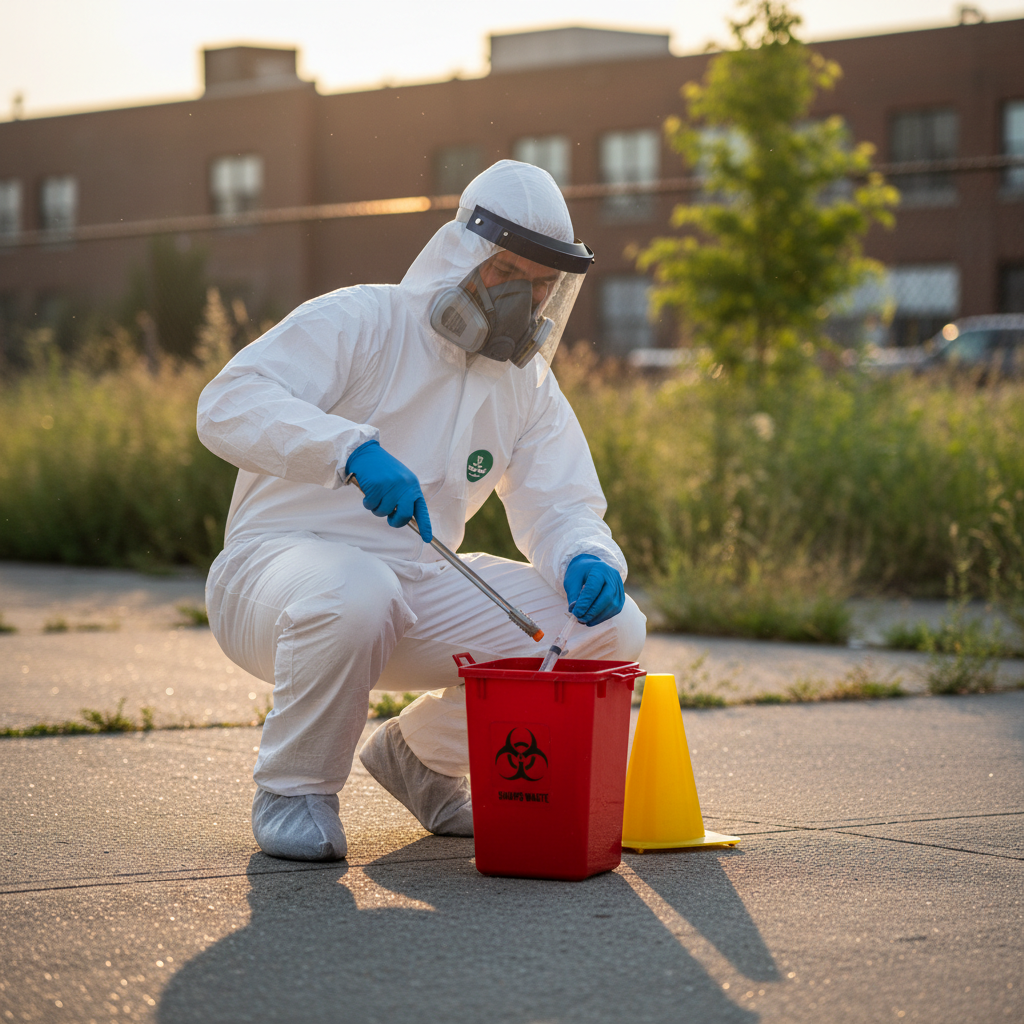
Never pick up a used needle with your bare hands. The risk of contracting Hepatitis B, Hepatitis C, or HIV from a needlestick injury is real—Hepatitis B transmission rates from a contaminated needle are as high as 30%. For a single needle in a public area, use a rigid puncture-proof container and tongs or pliers. For multiple needles, evidence of drug activity, or needles in areas frequented by children, call a professional biohazard cleanup company. The cost for professional needle cleanup ranges from $300 to $3,000+ depending on the scope.
Immediate Safety Steps
Whether you find one needle or dozens, the first priority is preventing anyone from getting stuck. Follow these steps immediately:
Stop and Secure the Area
Do not touch the needle. Keep children, pets, and other people away from the area. If the needle is in a public space, stand nearby to warn others until you can secure it.
Assess the Situation
Is this a single discarded needle, or are there multiple needles and drug paraphernalia? A single needle can usually be handled safely on your own. Multiple needles, drug residue, or evidence of a drug use site requires professional cleanup.
Protect Yourself
If you decide to pick up a single needle yourself, put on thick puncture-resistant gloves (leather work gloves, not latex). Use metal tongs, pliers, or a mechanical pick-up tool to handle the needle. Never recap a needle.
Use a Sharps Container
Place the needle in an FDA-approved sharps container or a rigid, puncture-proof container with a secure lid (a thick plastic laundry detergent bottle works in an emergency). Never put needles in regular trash bags, recycling bins, or glass containers.
Dispose Properly
Take the sealed container to a sharps disposal location: pharmacies, hospitals, fire stations, or community drop-off sites. Many areas offer free sharps disposal. Search “sharps disposal near me” or visit safeneedledisposal.org for locations.
Never recap a needle. Never break or bend a needle. Never put needles in regular trash or recycling. Never flush needles down a toilet. Never pick up a needle with bare hands. Even a needle that “looks clean” can carry bloodborne pathogens that survive on surfaces for days to weeks.
Disease Risks From Needlestick Injuries
Used needles can transmit several serious bloodborne diseases. The risk depends on the pathogen, the type of exposure, and how recently the needle was used.
| Disease | Transmission Risk (per needlestick) | Survival on Needle | Post-Exposure Treatment |
|---|---|---|---|
| Hepatitis B (HBV) | 6–30% | Up to 7 days at room temperature | HBIG injection + vaccine series (within 24 hours) |
| Hepatitis C (HCV) | 1.8% (range 0–7%) | Up to 6 weeks in dried blood | No vaccine; monitoring + early treatment with antivirals if infected |
| HIV | 0.23% (1 in 435) | Hours to days (virus fragile) | PEP (post-exposure prophylaxis) — must start within 72 hours |
| Tetanus | Possible from any puncture wound | Spores persist indefinitely | Tetanus booster if not current (within 48 hours) |
Hepatitis B is the most dangerous needlestick risk—the virus is 50–100 times more infectious than HIV and can survive on surfaces for up to a week. If you have not been vaccinated for Hepatitis B, a needlestick from a contaminated syringe carries a serious risk of infection. The Hepatitis B vaccine is safe, effective, and widely available—consider getting vaccinated if you work in a setting where needle exposure is possible.
How to Safely Dispose of a Single Needle
If you find a single needle and decide to handle it yourself, follow these exact steps:
Single Needle Disposal Checklist
When to Call a Professional
A single isolated needle can be handled with the steps above. But many situations require professional biohazard cleanup:
Call a Professional When
- Multiple needles or syringes are found
- Drug paraphernalia is present (spoons, cotton, tourniquets, pipes)
- Needles are found in a residential unit (tenant drug use)
- Blood, bodily fluids, or drug residue is present
- Needles are in areas children frequent (playgrounds, parks, daycares)
- A needle is embedded in carpet, furniture, or soft materials
- You find a suspected drug use or manufacturing site
- Needles are in a workplace or commercial building
Handle It Yourself When
- Single needle in an outdoor area (sidewalk, parking lot)
- No other drug paraphernalia present
- No blood or bodily fluids visible
- You have proper gloves and a sharps container
- The area does not need further decontamination
- You are comfortable and confident handling it safely
When in doubt, call a professional. The peace of mind of knowing the area is thoroughly decontaminated is worth the cost—especially in properties with tenants, customers, or children. Get free quotes from certified companies to understand your options.
What to Do If You Get Stuck
If you or someone else is stuck by a used needle, time is critical. Follow these steps immediately:
Let the Wound Bleed Freely
Allow the puncture site to bleed for several minutes. Do not squeeze or suck the wound—this can push pathogens deeper into tissue.
Wash Immediately
Clean the wound thoroughly with soap and running water for at least 5 minutes. Do not use bleach, alcohol, or hydrogen peroxide on the wound—these can damage tissue and do not reduce infection risk.
Go to the Emergency Room Immediately
Do not wait for a doctor’s appointment. Go to the ER within 2 hours if possible. Bring the needle in a sealed container if you can safely retrieve it—it may be tested.
Request Post-Exposure Evaluation
At the ER, you will receive baseline blood tests for HIV, Hepatitis B, and Hepatitis C. The doctor will evaluate your need for:
- HIV PEP: Post-exposure prophylaxis must start within 72 hours (sooner is better). A 28-day course of antiretroviral medication.
- HBIG + Hepatitis B vaccine: If you are not vaccinated for Hepatitis B, immunoglobulin and the vaccine series should start within 24 hours.
- Tetanus booster: If your last tetanus shot was more than 5 years ago.
Follow Up
Return for follow-up blood tests at 6 weeks, 3 months, and 6 months to confirm no infection has occurred.
Community needlestick injuries (from discarded needles found in public) carry a lower risk than occupational needlestick injuries in healthcare settings. The needle has been exposed to air and temperature changes that reduce pathogen viability. However, the risk is not zero, and Hepatitis B and C can survive outside the body for extended periods. Always seek medical evaluation.
Landlord and Property Owner Obligations
Property owners have specific legal obligations when needles are found on their property, particularly in rental and commercial settings.
| Scenario | Landlord Obligation | Who Pays |
|---|---|---|
| Needle found in common area (hallway, parking lot, laundry room) | Remove immediately or secure area and call professional. Document the incident. | Landlord |
| Needles found in a vacated unit | Professional cleanup and decontamination before re-renting. Test for drug residue contamination if drug use is suspected. | Landlord (can pursue former tenant for costs) |
| Active tenant reported drug use in their unit | Follow local eviction procedures for lease violations. Document everything. Do not enter without proper notice. | Tenant liability; landlord pays upfront for remediation after vacating |
| Needle in a playground or children’s area | Secure area immediately. Call professional for cleanup and area decontamination. File an incident report. | Property owner / HOA |
| Employee reports a needlestick on your property | Provide immediate medical care. File workers’ compensation claim. Document the incident per OSHA requirements. | Workers’ comp insurance |
If a tenant, visitor, or employee is stuck by a needle on your property and you knew or should have known about the needle problem without taking action, you face significant personal injury liability. Document every report, respond quickly, and keep records of all cleanup actions taken.
Business and School Protocols
Businesses, schools, and public facilities should have written sharps response protocols in place before an incident occurs.
Business Protocol
- Designate trained staff for sharps response
- Keep sharps containers and pickup tools in accessible locations
- Post clear procedures in employee areas
- Maintain a relationship with a biohazard cleanup company for larger incidents
- Document every incident: date, location, number of sharps, how disposed
- Review and update protocol annually
School Protocol
- Train all staff (not just custodians) on recognition and reporting
- Never allow students to pick up needles
- School nurse should have needlestick response supplies
- Secure the area and call administration immediately
- Contact parents/guardians if a child is exposed
- File incident report with the school district
- Consider professional cleanup for any indoor find
Needle Cleanup Costs
Professional needle and sharps cleanup costs depend on the number of needles, the area affected, and whether broader decontamination is needed.
| Scope | Typical Cost | What’s Included |
|---|---|---|
| Small area (1–5 needles, outdoor) | $300 – $800 | Sharps removal, area inspection, surface decontamination, disposal |
| Medium area (6–25 needles, indoor or outdoor) | $800 – $2,000 | Thorough sweep, sharps removal, surface cleaning, decontamination, disposal |
| Large area / drug use site | $2,000 – $5,000+ | Complete area sweep, sharps removal, deep cleaning, decontamination, drug residue testing if needed |
| Residential unit (tenant drug use) | $3,000 – $10,000+ | Full unit cleanup, sharps removal, surface decontamination, possible drug residue testing, waste disposal |
| Add-on: drug residue testing | $300 – $1,000 | Surface swab testing for meth, fentanyl, or other drug residues |
Preventing Needle Dumping on Your Property
While you cannot eliminate the problem entirely, these measures significantly reduce needle dumping and drug use on your property:
Physical Deterrents
- Install bright lighting in parking lots, alleys, and building perimeters
- Eliminate hiding spots: trim bushes, remove abandoned structures, secure vacant units
- Install security cameras with visible signage
- Lock dumpster enclosures and storage areas
- Install tamper-proof sharps disposal containers in restrooms (for businesses)
- Use fencing or access controls for vulnerable areas
Management Practices
- Conduct regular property sweeps (daily for high-risk areas)
- Report repeated needle finds to local police non-emergency line
- Work with local needle exchange programs to install proper disposal options
- Train maintenance staff on safe sharps handling
- Respond immediately to tenant reports of drug activity
- Build relationships with neighbors for mutual reporting
Frequently Asked Questions
Can I get HIV from a needle found on the ground?
The risk is very low but not zero. HIV is fragile and does not survive long outside the body—the CDC estimates the risk from a community needlestick at approximately 0.23% or less, and likely much lower for a dried needle. However, you should still go to the ER immediately for evaluation. HIV post-exposure prophylaxis (PEP) is highly effective if started within 72 hours.
How long do diseases survive on a used needle?
Hepatitis B can survive on surfaces for up to 7 days. Hepatitis C can survive in dried blood for up to 6 weeks. HIV typically survives only hours to a few days outside the body, less in direct sunlight or high temperatures. Treat every found needle as potentially infectious regardless of how old it appears.
Should I call the police when I find needles?
For a single discarded needle, police involvement is generally not necessary—dispose of it safely and move on. For multiple needles, drug paraphernalia, or evidence of a drug use site, contact your local police non-emergency number to report the activity. If you find needles in the same location repeatedly, police may increase patrols in the area.
Can I put a found needle in the regular trash?
No. Putting needles in regular trash is illegal in many jurisdictions and creates a needlestick hazard for sanitation workers, waste facility employees, and anyone who touches the bag. Always use an FDA-approved sharps container or a rigid, puncture-proof container with a sealed lid. Dispose at a pharmacy, hospital, or community sharps drop-off site.
My child was stuck by a needle at a park. What should I do?
Go to the emergency room immediately. Do not wait. Bring the needle in a sealed container if you can safely retrieve it. The ER will test your child’s blood, administer Hepatitis B immunoglobulin and vaccine if needed, evaluate for HIV PEP, and schedule follow-up testing. Document everything and report the incident to the park authority.
Who is liable if someone gets stuck on my property?
Property owners can be held liable if they knew or should have known about a needle hazard and failed to act. This means regular property inspections, prompt cleanup when needles are found, and documented response procedures all help protect you. The more proactive your prevention and response, the stronger your legal defense.
Need Professional Needle and Sharps Cleanup?
Do not risk your health or your liability. Certified biohazard cleanup companies handle sharps removal, area decontamination, and proper disposal safely and quickly.