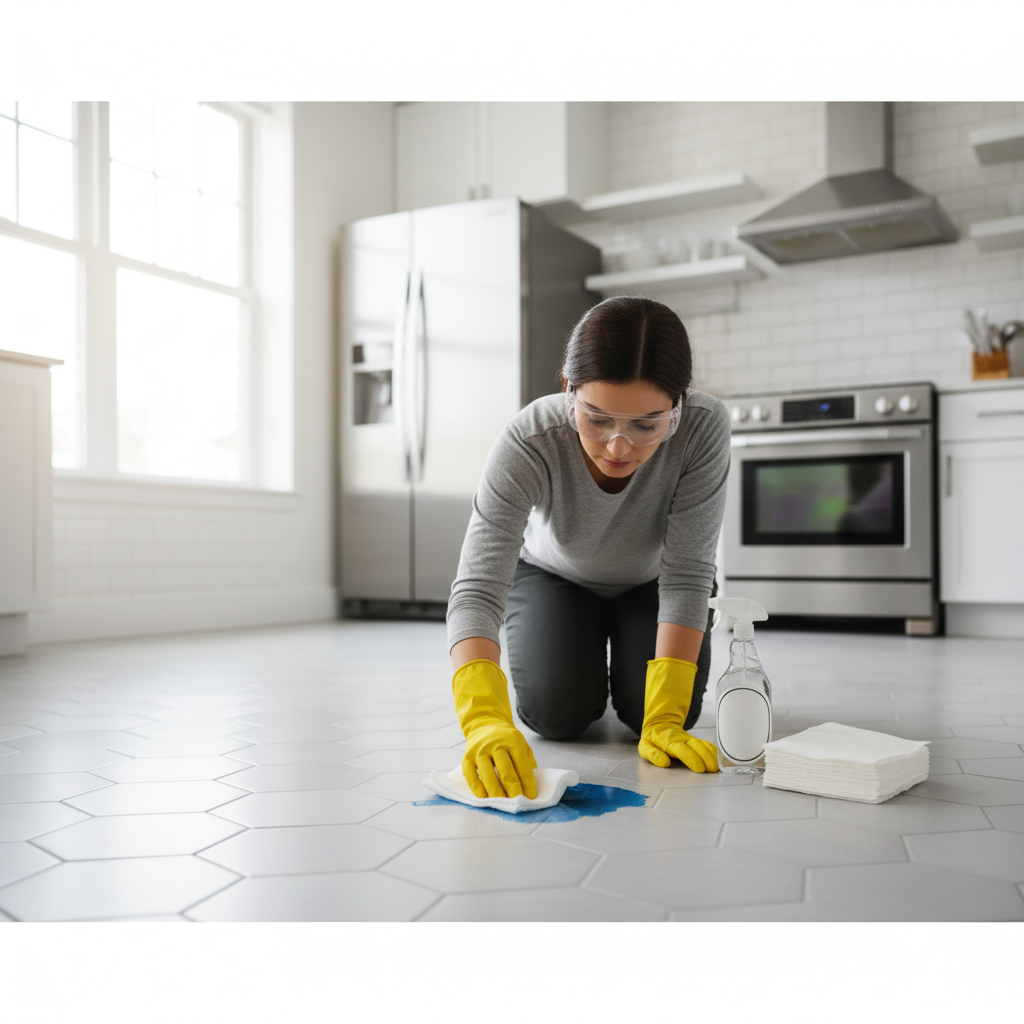
Most minor household chemical spills — a broken mercury thermometer, a small bleach splash, or a spilled cleaning product — can be safely cleaned up yourself with proper precautions. However, large spills, mixed chemicals (especially bleach + ammonia), fuel oil releases, and any spill causing breathing difficulty require immediate evacuation and professional help. Call 911 for medical emergencies, Poison Control (1-800-222-1222) for exposure questions, and your local fire department for chemical spills you cannot safely contain. Professional chemical spill cleanup costs $1,500 to $10,000+ depending on the substance and contamination extent.
Immediate Safety Steps for Any Chemical Spill
Regardless of the substance involved, follow these steps immediately when a chemical spill occurs in your home.
Get Everyone Away From the Spill
Move all people and pets away from the affected area immediately. If anyone is showing symptoms of exposure (coughing, burning eyes, difficulty breathing, dizziness), move them to fresh air and call 911.
Ventilate the Area
Open windows and exterior doors in the affected area. If safe to do so, turn on exhaust fans. Do not use central HVAC — it can spread fumes throughout the house. If you cannot ventilate safely without entering the spill area, evacuate instead.
Identify the Chemical
Read the product label to identify the substance and any hazard warnings. If the container is damaged or missing its label, note the product name, manufacturer, and any visible hazard symbols. You will need this information for Poison Control or emergency responders.
Call for Help If Needed
911 for medical emergencies or large spills. Poison Control (1-800-222-1222) for exposure questions and first aid guidance. Your local fire department for spills you cannot safely contain. Fire departments have hazmat training and can advise even for non-emergency situations.
Contain the Spill (Only If Safe)
If the substance is not producing dangerous fumes and you can approach safely, contain the spread. Use towels, rags, cat litter, or baking soda to absorb liquids and create a barrier. Do not allow the spill to reach drains, as many household chemicals are illegal to pour into the sewer system.
Never mix chemicals during cleanup. Even well-intentioned cleanup attempts can create deadly gas combinations. Bleach + ammonia creates chloramine gas. Bleach + vinegar creates chlorine gas. Bleach + rubbing alcohol creates chloroform. Hydrogen peroxide + vinegar creates peracetic acid. When in doubt, ventilate and evacuate — do not try to neutralize unknown spills.
Common Household Chemical Emergencies
These are the chemical spill scenarios most frequently encountered in homes, along with specific guidance for each.
Mercury (Broken Thermometer or CFL Bulb)
Danger level: Moderate
Key risk: Mercury vapor is toxic when inhaled, especially in enclosed spaces.
Do: Ventilate the room. Use stiff cardboard to scoop beads onto paper. Use tape to pick up tiny droplets. Place in a sealed glass jar or zip-lock bag.
Don’t: Vacuum (it spreads mercury vapor), sweep with a broom (it breaks beads into smaller pieces), or pour mercury down the drain.
Disposal: Contact your local hazardous waste facility. Never put mercury in regular trash.
Bleach + Ammonia (Toxic Gas)
Danger level: High — potentially fatal
Key risk: Creates chloramine gas causing severe respiratory damage.
Do: Evacuate immediately. Open windows from outside if possible. Call 911 if anyone is symptomatic. Wait for the area to air out completely (at least 1–2 hours with ventilation).
Don’t: Re-enter the area until fumes have completely dissipated. Do not try to clean up the mixture.
Note: This commonly happens when mixing cleaning products. Many “multi-surface cleaners” contain ammonia.
Fuel Oil / Heating Oil Spill
Danger level: Moderate to high (depending on volume)
Key risk: Vapors are flammable and toxic. Oil soaks into concrete, wood, and soil, creating long-term contamination.
Do: Ventilate immediately. Eliminate ignition sources (no flames, no electrical switches). Absorb with cat litter, sand, or commercial absorbent. For spills over 5 gallons, call your state environmental agency.
Don’t: Wash oil into drains or storm sewers. Do not use water to clean oil — it spreads the contamination.
Disposal: Absorbed material is hazardous waste. Contact your local environmental agency.
Gasoline Spill (Indoor)
Danger level: High — immediate fire/explosion risk
Key risk: Gasoline vapors are heavier than air, pool at floor level, and ignite easily from any spark or flame.
Do: Evacuate immediately. Do not flip any light switches or use electronics. Open the garage door from outside if possible. Call the fire department for spills over 1–2 cups indoors.
Don’t: Start a car in the area, use a vacuum, or create any ignition source.
Note: A single gallon of gasoline has the explosive energy of 14 sticks of dynamite.
Pesticide / Herbicide Spill
Danger level: Moderate
Key risk: Skin absorption and ingestion. Some pesticides are neurotoxic.
Do: Ventilate. Wear rubber gloves and eye protection. Absorb with cat litter or paper towels. Clean the area with soap and water. Wash any contaminated skin with soap and water for 15–20 minutes.
Don’t: Use a garden hose to wash pesticides into storm drains. Do not eat, drink, or smoke until you have washed your hands thoroughly.
If ingested: Call Poison Control immediately. Have the product label ready.
Paint Thinner / Solvent Spill
Danger level: Moderate
Key risk: Flammable vapors and central nervous system effects (dizziness, headache, nausea) from inhalation.
Do: Ventilate aggressively. Absorb with rags or paper towels. Clean residue with soap and water. Seal contaminated materials in a metal container with a tight lid.
Don’t: Leave solvent-soaked rags in a pile — they can spontaneously combust. Do not pour solvents down drains.
Disposal: Hazardous waste pickup or drop-off only.
When to Evacuate
Some chemical spills require immediate evacuation. Do not attempt cleanup in these situations — get everyone out and call for help from outside.
⚠ Evacuate Immediately If
DIY Cleanup for Minor Spills
Small, single-chemical spills of common household products can generally be cleaned up safely without professional help. Follow these guidelines.
| Chemical Category | Examples | Cleanup Method | PPE Needed |
|---|---|---|---|
| Bleach / chlorine cleaners | Clorox, toilet bowl cleaner, mold removers | Ventilate. Absorb with paper towels. Rinse area thoroughly with water. Wash contaminated clothing separately. | Rubber gloves, eye protection |
| Ammonia-based cleaners | Windex, many multi-surface sprays | Ventilate. Absorb with paper towels. Rinse with water. Ammonia evaporates quickly with good airflow. | Rubber gloves |
| Acid-based cleaners | Lime-Away, CLR, some rust removers | Ventilate. Neutralize with baking soda, then absorb. Rinse thoroughly with water. | Rubber gloves, eye protection |
| Alkali / caustic products | Oven cleaner, drain opener (lye-based) | Ventilate. Do not touch with bare skin. Absorb carefully with paper towels. Neutralize residue with diluted vinegar, then rinse with water. | Rubber gloves, eye protection, long sleeves |
| Small mercury spill | Broken thermometer, CFL bulb | Ventilate. Scoop beads with cardboard. Use tape for small droplets. Seal in glass jar. Do not vacuum. | Rubber gloves |
| Paint / stain | Latex paint, wood stain | Absorb wet paint with rags. Clean residue with soap and water (latex) or mineral spirits (oil-based). Ventilate for oil-based products. | Rubber gloves |
Every home should have a basic chemical spill kit: rubber gloves, safety goggles, baking soda (neutralizes acids), cat litter (absorbs liquids), paper towels, sealable plastic bags, and Poison Control’s number (1-800-222-1222) posted visibly. Total cost: under $20.
When to Call Professionals
Some chemical spills are beyond safe DIY cleanup. Call a professional biohazard remediation company or your local hazmat team in these situations.
Call a Professional When
Health Risks of Chemical Exposure
Chemical exposure in the home can cause acute (immediate) and chronic (long-term) health effects depending on the substance, concentration, duration of exposure, and route of entry (inhalation, skin contact, ingestion).
| Route of Exposure | Acute Symptoms | Chronic Effects (prolonged/repeated exposure) |
|---|---|---|
| Inhalation | Coughing, wheezing, shortness of breath, chest tightness, dizziness, nausea, headache | Chronic respiratory disease, sensitization, chemical pneumonitis, neurological damage |
| Skin contact | Burns, redness, blistering, rash, irritation | Dermatitis, sensitization, systemic absorption of toxic chemicals |
| Eye contact | Burning, redness, tearing, blurred vision, pain | Corneal damage, permanent vision impairment (strong acids/alkalis) |
| Ingestion | Nausea, vomiting, diarrhea, abdominal pain, burns to mouth/throat | Organ damage (liver, kidneys), poisoning |
Skin contact: Remove contaminated clothing and flush skin with running water for at least 15–20 minutes. Eye contact: Flush eyes with clean water for at least 15 minutes; remove contact lenses first. Inhalation: Move to fresh air immediately. Ingestion: Call Poison Control (1-800-222-1222) immediately. Do not induce vomiting unless specifically instructed by Poison Control — some chemicals cause more damage coming back up.
Chemical Waste Disposal Requirements
Chemicals cleaned up from a home spill cannot simply be thrown in the trash or poured down the drain. Improper disposal is both environmentally harmful and illegal under federal and state environmental laws.
Household Hazardous Waste (HHW) Programs
Most counties and municipalities operate household hazardous waste collection programs — either permanent drop-off facilities or periodic collection events. These accept paint, solvents, pesticides, batteries, mercury, fluorescent bulbs, and other common household chemicals at no charge. Search “[your county] household hazardous waste” to find your local program.
What You Cannot Throw Away
The following should never go in regular household trash or down the drain: mercury (any amount), oil-based paint, solvents, pesticides, pool chemicals, automotive fluids, fluorescent bulbs, batteries (lithium, button cell), and any chemical labeled “hazardous,” “toxic,” “corrosive,” or “flammable.”
Some chemical spills must be reported to state or federal agencies. Fuel oil spills exceeding certain thresholds (typically 25–50 gallons, varies by state) must be reported to your state environmental agency. Any spill that reaches waterways, storm drains, or groundwater should be reported to the EPA’s National Response Center at 1-800-424-8802. When in doubt, report — there is no penalty for over-reporting, but failure to report a required spill can result in fines.
Chemical Spill Cleanup Costs
Most minor household chemical spills cost little to nothing to clean up yourself. Professional cleanup becomes necessary for larger spills, contamination in porous materials, or hazardous substances.
| Scenario | Estimated Cost | Notes |
|---|---|---|
| DIY minor spill cleanup | $0 – $50 | Gloves, absorbents, and cleaning supplies. Most homeowners already have what they need. |
| Hazardous waste disposal (HHW program) | Free – $50 | Most municipal HHW programs are free for residents. Some charge a small fee for large volumes. |
| Professional chemical spill cleanup (small) | $1,500 – $3,000 | Localized spill in one room. Surface decontamination and odor treatment. |
| Professional chemical spill cleanup (large) | $3,000 – $10,000 | Multiple rooms or significant material absorption. May include flooring/drywall removal. |
| Fuel oil / heating oil remediation | $5,000 – $25,000+ | Depends on volume spilled, soil contamination, and state remediation requirements. Indoor tank spills at the lower end; outdoor soil contamination at the higher end. |
| Mercury decontamination (professional) | $2,000 – $8,000 | For large mercury spills (e.g., broken mercury thermostat, large amount from broken equipment). Includes vapor monitoring and clearance testing. |
| Odor removal (post-chemical spill) | $500 – $3,000 | Ozone or hydroxyl treatment for lingering chemical odors after the spill has been cleaned. |
Homeowner’s insurance may cover professional chemical spill cleanup if the spill was “sudden and accidental” (e.g., a heating oil tank failure). Gradual leaks and maintenance-related spills are typically excluded. Check your policy and file promptly — see our insurance claims guide for step-by-step instructions.
Preventing Chemical Spills at Home
Most household chemical spills are preventable with basic precautions.
Prevention Checklist
Frequently Asked Questions
What should I do if I accidentally mix bleach and ammonia?
Evacuate immediately. Mixing bleach and ammonia creates chloramine gas, which causes severe respiratory irritation and can be fatal in enclosed spaces. Get everyone (including pets) out of the house, open windows from outside if possible, and call 911 if anyone is experiencing breathing difficulty. Do not re-enter until the area has been ventilated for at least 1–2 hours.
How do I clean up a broken mercury thermometer?
Ventilate the room by opening windows. Do not vacuum or sweep — this spreads mercury vapor and breaks beads into harder-to-find droplets. Use stiff cardboard to scoop visible beads onto paper, then use tape to pick up tiny droplets. Place all mercury and contaminated materials in a sealed glass jar or zip-lock bag. Contact your local household hazardous waste facility for proper disposal.
Can I pour bleach down the drain?
Small amounts of diluted household bleach (sodium hypochlorite) can generally be poured down the drain with running water. However, never pour bleach down the drain if you’ve recently used ammonia-based or acid-based drain cleaners — the combination creates toxic gases. Large quantities of concentrated bleach should go to your local HHW facility.
Does homeowner’s insurance cover chemical spill cleanup?
It depends on the cause. “Sudden and accidental” spills (e.g., a heating oil tank failure, an appliance leak) are generally covered. Gradual leaks, maintenance neglect, and intentional acts are excluded. The sewer backup endorsement may apply if chemicals entered through drains. File a claim promptly and document everything.
When do I need to report a chemical spill to the government?
Reporting requirements vary by state and substance. Generally, you must report: fuel oil spills exceeding your state’s threshold (typically 25–50 gallons), any spill reaching waterways or storm drains, and any release of federally regulated hazardous substances above reportable quantities. Contact the EPA National Response Center (1-800-424-8802) or your state environmental agency when in doubt.
How do I find my local hazardous waste disposal facility?
Search “[your county] household hazardous waste” online, or call your county’s solid waste department. The EPA also maintains a locator at epa.gov/hw/household-hazardous-waste-hhw. Most programs are free for residents and accept paints, solvents, pesticides, batteries, mercury, and other common household chemicals.
Need Professional Chemical Spill Cleanup?
For spills beyond safe DIY cleanup — fuel oil, unknown substances, chemicals in porous materials — professional biohazard remediation companies have the equipment, training, and disposal capabilities to handle it safely.