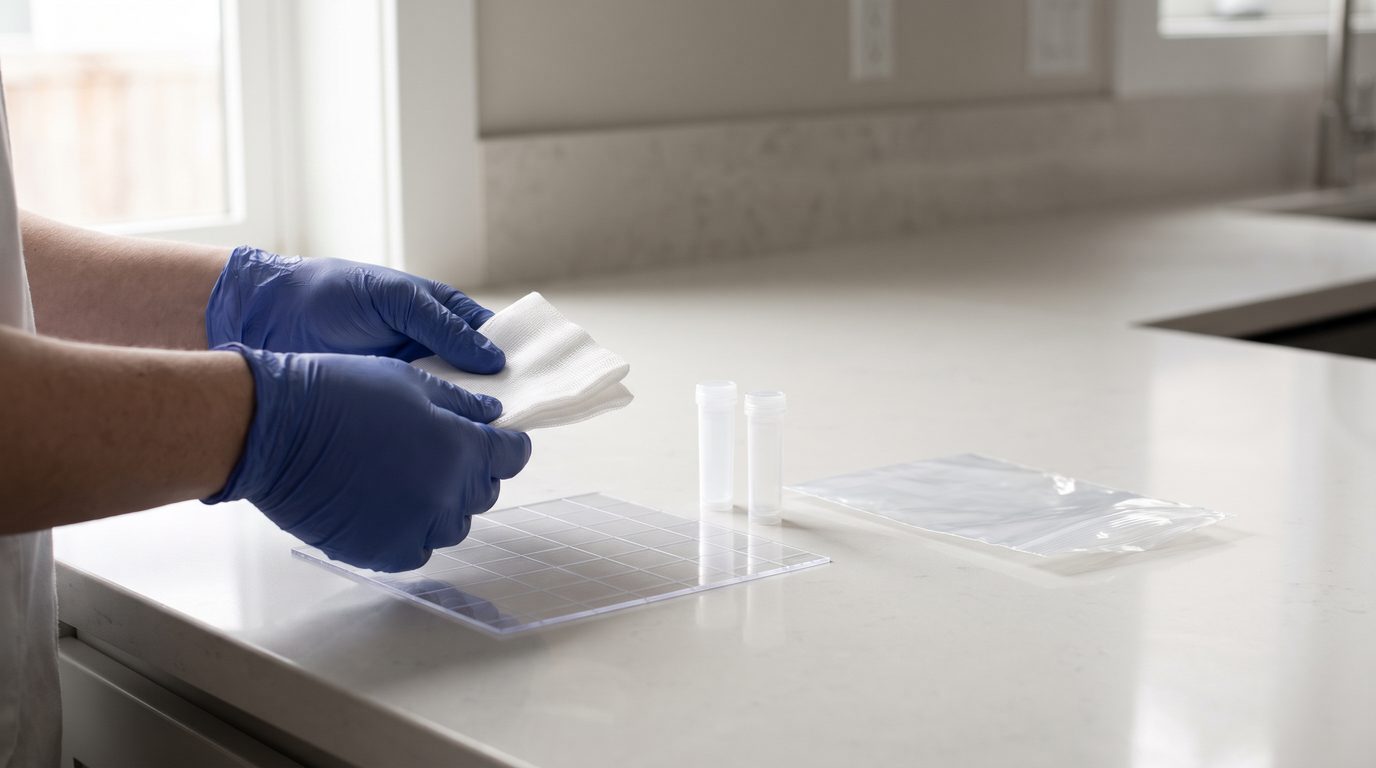
A home meth test kit tells you whether meth is on one surface. It does not tell you how much. Only a wipe sample analyzed by a lab gives a number, in micrograms per 100 square centimeters (µg/100 cm²), that you can compare with your state's cleanup standard. In the states that set one, the standard runs from 0.05 to 1.5. Some color-change kits only react above 15 µg/100 cm², so a negative kit result does not clear a house. If a lab result is over your state's limit, call your local health department before anyone starts cleaning.
Search by ZIP code for meth lab cleanup companies near you, then call one directly.
Two kinds of test, two different questions
A home meth test kit answers "is it here?" A lab answers "how much?" State cleanup rules are written as amounts, so only the second answer can be held up against them. Detection levels below are the makers' and labs' own figures.
| Test | What it tells you | Lowest level it reports | How fast | Does a state accept it? |
|---|---|---|---|---|
| Color-change kit (example: SKC MethAlert) | Present or not | 15 µg/100 cm² | On site | No. Its instructions say results "should not be used for clearance purposes." |
| Immunoassay cassette kit (example: SKC MethChek) | Above or below the kit's cutoff | Four versions: 0.05, 0.1, 0.5 or 1.5 | On site | None found. SKC says to confirm by lab analysis "if required by the individual state." |
| Mail-in lab kit (you wipe, a lab measures) | How much, as a number | ALS: 0.1 µg per sample | ALS: within a week. SimpleLab: about 10 business days | Washington, if no health officer has declared the property contaminated. Elsewhere, ask first. |
| Professional sampling (certified tester) | How much, from a sampling plan | Set by the lab | Set by the lab | The route the rules expect in Colorado (screening for a sale) and Utah (sampling after cleanup) |
What home kits detect, and what they miss
Washington's Department of Health says field testing strips "can be accurate and sensitive for the drug being tested, but do not tell you how much of the drug is there." Depending on the strip, "it will tell you if the drug is present, but not if it's above or below the state decontamination standard."
The gap can be large. SKC's MethAlert, a color-change kit, detects meth residue "on surfaces from 15 to 5000 µg/100 cm²," the company says. That floor is 10 times the highest state standard (1.5) and 300 times Arkansas's (0.05). A house can fail every state standard and still give a negative result on a kit like that.
It works the other way too. Washington DOH: "If the methamphetamine test strip is sensitive to levels below the state decontamination standard, a positive result may not mean the area is unsafe."
What "0.1" and "0.5" mean on a kit box
Those numbers are cutoffs. SKC sells its MethChek cassette with a lower limit of 0.05, 0.1, 0.5 or 1.5 µg/100 cm², to match different state standards: a 0.5 kit for Colorado or Indiana, a 0.1 kit for Kentucky or Tennessee. SKC adds that "Sensitivity depends on many factors including the operator, the surface being wiped, and the type of methamphetamine that is present."
Some kits sold online state no detection level at all. If the box does not say what amount turns it positive, you cannot compare its result with any standard. Washington's guide for shelters and housing facilities (December 2024) says field test strips "are also available to be purchased online but are not recommended."
How lab testing works
A lab test starts with a wipe. Someone marks off a square of surface, wipes it with a wetted gauze pad, seals the pad and ships it to a lab. EPA's cleanup guidelines say "Most guidance documents suggest a minimum sample area of 100 cm2," which is 10 cm by 10 cm.
At the lab, the pad is usually run by NIOSH Method 9111 (liquid chromatography/mass spectrometry) or 9109 (gas chromatography/mass spectrometry). Method 9111 lists an estimated detection limit of 0.1 µg per sample.
Discrete or composite
A discrete sample is one area, one pad, one result. EPA says discrete samples belong "in areas where there is a high probability of exposure (e.g., countertops, ventilation systems)." A composite puts several areas on one result, which costs less. EPA's limit: "The composite sample should consist of no more than four discrete samples." Utah's rule allows either kind for confirmation sampling. A composite is an average: the lab ALS says "the total result is divided by the number of areas sampled to determine an average result per area."
Who takes the sample matters
In Colorado, "No person other than a Consultant in good standing may conduct screening level assessments" for a home sale, and those screening steps "are not to be used to make clearance decisions." In Utah, the certified decontamination specialist does the confirmation sampling after cleanup. Washington is looser: "You can also take and send samples to a lab if the property has not been declared contaminated by a local health officer."
How to take a wipe sample yourself
These steps follow EPA's wipe sampling procedure (section 5.3). A mail-in kit comes with its own instructions; where they differ, follow the lab's.
EPA names countertops and ventilation systems. Utah's rule wipes three 100 cm² areas in each affected room (floor, one wall, ceiling) plus three in the ventilation system. Use smooth, hard surfaces where you can.
Use the kit's template. Colorado's rule says physical templates may not be re-used.
EPA: "Use a new set of clean, non-powdered impervious gloves for each sample collected."
EPA says "Agreement has not yet been reached as to which solvent should be used," and that methanol "may remove paint from wipe surfaces." Use what your lab sends.
Press firmly. "Smooth surfaces should be wiped; rough surfaces should be blotted." Work in shrinking squares from the edge in, or in an overlapping S pattern. Fold the pad dirty side in, without letting it touch anything, and wipe the square again.
Fold once more, seal it, and label it with the sample number and the spot. The chain of custody form, the lab EMSL says, "must accompany any samples sent to the laboratory."
EPA says to send at least one blank per 10 samples: a pad wetted and folded, but not wiped. EMSL says meth keeps on the pad "for at least 7 days at room temperature," and recommends refrigeration.
It can tell you whether to worry. It does not clear a property in a state where a certified person has to sample, such as Colorado and Utah. Buying, selling or renting out in a state with a meth program? Ask the state or your local health department which samples count before you spend money.
Reading your lab report against your state's standard
A lab report can show two numbers per sample. Utah's health department says to skip the one in µg/sample: "Don't use that result." Use the one in µg/100 cm²: "This is the result to use." If you wiped a larger area or several areas on one pad, ALS says results "are then normalized to a 100 cm² surface area."
Then compare it with your state. These are the numbers in state rules and guidance, from our state-by-state research.
| Standard (µg/100 cm²) | States |
|---|---|
| 1.5 | Washington, California, Montana, Nebraska |
| 1.0 | Utah, West Virginia |
| 0.5 | Colorado, Indiana |
| 0.1 | Kentucky, Tennessee, Alaska, Idaho, Hawaii |
| 0.05 | Arkansas |
| Guidance only, not law | Michigan 0.5, Wisconsin 1.5, Kansas 1.5, Virginia 1.5 (voluntary), Vermont 0.1 (recommendation) |
| No number | Oregon (its rule defines cleanup as reaching the "lowest practical level"), North Carolina (process only), Minnesota (points to EPA's guidelines) |
Every other state is in the full state-by-state table. There is no federal number: EPA's guidelines say "It does not set requirements."
What the number means for your health
- EPA: "Most state remediation standards are based on analytical detection limits and feasibility," not health, but "are believed to be set at sufficiently conservative levels to still be health-protective."
- Washington: its 1.5 standard "was created based on negative health effects found in people."
- Colorado (Boulder County health): the state's 0.5 is "a technology-based standard, not a health-based standard," with "a built-in 300-fold margin of safety," so going over it is not a "threshold" where harm starts. The same document says "the associated high uncertainty of long-term exposure from living in a previously meth-contaminated residence justifies the current established clean up levels."
- Utah: asked what a result under 1.0 will do to you or a tenant: "Probably nothing." It adds: "We do not know for certain what the overall lifetime risks are for long-term exposure to small amounts of methamphetamine."
Low levels found? Read them against your own state's number, not another state's or another country's. For health effects, see health risks of meth residue.
What to do with a positive result
Kit positive: get a lab test. A kit cannot tell you whether you are over your state's standard.
Lab result under the standard: keep the report. In Utah, at or under 1.0 the owner "has no legal obligation to decontaminate," though the owner can choose to.
Over the standard: call your local health department before anyone starts cleaning. What follows depends on the state.
- Utah: over 1.0, "the owner of the property has a legal obligation to decontaminate the property." Cleaning only part of a building is allowed, but it "requires considerably more testing."
- Washington: "Your local health officer will determine if the area is considered contaminated." The state's shelter and housing guide requires certified decontamination where "There is illegal drug manufacturing, distribution, or storage." For residue from use, it depends on the setting and the local health department.
- Colorado: the standard is 0.5, and the state certifies both the consultants who sample and the contractors who clean.
Washington DOH and Utah's Department of Environmental Quality each keep a list of certified companies. When you call a company from our meth lab cleanup listings, ask for its state certification number and check it against that list.
Selling or renting brings its own duties: see meth disclosure laws by state, our drug house guide for landlords and property value after a biohazard event.
What meth testing costs
Two prices from vendors' own pages, checked on November 17, 2026. They may change.
| Product | Type | Price shown | What the seller says |
|---|---|---|---|
| Bio Recovery, Meth Testing Kits | Instant kit | $49.99 | "You can have your answer in less than 15 minutes." No detection level stated. The page also says to call for pricing. |
| SimpleLab, Methamphetamine Surface Wipe Test | Mail-in lab test | $270 | "one wipe is intended for testing only one surface." Results about 10 business days after the lab receives it. |
We found no published price for a professional sampling visit. When you get quotes, ask for the lab's fee per sample and the site-visit fee separately.
EPA says testing before cleanup can reduce costs "by streamlining the cleanup process and identifying materials that are too contaminated to clean and should simply be removed," and that testing after cleanup "should not be skipped." In Utah, "The property owner is responsible for the costs of testing and decontamination," and the state does not pay them back. Utah also warns that "Some banks will not provide a loan when there are any positive tests, unless decontamination has first occurred."
Fentanyl is a different test
A meth test does not tell you about fentanyl. Washington DOH says "Fentanyl test strips may also give a false positive if methamphetamine is present instead of fentanyl," and "There are no labs accredited by Ecology for fentanyl analysis." See our guide to fentanyl residue in a house and our listings for fentanyl decontamination.
Frequently Asked Questions
My meth test kit was negative. Is the house OK?
Not necessarily. Some color-change kits only react above 15 µg/100 cm² (SKC MethAlert), far above every state standard. A negative counts only if the kit's cutoff is at or below your state's standard. A lab-analyzed wipe sample is the way to be sure.
What's the difference between a 0.1 and a 0.5 meth test?
They are kit cutoffs matched to different state standards: 0.1 for states like Kentucky and Tennessee, 0.5 for Colorado and Indiana. Use the one that matches your state. A kit set lower than your standard can read positive on a house that meets the rule (Washington DOH).
Can I test a house for meth myself?
You can wipe and mail samples to a lab. Washington allows it if a health officer has not declared the property contaminated. In Colorado and Utah, the samples that count under state rules are taken by a certified person, and Utah recommends "working with a certified decontamination specialist for testing."
How long do meth lab test results take?
ALS says "within a week." SimpleLab says about 10 business days after the lab receives your sample. Instant kits read on site.
Does a positive meth test mean the house is unsafe?
Not by itself. A kit positive means meth is there; a lab number over your state's standard means the state's rules apply. Washington says a strip more sensitive than the standard "may not mean the area is unsafe."
Can a meth test tell when the meth got there?
No. Utah: "A single battery of test results cannot determine when a dwelling became contaminated."
Does a meth test pick up fentanyl?
Fentanyl needs its own test, and a fentanyl strip can read positive when meth is there instead (Washington DOH).
Should a landlord test for meth between tenants?
Usually the owner decides. Washington DOH says "We do not have a policy that states when to test for methamphetamine or other drug residue from use," unless a health officer requires it. If you test, keep the dated lab report with the lease file. See our page for landlords.
Sources: EPA, Voluntary Guidelines for Methamphetamine and Fentanyl Laboratory Cleanup (revised edition, August 2021), sections 3.6, 5.1 and 5.3 and Appendix B; NIOSH Method 9111 and Method 9109 (Oct. 17, 2011); Washington DOH, Drug Residue; Washington DOH 334-568, Exposure Reduction Practices for Methamphetamine and Fentanyl Residue in Shelters and Housing Facilities (Dec. 2024); Utah Admin. Code R392-600-6; Utah DHHS, Methamphetamine Frequently Asked Questions; Colorado 6 CCR 1014-3, Part 1, sections 3.0, 6.0 and 7.0; Boulder County, Exposure to Methamphetamine; Or. Admin. R. 333-040-0020; Minnesota Department of Health, meth lab cleanup page (updated Jan. 14, 2026); SKC, MethAlert Colorimetric Wipe Kit and tech note 1763; SKC, Performance of MethChek Immunoassay Wipe Kits, tech note 1722; ALS, Meth Testing Kits; EMSL, Meth sampling instructions (rev. 2.0, Mar. 3, 2021); Bio Recovery, Meth Test Kits and SimpleLab, Methamphetamine Surface Wipe Test (prices checked Nov. 17, 2026).
Over your state's standard?
Our directory lists 129 companies for meth lab cleanup (November 17, 2026). In states that certify testers and cleanup firms, ask for the certification number before you hire.