Quick Answer
Fentanyl residue in a house can pose serious health risks, particularly through inhalation of contaminated dust or contact with mucous membranes. While brief skin contact with dry residue is unlikely to cause overdose, long-term exposure in a contaminated living space (especially for children, pets, and immunocompromised individuals) is a genuine concern. Professional testing costs $300-$1,200 and decontamination runs $2,000-$25,000+ depending on contamination severity. Only a handful of states currently have fentanyl-specific cleanup standards, with California being the most developed.
Health Risks of Fentanyl Residue Exposure
Fentanyl is a synthetic opioid approximately 100 times more potent than morphine and 50 times more potent than heroin. The DEA considers just 2 milligrams, roughly the size of a few grains of salt, a potentially lethal dose. In 2024 alone, the DEA seized more than 60 million fentanyl pills and nearly 8,000 pounds of fentanyl powder, equivalent to over 380 million potentially deadly doses.
But does that mean residue on a countertop can kill you? The science is more nuanced than the headlines suggest.
What the Science Actually Says
The American College of Medical Toxicology (ACMT) and the American Academy of Clinical Toxicology (AACT) issued a joint position statement clarifying that incidental dermal absorption of fentanyl is unlikely to cause opioid toxicity. Their key findings:
- Fentanyl in street formulations is not efficiently absorbed through intact skin: unlike pharmaceutical fentanyl patches, which use a specialized matrix designed to optimize transdermal delivery over 48-72 hours
- Powder and tablet forms require dissolution and sustained contact for meaningful skin absorption
- To date, there have been no verified reports of emergency responders developing opioid toxicity from incidental skin contact with fentanyl
- Brief skin contact with dry residue, if promptly removed, is not expected to produce toxic effects
The routes of exposure that matter most in a residential setting are:
| Exposure Route | Risk Level | Residential Concern |
|---|---|---|
| Inhalation (dust/particles) | HIGH | Fentanyl particles (0.2-2.0 microns) become easily airborne during normal activity: walking, vacuuming, HVAC operation. This is the primary residential risk. |
| Mucous membrane contact | HIGH | Touching contaminated surfaces then touching eyes, nose, or mouth. Particularly concerning for children and pets. |
| Ingestion | HIGH | Children's hand-to-mouth behavior makes this a critical risk in contaminated homes. Pets licking surfaces or grooming after contact. |
| Dermal (skin absorption) | MODERATE | Prolonged or repeated skin contact with concentrated residue. Lower risk from brief, incidental contact with dry surfaces. |
| Wound/broken skin | HIGH | Any break in skin (cuts, abrasions) dramatically increases absorption rate and toxicity risk. |
Symptoms of Fentanyl Exposure
According to CDC/NIOSH guidance, fentanyl exposure can cause rapid onset of respiratory depression (slow, shallow breathing), drowsiness, confusion, pinpoint pupils, nausea, loss of consciousness, and in severe cases cardiac arrest. If you suspect exposure, administer naloxone (Narcan) immediately if available and call 911.
How Homes Become Fentanyl-Contaminated
Fentanyl contamination in residential properties typically results from one of several activities:
- Pill pressing operations ("pill mills"), Counterfeit pills are manufactured by mixing fentanyl powder with fillers and pressing them into pill form. DEA lab analysis shows these pills average 2.4 mg of fentanyl per tablet, with some containing up to 5.1 mg (more than twice the lethal dose). The pressing process generates significant airborne dust.
- Cutting and packaging houses: Fentanyl is mixed with other drugs (heroin, cocaine, methamphetamine) for distribution. These mixing operations spread fine powder throughout the space.
- Heavy use over time, Smoking fentanyl leaves residue on surfaces similar to how cigarette smoke coats walls. Repeated use in a confined space builds up surface contamination.
- Spills and handling, Even small spills of fentanyl powder can contaminate a room due to the drug's extreme potency and fine particle size.
The EPA notes that fentanyl contamination can spread throughout a property as fine dust or powder, settling on surfaces far from the original source: inside HVAC systems, on soft furnishings, in carpet fibers, and in wall cavities.
Fentanyl vs. Meth Contamination: Key Differences
Both are serious, but they present fundamentally different challenges for testing, cleanup, and cost estimation.
| Factor | Fentanyl | Methamphetamine |
|---|---|---|
| Potency | Lethal at 2 mg; 100x morphine | Lethal dose approximately 100-200 mg |
| Particle size | 0.2-2.0 microns: easily airborne, penetrates deep into lungs | Larger particles; vapor/smoke residue coats surfaces |
| Primary contamination source | Pill pressing, cutting, smoking | Cooking (manufacturing), smoking |
| Chemical properties | Not volatile; does not easily enter air on its own; fine powder disperses mechanically | Volatile; off-gasses from surfaces; vapor embeds in porous materials |
| Established cleanup standard | Very few states, California requires "below detection level" | Most states, typically 0.1-1.5 µg/100 cm² |
| Decontamination agents | Peracetic acid, activated hydrogen peroxide, acidified hypochlorite (EPA-tested) | Various commercial formulations; well-established protocols |
| PPE required for entry | Full respiratory protection (N100/P100 minimum); SCBA for high contamination | N95 respirator sufficient for most assessments |
| Cleanup cost range | $3,000-$25,000+ | $5,000-$50,000+ |
| Labs in U.S. | Pill mills and cutting houses (common); manufacturing labs (rare) | Cook labs historically common, declining |
How to Test for Fentanyl in a Home
Whether you're a landlord after an eviction, a buyer doing due diligence, or a property manager responding to drug activity reports, professional testing is the only reliable way to confirm and quantify fentanyl contamination.
Testing Methods Compared
| Method | Cost | Detection Limit | Best For |
|---|---|---|---|
| Presumptive wipe test (field test) | $15-$50/test | 20-50 nanograms | Quick screening to determine if further testing is needed. High false-positive rate, not definitive. |
| Laboratory wipe sampling (LC-MS/MS) | $150-$400/sample | Sub-nanogram | Gold standard for confirmation and quantification. Required for legal documentation and remediation clearance. |
| Composite surface sampling | $300-$800/area | Sub-nanogram | Multiple wipes analyzed as a single sample. Cost-effective for screening large areas but can mask hot spots. |
| Full property assessment (IH) | $500-$1,200 | Sub-nanogram | Certified Industrial Hygienist collects strategic samples from multiple surfaces and HVAC. Comprehensive report suitable for insurance, legal, and regulatory purposes. |
How Wipe Testing Works
The standard method uses lint-free gauze sponges (typically 5 cm × 5 cm rayon/polyester blend) wetted with a solvent, wiped across a measured 100 cm² surface area. Samples are chain-of-custody documented and sent to an accredited lab for LC-MS/MS analysis. Results are reported in µg/100 cm².
- Sample each room individually: compositing across rooms can dilute contaminated surfaces below detection limits
- Priority locations: HVAC vents/returns, kitchen counters, bathroom surfaces, window sills, carpet
- HVAC sampling is critical, contaminated ductwork can re-contaminate a cleaned property
- Use an independent testing firm, never use the same company for testing and remediation
Need help finding testing professionals? Search our directory for certified environmental testing companies in your area.
State Fentanyl Decontamination Standards
Unlike methamphetamine, where most states have established cleanup levels (typically 0.1-1.5 µg/100 cm²), fentanyl decontamination standards are still emerging. As of early 2026, very few states have fentanyl-specific regulations, and no federal standard exists for residential fentanyl remediation.
| State | Fentanyl Standard | Key Law/Regulation | Notes |
|---|---|---|---|
| California | Below detection level | AB 1596 (eff. Jan 1, 2020) | Most comprehensive state law. Renamed act to "Methamphetamine or Fentanyl Contaminated Property Cleanup Act." Requires landlord disclosure. Standard is interim: becomes inoperative when a health-based standard is adopted. |
| Washington | No fentanyl-specific standard | WAC 246-205 (meth only) | Recommends using CDL-certified contractors and following meth lab framework for fentanyl sites. Meth standard is 1.5 µg/100 cm². |
| Indiana | No fentanyl-specific standard | IC 16-41-20 (meth only) | Meth standard is 0.5 µg/100 cm². Some contractors apply this threshold to fentanyl given its higher potency. |
| Kentucky | No fentanyl-specific standard | KRS 224.1-410 (meth only) | Meth standard is 0.1 µg/100 cm², among the strictest. No fentanyl provision. |
| Alaska | No fentanyl-specific standard | 18 AAC 78.100 (meth only) | Meth standard is 0.1 µg/100 cm². No fentanyl provision. |
| Utah | No fentanyl-specific standard | R392-600 (meth only) | Requires pre- and post-cleanup testing. Meth standard is 1.0 µg/100 cm². |
| Most other states | No standard | Varies | Many states have no clandestine drug lab cleanup laws at all (IL, IA, KS, and others). Properties may be addressed under general hazmat/environmental regulations. |
The EPA's Voluntary Guidelines for Methamphetamine and Fentanyl Laboratory Cleanup provide federal-level guidance, but compliance is voluntary.
PPE and Safety for Entering Fentanyl-Contaminated Spaces
CDC/NIOSH defines three exposure levels with corresponding PPE requirements for anyone entering a potentially fentanyl-contaminated environment. These guidelines apply to professionals, civilians should not enter suspected fentanyl-contaminated properties at all.
| Exposure Level | Situation | Required PPE |
|---|---|---|
| Minimal | Suspected contamination but no visible drugs | Nitrile gloves (5 ± 2 mil thickness). N95 respirator recommended as precaution. |
| Moderate | Small amounts of powder or liquid visible | Nitrile gloves, arm/skin protection, N100/P100/R100 filtering facepiece respirator, protective eyewear/face shield. |
| High | Large amounts of powder or liquid visible; pill pressing equipment present | Do not enter without specialized training. Full Tyvek suit, double gloving, SCBA or supplied-air respirator (SAR), full face shield. Decontamination corridor required for exit. |
Key Safety Practices (NIOSH/DEA Guidance)
- Never touch your face after touching any surface in the space
- Change gloves frequently during assessment or cleanup
- Have naloxone (Narcan) on-site with at least two people present
- No eating, drinking, or smoking in or near the contaminated area
- Decontaminate PPE before removal: soap and water, head-to-toe, downward motions
- Bag and dispose of all disposable PPE as contaminated waste
The Decontamination Process
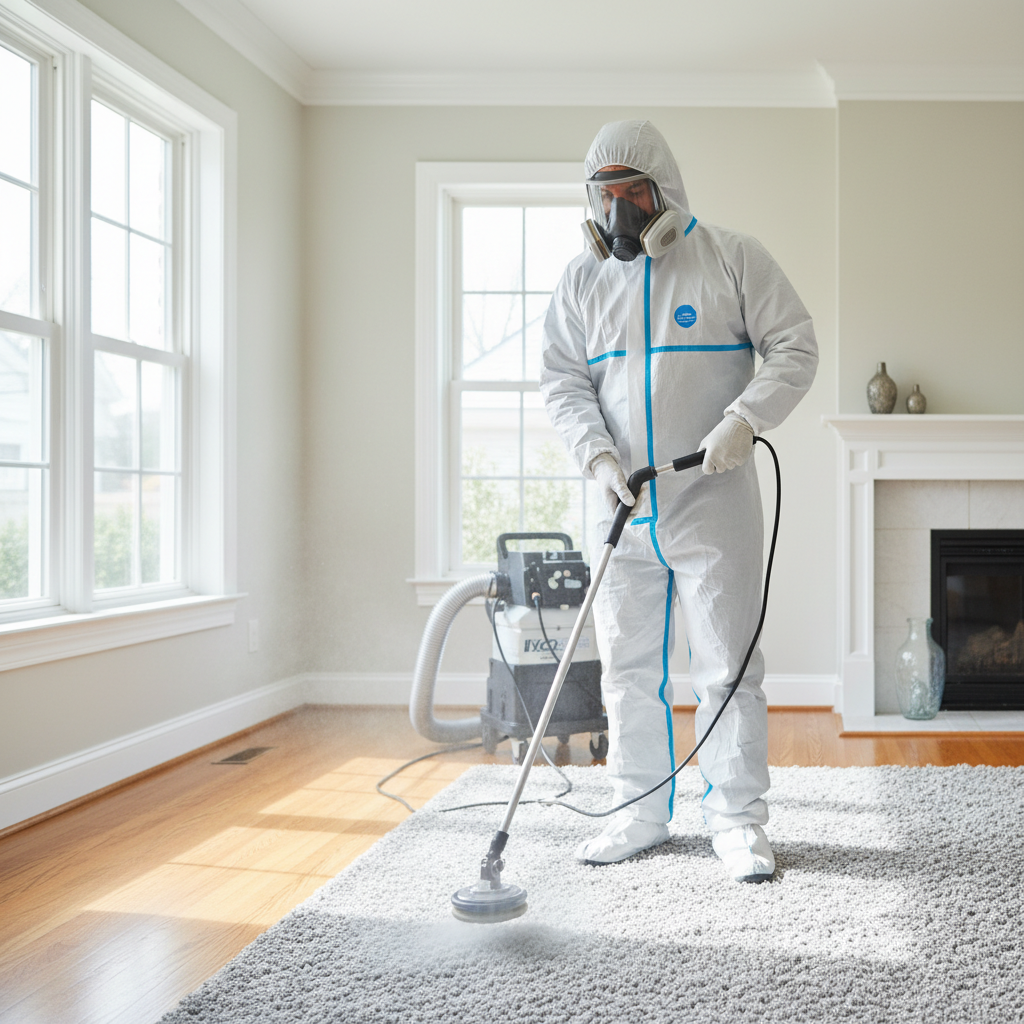
Professional fentanyl remediation follows a structured protocol. EPA research has identified the most effective decontamination methods, and certified contractors follow these evidence-based procedures.
Step 1: Assessment and Testing
A certified Industrial Hygienist (IH) conducts surface wipe sampling across the property, including HVAC components. The IH identifies contamination levels and creates a remediation scope of work. This assessment must be performed by a firm independent of the cleanup contractor.
Step 2: Containment and Isolation
The contaminated area is sealed with plastic sheeting and negative air pressure. HVAC systems are shut down. Entry/exit points are controlled with decontamination corridors.
Step 3: Removal of Contaminated Materials
Porous materials (carpet, padding, upholstered furniture, mattresses, unsealed wood, and heavily contaminated drywall) are removed, double-bagged, labeled, and transported by licensed hazmat haulers.
Step 4: Chemical Decontamination
EPA research has identified the most effective decontamination agents for fentanyl on building materials:
- Peracetic acid or activated hydrogen peroxide (most effective on glass, laminate, plastics, and painted drywall with a one-hour contact time
- Acidified hypochlorite solutions) highly effective with similar contact time requirements
- These solutions are applied by spray to all remaining hard surfaces and structural components
- For PPE decontamination, peracetic acid solutions degrade fentanyl in as little as 1-5 minutes
Step 5: HVAC Decontamination
Ductwork, air handlers, coils, and return vents are cleaned and treated. In severe contamination cases, ductwork may need to be replaced entirely. Skipping this step guarantees re-contamination when the system operates.
Step 6: Post-Remediation Clearance Testing
The independent IH returns to collect new wipe samples to verify contamination is at acceptable levels. In California, this means below detection level. A clearance report serves as legal documentation for property disclosure, insurance claims, and future sale.
What Fentanyl Decontamination Costs
Fentanyl remediation costs are influenced by property size, contamination severity, surface types, state regulatory requirements, and whether structural materials must be removed and replaced.
| Contamination Level | Typical Scenario | Cost Range |
|---|---|---|
| Low (surface use only) | Single room, hard surfaces, no HVAC involvement, casual drug use over short period | $2,000-$5,000 |
| Moderate (extended use/small operation) | Multiple rooms, some porous materials, HVAC contamination, drug use or small-scale packaging | $5,000-$15,000 |
| High (pill mill/cutting house) | Whole-house contamination, heavy HVAC involvement, structural material removal needed, pill pressing or cutting operation | $15,000-$40,000+ |
| Severe (manufacturing or major spill) | Extensive structural removal, full HVAC replacement, multi-phase remediation with repeat testing | $25,000-$100,000+ |
Additional Costs to Budget
- Pre-remediation testing: $500-$1,200 (independent Industrial Hygienist)
- Post-remediation clearance testing: $500-$1,200 (same IH, separate visit)
- Hazardous waste disposal: $500-$3,000 (licensed transport and disposal of removed materials)
- Structural reconstruction: $2,000-$15,000+ (drywall, flooring, subflooring replacement, typically done by a separate general contractor)
- HVAC replacement (if required): $3,000-$10,000
Use our cost calculator to get a preliminary estimate based on your property details, or request free quotes from certified decontamination companies in your area.
Frequently Asked Questions
Find Certified Fentanyl Decontamination Near You
BioCleaners Directory connects you with licensed, certified decontamination companies: verified for proper hazmat credentials, EPA-compliant methods, and the documentation you need.
Free to use. No account required. Available 24/7.