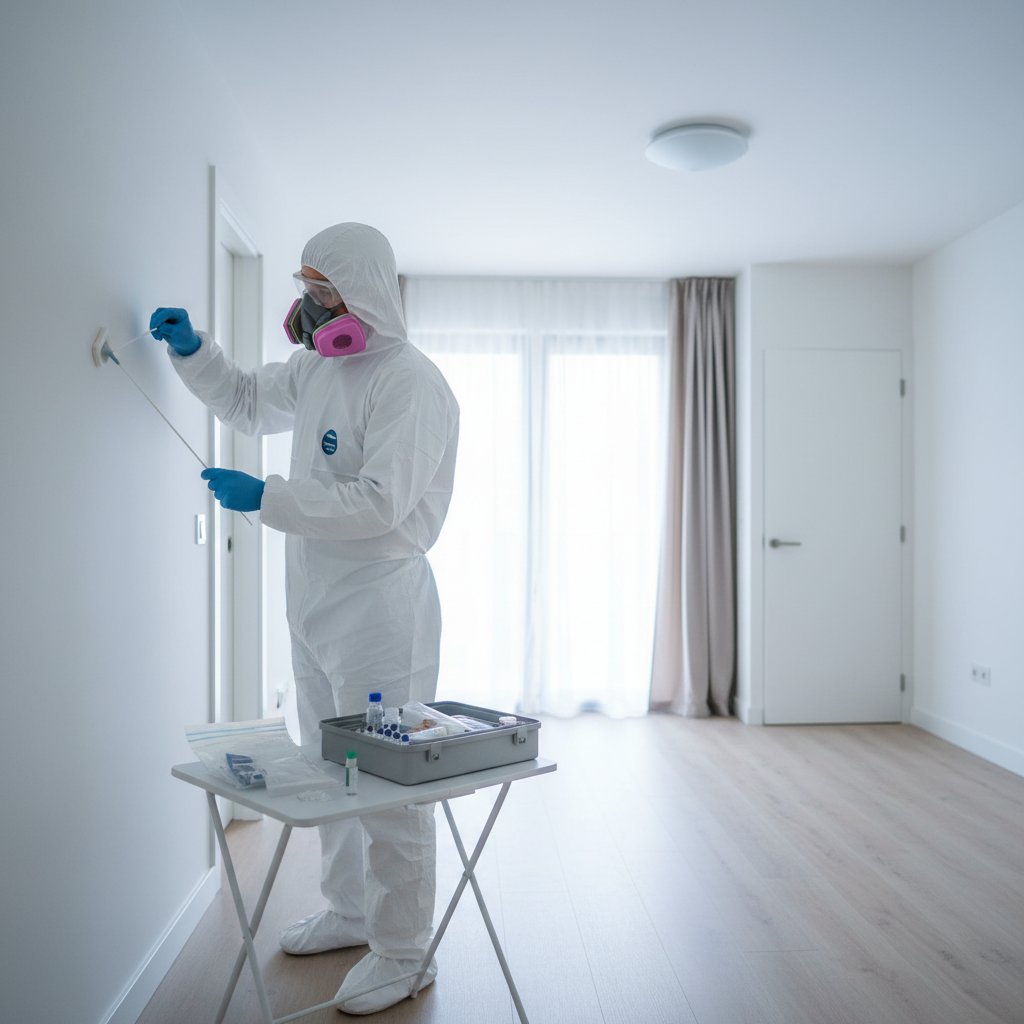
You cannot see meth residue with the naked eye. Chemical odors (ammonia, cat-urine smell), yellow-brown wall staining, corroded fixtures, and burn marks are the most common visual indicators of a former meth lab — but the only reliable confirmation is a surface-wipe test. DIY screening kits cost $30–$75, professional assessments run $500–$1,500, and full remediation ranges from $5,000 to $50,000+ depending on contamination severity. State cleanup standards vary widely, from 0.05 μg/100 cm² (Arkansas) to 1.5 μg/100 cm² (California, Washington, Montana).
- Physical Signs of a Former Meth Lab
- Health Risks of Meth Residue Exposure
- Meth Residue Testing: DIY vs. Professional
- State-by-State Contamination Standards
- State Disclosure & Remediation Laws
- Checking the DEA Clandestine Lab Register
- The Meth Lab Cleanup Process
- Decontamination Costs
- Frequently Asked Questions
Physical Signs of a Former Meth Lab
Methamphetamine manufacturing leaves behind chemical residues that embed in drywall, carpet, HVAC systems, and plumbing. While visual evidence alone is never conclusive, the following signs should prompt immediate testing.
⚠ Visual Warning Signs Checklist
Health Risks of Meth Residue Exposure
Methamphetamine residue contaminates surfaces and embeds in porous materials like drywall, carpet, and insulation. A 2016 study published in the CDC’s Morbidity and Mortality Weekly Report (MMWR) documented adverse health effects in residents of former meth labs in Victoria, Australia, confirming that environmental exposure alone — without direct drug use — causes real symptoms.
Contaminated surfaces expose occupants through dermal absorption (skin contact), inhalation (off-gassing from walls and carpets), and ingestion (hand-to-mouth contact, especially in young children). Residues have been shown to persist for months to years if not professionally remediated.
| Exposure Level | Primary Symptoms | Who Is Most at Risk |
|---|---|---|
| Low-level / short-term | Headaches, eye irritation, skin rashes, nausea, dizziness | All occupants |
| Moderate / ongoing | Respiratory irritation, persistent cough, sleep disruption, behavioral changes, nose bleeds | Children, elderly, asthma sufferers |
| High-level / chronic | Central nervous system effects (similar to meth use), liver and kidney stress, compromised immune response | Infants (crawling on contaminated surfaces), immunocompromised individuals |
Meth Residue Testing: DIY vs. Professional
If you suspect a property was used for meth production or heavy meth use, testing is the only way to confirm. There are two main approaches.
| Factor | DIY Screening Kit | Professional Assessment |
|---|---|---|
| Cost | $30–$75 per kit | $500–$1,500 |
| How It Works | Surface wipe with chemical reagent; color change indicates presence/absence of meth | Certified industrial hygienist collects wipe samples sent to accredited NATA/AIHA lab |
| Accuracy | Screening-level only; ~9% average deviation on validated kits (e.g., AccuMeth); false positives possible | Quantitative results in μg/100 cm²; legally defensible and accepted by state agencies |
| Detection Threshold | Typically 0.1 or 0.5 μg/100 cm² depending on kit | As low as 0.05 μg/100 cm² |
| Turnaround | Instant (5–10 minutes on-site) | 3–7 business days for lab results |
| Best For | Pre-purchase screening; quick pass/fail before investing in professional testing | Legal compliance; pre/post-remediation clearance; real estate transactions |
| Limitations | Cannot quantify exact contamination level; won’t satisfy state regulatory requirements | Higher cost; requires scheduling with a certified professional |
State-by-State Meth Contamination Standards
There is no federal standard for acceptable methamphetamine residue levels in residential properties. The EPA published Voluntary Guidelines for Methamphetamine and Fentanyl Laboratory Cleanup (updated 2021) to assist state and local agencies, but each state sets its own enforceable limit. These standards range from a strict 0.05 μg/100 cm² to a more permissive 1.5 μg/100 cm².
| State | Standard (μg/100 cm²) | Disclosure Required | Notes |
|---|---|---|---|
| Alaska | 0.1 | Yes | Applies to all surfaces |
| Arizona | 0.1 | Yes (waived after remediation) | Disclosure duty ends once property passes clearance testing |
| Arkansas | 0.05 | Yes | Strictest standard in the nation |
| California | 1.5 | Yes | Health & Safety Code §25400.28; written disclosure mandatory |
| Colorado | 0.5 | Yes | 0.5 per room; 4.0 for attics; tiered approach |
| Hawaii | 0.1 | Yes | State-regulated cleanup program |
| Idaho | 0.1 | Yes | Department of Health and Welfare oversees remediation |
| Illinois | 0.1 | Yes | Methamphetamine Production Facility Act |
| Indiana | 0.5 | Yes | Required on Seller’s Disclosure Form 46234 |
| Kentucky | 0.1 | Yes | Cabinet for Health and Family Services manages program |
| Minnesota | 0.1 (production) / 1.5 (use) | Yes | Two-tiered: stricter for labs, more lenient for use-only properties |
| Missouri | 0.1 | Yes | Highest number of seized labs in the DEA register |
| Montana | 1.5 | Yes | Department of Environmental Quality |
| Nebraska | 0.1 | Yes | Department of Health and Human Services |
| New Mexico | 1.0 | Yes | Measured per square foot rather than 100 cm² |
| North Carolina | 0.1 | Yes | State-regulated decontamination program |
| Oklahoma | 0.1 | Yes | DEQ-regulated cleanup standards |
| Oregon | 0.5 | Yes | Measured per square foot; state health authority oversees |
| South Dakota | 0.1 | Yes | Department of Agriculture and Natural Resources |
| Tennessee | 0.1 | Yes | Second-highest lab seizure count in DEA data |
| Utah | 1.0 | Yes | DHHS “Appletree” decontamination program |
| Washington | 1.5 | Yes | Standard based on health-effect studies; DOH regulates |
| West Virginia | 0.1 | Yes | State-regulated cleanup program |
| Wyoming | 0.75 | Yes | Unique threshold; Department of Environmental Quality |
State Disclosure & Remediation Laws
There are no federal laws requiring meth lab disclosure or mandating cleanup. Approximately half of U.S. states require sellers to disclose known meth contamination during real estate transactions. Requirements vary significantly.
In these states, sellers must disclose known meth manufacturing or contamination as part of the real estate transaction:
Arizona, California, Colorado, Idaho, Illinois, Indiana, Kentucky, Minnesota, Missouri, Montana, Nebraska, New Hampshire, New Mexico, North Carolina, Oklahoma, Oregon, South Dakota, Tennessee, Utah, Washington, West Virginia, Wyoming
Some states (like Arizona) waive the disclosure requirement after successful remediation and clearance testing.
These states have no specific meth-contamination disclosure statute, though general property-condition disclosure rules may still apply:
Alabama, Connecticut, Florida, Georgia, Iowa, Kansas, Louisiana, Maine, Maryland, Massachusetts, Michigan, Mississippi, New Jersey, New York, Ohio, Pennsylvania, Rhode Island, South Carolina, Texas, Vermont, Virginia, Wisconsin
Always consult a local real estate attorney. General disclosure duties may still cover known hazards in your state.
Checking the DEA Clandestine Lab Register
The DEA maintains the National Clandestine Laboratory Register at dea.gov/clan-lab, a free public database of addresses where law enforcement has discovered clandestine drug labs or dump sites. Before buying or renting any property, check this register.
Go to dea.gov/clan-lab and search by state and county.
Enter the property address or browse the list of seized locations in your county. The register includes the date of seizure and the type of lab or dump site found.
The register only includes labs reported by law enforcement. There is no federal requirement for agencies to report, so the database significantly undercounts actual contaminated properties. States with the most entries include Missouri (2,779), Tennessee (1,580), Indiana (1,289), and Arkansas (1,211).
A clean DEA register result does not guarantee the property was never used for meth. Many labs are never discovered by police. If you see physical signs or have concerns, get a professional assessment.
The Meth Lab Cleanup Process
Professional meth lab remediation follows the EPA’s Voluntary Guidelines for Methamphetamine and Fentanyl Laboratory Cleanup and applicable state regulations. The process is methodical, often taking days to weeks depending on severity.
A certified contractor or industrial hygienist inspects the property and collects initial surface-wipe samples from walls, floors, HVAC components, and plumbing. Samples are sent to an accredited lab for quantitative analysis.
Based on lab results, a written remediation plan is created specifying which areas exceed state limits and what methods will be used — from chemical washing to full demolition of drywall, carpet, and insulation.
Workers in full PPE (respirators, Tyvek suits, gloves) seal off contaminated areas. Porous materials like carpet, drapes, and heavily contaminated drywall are removed and disposed of as hazardous waste. HVAC ductwork is cleaned or replaced.
Remaining hard surfaces are cleaned with specialized chemical solutions designed to break down methamphetamine residue. Multiple wash cycles may be needed. Some contractors use ozone or hydroxyl generators for odor removal as well.
After remediation, an independent industrial hygienist (not the cleanup contractor) collects new surface-wipe samples. The property must test below your state’s legal threshold to receive a clearance certificate.
A formal clearance report is issued, which is required for property resale in regulated states. Keep this document permanently — it protects you from future liability.
Meth Lab Decontamination Costs
Cleanup costs vary dramatically based on property size, contamination severity, and whether the home was used for meth production (labs generate far more contamination than use alone). The EPA estimates cleanup costs between $5,000 and $50,000, with severe cases exceeding $100,000.
| Service | Typical Cost Range | Details |
|---|---|---|
| DIY Screening Kit | $30–$75 | Instant results; not legally sufficient |
| Professional Testing | $500–$1,500 | Accredited lab analysis; multiple sample points |
| Minor Remediation (use only) | $3,000–$8,000 | Surface cleaning; no demolition needed |
| Standard Lab Remediation | $5,000–$20,000 | Chemical wash, carpet/drywall removal, HVAC cleaning |
| Severe Lab Remediation | $20,000–$50,000+ | Full interior gutting; hazardous waste disposal; soil remediation |
| Clearance Testing (post-cleanup) | $500–$1,000 | Independent verification required by most states |
⚠ Cost Warning
Use our biohazard cleanup cost calculator to get a personalized estimate based on your property size and contamination type.
Frequently Asked Questions
How can I tell if my house was used as a meth lab?
Look for chemical odors (ammonia, cat-urine smell), yellow-brown wall staining, corroded fixtures, red phosphorus stains in bathrooms, burn marks, and unusual ventilation modifications. However, these signs are not conclusive. The only reliable method is surface-wipe testing, available as DIY kits ($30–$75) or professional assessments ($500–$1,500). Also check the DEA National Clandestine Laboratory Register.
What is the acceptable level of meth residue in a home?
There is no federal standard. State limits range from 0.05 μg/100 cm² (Arkansas, the strictest) to 1.5 μg/100 cm² (California, Washington, Montana). Most states with standards use either 0.1 or 0.5 μg/100 cm². Some states like Minnesota use a two-tiered system: 0.1 for meth production properties and 1.5 for meth-use-only properties. Several states, including Florida, Ohio, Texas, and New York, have no statewide standard at all.
What are the state laws on meth lab cleanup?
About half of U.S. states require sellers to disclose known meth contamination during real estate sales. States like California require written disclosure; Arizona waives the requirement after certified remediation. States without specific meth laws may still hold sellers liable under general property-condition disclosure rules. The EPA provides voluntary guidelines but sets no enforceable federal requirement.
Is it safe to live in a former meth lab?
Not without proper remediation. The CDC has documented adverse health effects from living in former meth labs, including respiratory problems, headaches, skin irritation, and behavioral changes. Children are at the highest risk due to crawling on contaminated surfaces and hand-to-mouth behavior. Once a property has been professionally remediated and passes clearance testing below your state’s threshold, it is considered safe for habitation.
Does the DEA database list all former meth labs?
No. The DEA’s National Clandestine Laboratory Register only includes labs reported by law enforcement, and there is no federal requirement to report. The database significantly undercounts actual contaminated properties. A property not appearing in the register does not guarantee it was never used for drug manufacturing.
How long does meth lab cleanup take?
Professional remediation typically takes 3–7 days for a standard property. Severe contamination involving full interior demolition can take 2–4 weeks. Clearance testing results add an additional 3–7 business days. Total timeline from assessment to clearance certificate is usually 2–6 weeks.
Can I clean up meth contamination myself?
In most regulated states, no. Professional remediation by a certified contractor is required to obtain a clearance certificate, which is necessary for property resale and regulatory compliance. DIY cleaning will not remove meth residue embedded in porous materials and may expose you to harmful chemicals. Get quotes from certified meth lab cleanup professionals.
Find Certified Meth Lab Cleanup Professionals
Whether you need testing, full remediation, or clearance documentation, our directory connects you with certified biohazard cleanup companies experienced in meth lab decontamination in your area.