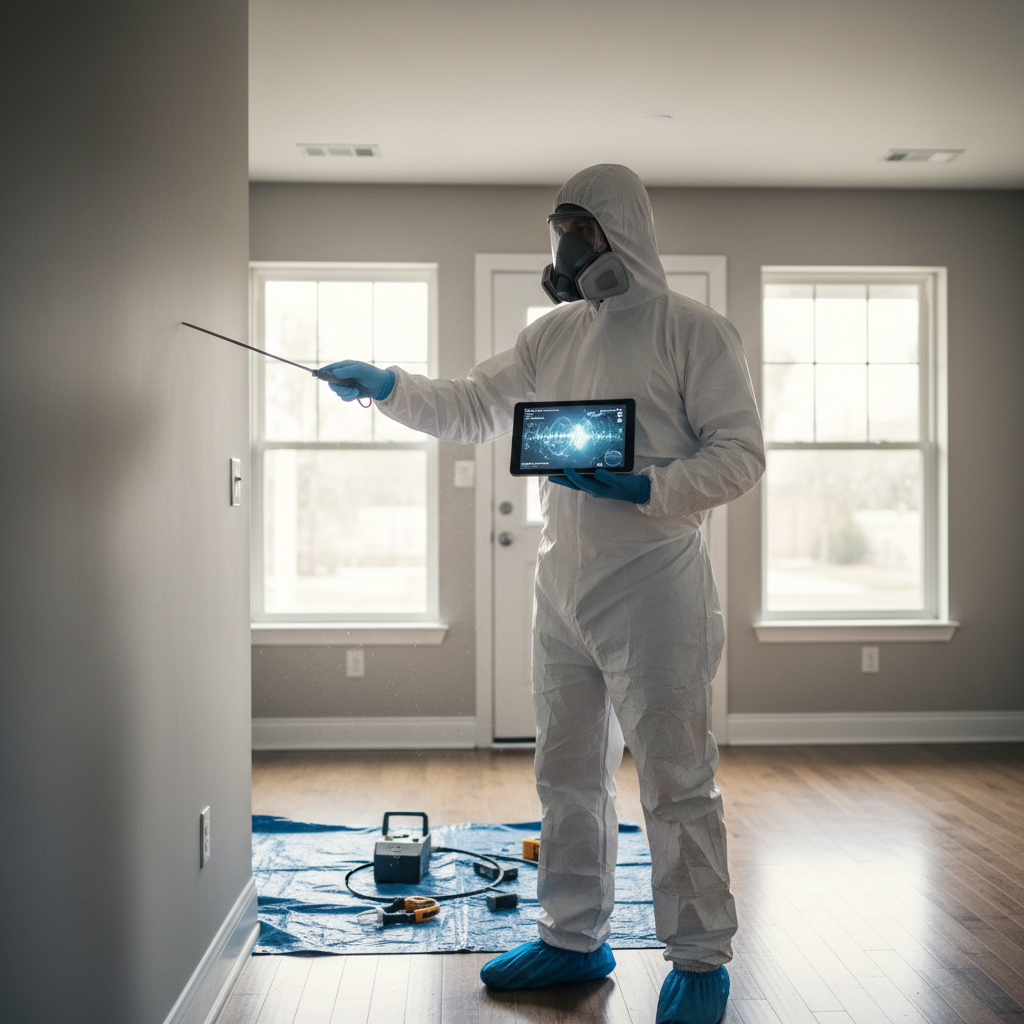
If you discover drug activity in your rental property, do not attempt cleanup yourself. Secure the property, document everything, contact law enforcement, then hire a certified decontamination contractor. Landlords can face civil liability, fines, and lawsuits from future tenants if contamination is not properly remediated. Most states require disclosure of drug manufacturing history when selling or re-renting, and cleanup costs range from $2,000 to $50,000+ depending on contamination severity.
What to Do When You Discover Drug Activity
Finding out your tenant has been using, manufacturing, or dealing drugs is every landlord's nightmare. Acting quickly and methodically protects you legally and minimizes contamination damage. Follow these steps in order.
Drug residues, especially from meth manufacturing and fentanyl handling, are dangerous. One pound of meth production generates 5 to 6 pounds of hazardous waste. Fentanyl particles as small as 0.2 microns can become airborne and cause exposure through skin contact or inhalation. Stay out of the unit until professionals assess it.
Call local police or the DEA tip line. If there is active drug manufacturing, this is a crime scene and law enforcement must process it first. The DEA maintains a National Clandestine Laboratory Register and coordinates initial hazardous material removal through their Environmental Management Program. Property will not be released for cleanup until law enforcement clears the scene.
Photograph the property from outside. Save all communications with the tenant. Obtain copies of police reports. This documentation will be critical for insurance claims, eviction proceedings, and any future legal action to recover cleanup costs.
File a claim immediately, even if you are unsure about coverage. Many landlord policies have time-sensitive reporting requirements. Delays in notification can be used as grounds for claim denial.
Most states allow expedited eviction (3-day notice) for drug-related activity. Drug manufacturing, distribution, or possession on the premises is almost universally treated as a non-curable lease violation, meaning tenants cannot fix the problem to avoid eviction.
Once the property is vacated and cleared by law enforcement, hire a qualified environmental inspector to test surfaces, air quality, and HVAC systems. Do not skip this step even if no manufacturing occurred. Drug use alone can leave dangerous residue levels on surfaces throughout a property.
If testing confirms contamination above state or EPA guideline levels, hire a licensed drug house cleanup contractor. Post-remediation testing must confirm the property meets clearance standards before it can be reoccupied.
Landlord Liability for Drug Contamination
Landlord liability for drug contamination operates on multiple levels: criminal, civil, and regulatory. Understanding where your exposure lies is essential to protecting yourself.
Criminal liability arises when landlords have knowledge of drug activity and fail to act. Courts look at whether you received complaints, whether law enforcement contacted you, and whether you took reasonable steps to address the situation.
Civil liability is broader. If you re-rent a contaminated property without proper remediation, future tenants who suffer health effects can sue for negligence. In Minnesota, landlords must remediate before re-renting to avoid liability. Property owners in Indiana must hire a Qualified Inspector and decontaminate to a clearance level of 0.5 micrograms per 100 square centimeters or the property cannot be transferred or reoccupied.
Regulatory liability means potential fines from health departments and environmental agencies. Many states require landlords to register contaminated properties and complete remediation within specific timelines.
Evicting Tenants for Drug Activity
Drug-related evictions are treated as serious lease violations in every state, but timelines and procedures vary. In most jurisdictions, drug activity qualifies as a non-curable violation, meaning you can proceed directly to an unconditional notice to vacate.
| State | Notice Type | Notice Period | Key Notes |
|---|---|---|---|
| Ohio | Unconditional Quit | 3 days | No cure period for drug activity; immediate court filing after notice expires |
| California | Unconditional Quit | 3 days | Drug manufacturing, distribution, or unlawful weapons on premises |
| Pennsylvania | Unconditional Quit | 10 days | Illegal drug activity on premises; criminal conviction not required |
| Minnesota | Unconditional Quit | Immediate | Landlord can file in court without notice for serious drug violations |
| Nevada | Unconditional Quit | 3 days | Non-curable violation; no option to remedy |
| Texas | Unconditional Quit | 3 days | Default unless lease specifies longer; criminal activity grounds |
| Florida | Unconditional Quit | 7 days | No opportunity to cure for drug-related violations |
| Colorado | Notice to Comply or Vacate | 10 days | Substantial violations; landlord may file if not cured |
The complete eviction process, from notice through court order and physical removal, typically takes 30 to 45 days depending on the jurisdiction and court backlog. Consult a local landlord-tenant attorney to ensure compliance with your state's specific procedures.
Drug Residue Testing Options and Costs
Professional testing determines whether contamination exists and how severe it is. This step is legally required in many states before a property can be re-rented or sold after known drug activity.
| Testing Type | What It Detects | Cost Range | Turnaround |
|---|---|---|---|
| Surface Wipe Test | Meth, fentanyl, cocaine, heroin residue on walls, counters, floors | $50 - $150/sample | 4 - 7 business days |
| Composite Surface Test | Same substances across larger homogeneous areas | $75 - $200/sample | 4 - 7 business days |
| HVAC System Test | Drug residue in ductwork, filters, air handler units | $150 - $400/sample | 5 - 10 business days |
| Air Quality Sampling | Airborne fentanyl particles, VOCs from meth production | $200 - $500/test | 5 - 10 business days |
| Comprehensive Property Assessment | Full multi-room, multi-surface, HVAC evaluation | $1,000 - $2,500 | 7 - 14 business days |
Surface wipe testing is the standard method: a contractor takes samples by wiping a measured area and sending them to an accredited laboratory. According to the EPA's Voluntary Guidelines for Methamphetamine and Fentanyl Laboratory Cleanup, the health-based clearance standard for methamphetamine is 1.5 micrograms per 100 square centimeters. For fentanyl, the American Conference of Governmental Industrial Hygienists (ACGIH) recommends a surface limit of 1.0 microgram per 100 square centimeters, though no federal standard currently exists.
Use our cost calculator to estimate testing and remediation costs for your property.
State Disclosure Requirements for Drug-Contaminated Properties
Approximately half of U.S. states require sellers and landlords to disclose whether a property has been used for drug manufacturing or has known drug contamination. Failing to disclose can result in lawsuits, rescinded sales, and regulatory penalties.
| State | Disclosure Required? | Key Statute / Requirement |
|---|---|---|
| California | Yes | Health & Safety Code 25400.28 requires written disclosure of meth or fentanyl contamination and copies of remediation orders or clearance test results |
| Virginia | Yes | Title 55.1-1219; tenants may terminate lease within 60 days if meth manufacturing history not disclosed and property not remediated |
| Indiana | Yes | Seller's Residential Real Estate Sales Disclosure form requires hazardous conditions disclosure including drug lab history |
| Minnesota | Yes | Sellers must disclose known meth production history; state health department maintains contaminated property registry |
| Missouri | Yes | Written disclosure required if property was used for meth production |
| Oregon | Yes | Seller must disclose drug manufacturing history; remediation certification may waive ongoing disclosure |
| Washington | Yes | Department of Health maintains registry; decontamination by CDL-certified contractor required; 1.5 ug/100cm2 meth standard |
| Colorado | Yes | Seller's Property Disclosure requires meth lab disclosure; remediation must meet state standards |
| Montana | Yes | Disclosure required for known contamination; state maintains clandestine lab registry |
| Arizona | Yes | Material fact disclosure required; drug manufacturing history is a material defect |
| Utah | Yes | Mandatory testing and remediation certification before transfer; state cleanup standards in effect |
| Nevada | Yes | Seller must disclose known drug activity; remediation records required |
| Illinois | Yes | Residential Real Property Disclosure Act covers hazardous conditions |
| Kentucky | Yes | Property owners must decontaminate to 0.5 ug/100cm2 clearance level before transfer |
| Georgia | Partial | General material defect disclosure; no drug-specific statute but courts treat contamination as material fact |
Even in states without specific drug disclosure statutes, general material defect disclosure requirements typically apply. Consult a local real estate attorney before listing or re-renting any property with known drug history.
Insurance Coverage for Drug Contamination
Insurance coverage for drug contamination is one of the most contested areas in landlord insurance. Whether your policy covers cleanup depends on the specific language, the type of drug activity, and how your state's courts interpret key terms.
Most landlord policies do not explicitly exclude damage from illegal drug use by tenants. Several courts have ruled that meth lab operation by a tenant constitutes vandalism, which is a covered peril. However, insurers frequently push back and may invoke criminal activity exclusions.
Key point: The criminal activity exclusion typically applies only to criminal acts by the insured (you), not by tenants. If you did not know about or participate in the drug activity, the exclusion should not apply.
Standard homeowners policies rarely cover drug contamination remediation. They are designed for owner-occupied properties and typically exclude damage from illegal activities regardless of who committed them. Specialized endorsements exist but are uncommon.
Commercial policies for multi-unit properties may cover drug contamination under pollution liability or vandalism provisions. Coverage depends heavily on policy language and whether contamination endorsements have been added.
Standalone environmental liability or pollution liability policies provide the strongest coverage for drug contamination. These policies are specifically designed to cover hazardous substance cleanup and are worth the additional premium for landlords in high-risk areas.
Remediation Costs by Contamination Type
Cleanup costs vary dramatically based on the type and extent of drug activity, property size, and state requirements. Here are realistic cost ranges based on industry data.
| Contamination Type | Typical Cost Range | Average Cost | What's Involved |
|---|---|---|---|
| Meth Use Only (smoking) | $2,000 - $8,000 | $5,000 | Surface cleaning, paint removal, carpet/pad replacement, HVAC cleaning |
| Meth Lab (small-scale) | $5,000 - $25,000 | $15,000 | Hazmat removal, surface decontamination, HVAC replacement, structural cleaning, waste disposal |
| Meth Lab (large-scale / superlab) | $25,000 - $150,000+ | $50,000+ | Full structural remediation, soil testing, demolition of heavily contaminated materials, multi-phase cleanup |
| Fentanyl Contamination | $2,000 - $10,000 | $5,000 | Specialized surface decontamination with peracetic acid or activated hydrogen peroxide, HVAC cleaning, air monitoring |
| Cocaine / Heroin Residue | $1,500 - $5,000 | $3,000 | Surface cleaning, carpet replacement, ventilation cleaning |
| Multi-Drug / Unknown Contamination | $5,000 - $30,000 | $12,000 | Comprehensive testing, multi-substance decontamination, full property remediation |
These costs do not include property repairs beyond contamination removal (drywall replacement, flooring, painting, fixtures). Total restoration costs including repairs average $44,000 according to recent industry data. The EPA has estimated that full meth lab cleanup can range from $5,000 to $50,000 depending on contamination severity, with extreme cases exceeding $200,000.
Get accurate quotes for your specific situation from certified professionals near you. Request free quotes from vetted drug house cleanup companies in your area.
Property Value Impact of Drug History
Drug contamination history has a measurable, research-backed impact on property values. A peer-reviewed study published in the Journal of Urban Economics found significant price effects both on the contaminated property and surrounding homes.
| Scenario | Value Impact | Recovery Timeline | Notes |
|---|---|---|---|
| Meth lab discovered (not yet remediated) | -12% to -19% | Immediate | Steepest decline at discovery; buyers avoid entirely |
| Neighboring properties (within 0.1 mi) | -6.5% | 2+ years | Stigma affects nearby homes even after cleanup |
| After professional remediation | -3% to -5% (residual stigma) | 2 - 5 years | Decontamination recovers about 75% of lost value; ~5% increase from pre-cleanup low |
| Drug use only (no manufacturing) | -2% to -5% | 1 - 2 years | Less severe if no public record; disclosure may not be required in all states |
| Fully remediated with clean certification | Near full recovery | 3 - 7 years | Stigma fades over time; clean test results help marketing |
The key finding: decontamination does not fully offset the impact of discovery. Remediation generates approximately a 5% price increase from the post-discovery low, but a residual stigma effect persists. In 2013 dollars, remediation generated roughly $7,200 in value recovery per property. Despite the remaining stigma, professional remediation is essential: unmediated contaminated properties are essentially unmarketable.
Lease Clauses That Protect Landlords
Prevention is always cheaper than remediation. Including the right clauses in your lease creates legal protections and makes eviction faster if drug activity occurs.
Essential Lease Protection Clauses
Explicitly prohibits use, possession, manufacture, sale, or distribution of controlled substances on the premises by tenants, occupants, and guests
States that any criminal activity, including drug offenses, is an immediate non-curable lease violation grounds for termination
Makes tenants responsible for the conduct of all guests and visitors on the property, including drug-related activity
Reserves landlord's right to inspect the property with reasonable notice (typically 24-48 hours); essential for early detection
States that proof of violation does not require criminal conviction; lease violation can be established by preponderance of evidence
Holds tenant financially responsible for all testing, remediation, and restoration costs resulting from drug activity on the premises
Prohibits storage or use of hazardous chemicals, solvents, and precursor materials commonly used in drug manufacturing
Allows landlord to receive alerts for unusual utility consumption spikes (meth labs consume abnormally high electricity and water)
Choosing a Remediation Contractor
Not all cleanup companies are qualified to handle drug contamination. Hiring the wrong contractor can leave you with lingering contamination and ongoing liability.
Red Flags to Avoid
- No state certification or license for hazardous materials cleanup
- Cannot provide proof of insurance including pollution liability coverage
- Does not perform post-remediation clearance testing with lab verification
- Quotes significantly below market rates (shortcuts on safety protocols)
- No written scope of work or decontamination plan
- Cannot provide references from similar drug contamination projects
A qualified contractor should be licensed in your state for hazardous materials or clandestine drug lab cleanup, carry proper insurance, follow EPA Voluntary Guidelines, and guarantee post-remediation testing will meet state clearance standards. They should provide a detailed written scope of work before beginning and a clearance certificate upon completion.
Use our search tool to find certified biohazard remediation companies in your area. For meth-specific contamination, look for contractors specializing in meth lab cleanup. For properties with fentanyl exposure, seek fentanyl decontamination specialists who use EPA-recommended cleaning agents like peracetic acid or activated hydrogen peroxide.
Frequently Asked Questions
Need Drug House Cleanup?
Get free quotes from certified decontamination professionals in your area. All companies are licensed, insured, and follow EPA guidelines.
Free service. No obligation. Verified professionals only.