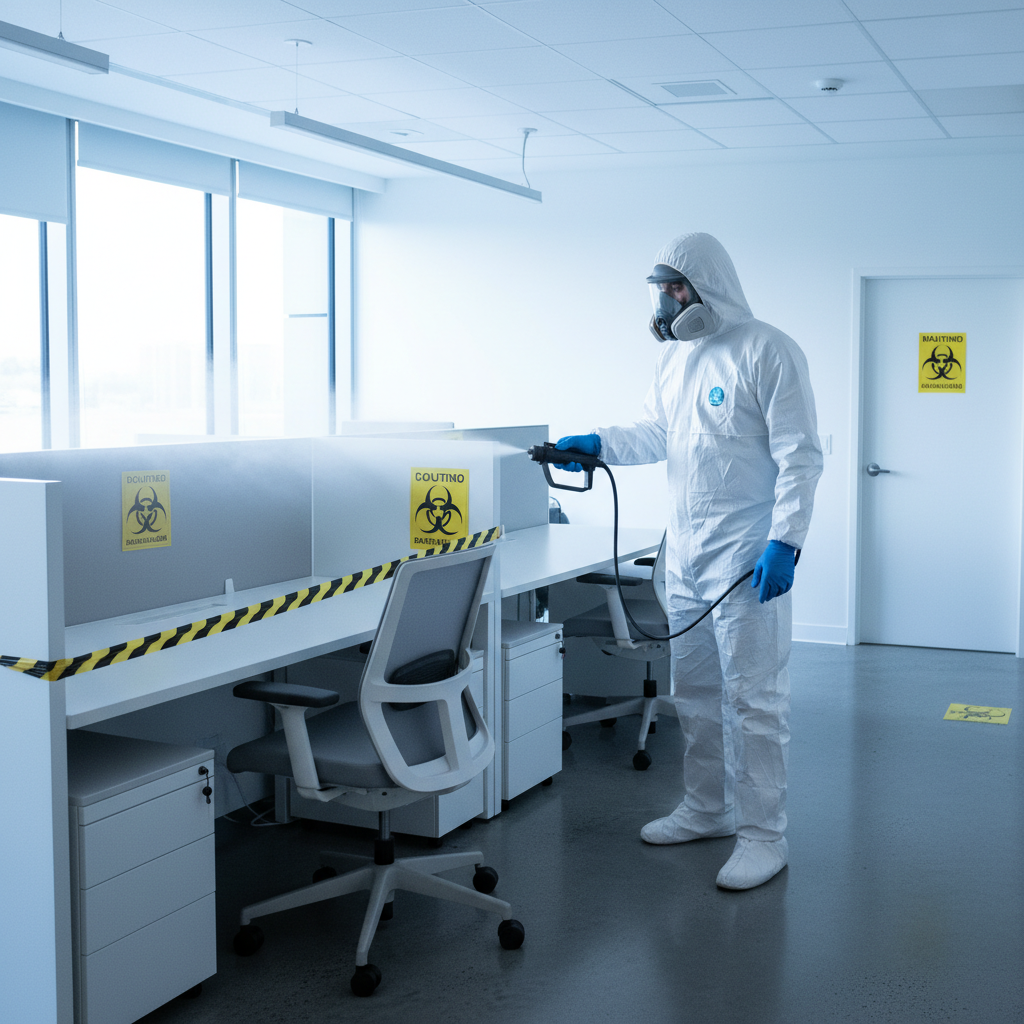
Professional infectious disease cleanup is required whenever a workplace incident involves bloodborne pathogens (OSHA 29 CFR 1910.1030), C. difficile or norovirus outbreaks that resist standard disinfection, tuberculosis exposure in enclosed spaces, or any contamination that exceeds your staff's training and PPE capabilities. For a single COVID-positive employee in an office, enhanced routine cleaning with EPA-registered disinfectants is typically sufficient — but healthcare facilities, food service operations, and schools face stricter requirements.
- When Professional Cleanup Is Required vs. Routine Cleaning
- OSHA Requirements for Infectious Disease Cleanup
- How Long Do Pathogens Survive on Surfaces?
- EPA-Approved Disinfection Methods
- Industry-Specific Requirements
- The Professional Cleanup Process
- Cost Ranges by Facility Size and Type
- Liability Considerations for Businesses
- Frequently Asked Questions
When an employee tests positive for a contagious illness or a facility experiences an outbreak, the first question is almost always: Do we need to hire a professional? The answer depends on the pathogen involved, your industry, the scope of contamination, and what federal and state regulations actually require. Getting it wrong can mean OSHA citations, liability exposure, or — worst case — ongoing transmission that shuts your business down.
This guide breaks down exactly when professional infectious disease cleanup is legally required, when enhanced in-house cleaning is sufficient, and how to make the right call for your specific situation.
When Professional Cleanup Is Required vs. Routine Cleaning
Not every exposure requires a hazmat team. The decision depends on the pathogen, the setting, and the scale of contamination. Here is a decision matrix to help you determine the right response:
| Scenario | Routine Cleaning | Enhanced Disinfection | Professional Required |
|---|---|---|---|
| Single COVID-positive employee (office) | ✗ | ✓ Sufficient | ✗ |
| COVID outbreak (5+ cases, shared HVAC) | ✗ | Maybe | ✓ Recommended |
| Norovirus in food service facility | ✗ | ✗ | ✓ Required |
| C. difficile contamination | ✗ | ✗ | ✓ Required |
| MRSA in gym/locker room | ✗ | If minor | ✓ If outbreak |
| Bloodborne pathogen exposure | ✗ | ✗ | ✓ Required (OSHA) |
| TB exposure in enclosed space | ✗ | ✗ | ✓ Required |
| Hepatitis B/C contamination | ✗ | ✗ | ✓ Required (OSHA) |
| Flu/cold in standard office | ✓ Sufficient | ✗ | ✗ |
OSHA Requirements for Infectious Disease Cleanup
OSHA does not have a single "infectious disease cleanup" standard. Instead, several overlapping regulations create a framework that employers must follow. Violating any of these can result in citations ranging from $16,131 per serious violation to $161,323 for willful or repeated violations (2024 penalty amounts).
Bloodborne Pathogens Standard (29 CFR 1910.1030)
This is the most directly relevant standard for infectious disease cleanup. It applies to any employer with workers who have reasonably anticipated exposure to blood or other potentially infectious materials (OPIM) — including healthcare, emergency response, dental offices, laboratories, mortuary services, drug treatment facilities, and janitorial staff.
Key requirements:
- Written Exposure Control Plan — must be reviewed and updated annually [1910.1030(c)(1)]
- Decontamination schedule — written procedures for cleaning based on location, surface type, soil type, and tasks performed [1910.1030(d)(4)(i)]
- Immediate cleanup — contaminated surfaces must be decontaminated after contact with blood/OPIM, when visibly contaminated, and at end of shift [1910.1030(d)(4)(ii)(A)]
- PPE at no cost — gloves, masks, eye protection, and gowns as needed [1910.1030(d)(3)]
- Regulated waste handling — closable, puncture-resistant, leak-proof, labeled containers [1910.1030(d)(4)(iii)]
- Annual training for all employees with potential exposure [1910.1030(g)(2)]
| OSHA Standard | Requirement | Industries Affected | Penalty (Serious) |
|---|---|---|---|
| 1910.1030 | Bloodborne Pathogen exposure control, cleanup, PPE, training | Healthcare, labs, janitorial, emergency response, dental, mortuary | Up to $16,131 |
| 1910.132 | PPE hazard assessment, provision, and training for all hazards | All general industry | Up to $16,131 |
| 1910.134 | Respiratory protection program, fit testing, medical evaluation | Any employer requiring respirators (TB, airborne pathogens) | Up to $16,131 |
| 1910.141 | General sanitation — workplace kept clean, proper waste disposal | All permanent workplaces | Up to $16,131 |
| 1910.1020 | Exposure records preserved 30 years, employee access to records | All employers with toxic/biological agent exposure | Up to $16,131 |
| General Duty Clause §5(a)(1) | Employer must provide workplace free from recognized hazards | All employers — catch-all for pathogens not covered by specific standards | Up to $16,131 |
The General Duty Clause
Even when no specific standard applies — such as a large-scale respiratory illness outbreak in a non-healthcare setting — OSHA can cite employers under the General Duty Clause (Section 5(a)(1) of the OSH Act). This requires employers to provide a workplace "free from recognized hazards that are causing or are likely to cause death or serious physical harm." A known outbreak that an employer fails to address adequately is a textbook General Duty violation.
How Long Do Pathogens Survive on Surfaces?
Understanding pathogen survival times is essential for determining cleanup urgency and method. Research published in BMC Infectious Diseases and the Journal of Hospital Infection documents how long common infectious agents remain viable on typical workplace surfaces:
| Pathogen | Hard Surfaces (Plastic, Steel) | Porous Surfaces (Fabric, Paper) | Risk Level |
|---|---|---|---|
| C. difficile (spores) | Up to 5 months | Up to 5 months | ⚠ Extreme |
| MRSA | Weeks to months | Days to weeks | ⚠ Very High |
| Hepatitis B (HBV) | Up to 7 days | Up to 7 days | ⚠ Very High |
| Norovirus | Up to 4 weeks | Up to 12 days | ⚠ Very High |
| SARS-CoV-2 (COVID-19) | Up to 72 hours | Up to 24 hours | Moderate |
| Influenza A/B | 24–48 hours | 8–12 hours | Moderate |
| Tuberculosis (M. tuberculosis) | Up to 4 months | Weeks | ⚠ Very High |
| VRE (Vancomycin-resistant Enterococcus) | Up to 4 months | Days to weeks | ⚠ Very High |
| Acinetobacter | Up to 5 months | Days | ⚠ Very High |
| RSV (Respiratory Syncytial Virus) | Up to 6 hours | 30–45 minutes | Lower |
Sources: Kramer et al., BMC Infectious Diseases (2006); van Doremalen et al., New England Journal of Medicine (2020); CDC Environmental Infection Control Guidelines.
EPA-Approved Disinfection Methods
The EPA maintains specific lists of registered antimicrobial products proven effective against different pathogens. Using products not on these lists may leave your facility inadequately disinfected — and could expose you to liability.
| EPA List | Target Pathogen | Common Active Ingredients | Typical Contact Time | Professional Grade? |
|---|---|---|---|---|
| List N | SARS-CoV-2 (COVID-19) | Quaternary ammonium, hydrogen peroxide, sodium hypochlorite | 1–10 minutes | Available retail & professional |
| List G | Norovirus | Sodium hypochlorite (bleach), hydrogen peroxide | 1–10 minutes | Professional recommended |
| List H | MRSA & VRE | Quaternary ammonium, phenolics, sodium hypochlorite | 3–10 minutes | Available retail & professional |
| List K | C. difficile spores | Sodium hypochlorite (bleach at 5,000+ ppm), peracetic acid | 5–10 minutes | Professional strongly recommended |
| List B | Tuberculosis (M. tuberculosis) | Phenolics, sodium hypochlorite, glutaraldehyde | 10+ minutes | Professional required |
| List S | Bloodborne pathogens (HIV, HBV, HCV) | Sodium hypochlorite, quaternary ammonium, iodophors | 1–10 minutes | Professional required (OSHA) |
Professional-Grade Methods
Certified infectious disease cleanup companies use methods that go beyond spray-and-wipe disinfection:
- Electrostatic spraying — charges disinfectant droplets so they wrap around surfaces and reach hidden areas. Covers 3x the area in the same time as manual wiping.
- Hydrogen peroxide vapor (HPV) — fills enclosed rooms with vaporized H₂O₂ that kills 99.9999% of pathogens including C. diff spores. Gold standard for healthcare decontamination.
- UV-C germicidal irradiation — supplemental treatment that destroys pathogen DNA/RNA on exposed surfaces. Used after manual cleaning, not as a standalone method.
- HEPA-filtered negative air machines — create negative pressure containment during cleanup of airborne pathogens like TB, preventing cross-contamination to adjacent spaces.
- ATP bioluminescence testing — post-cleanup verification that measures biological contamination levels on surfaces. Provides objective, documented proof of decontamination.
Industry-Specific Requirements
Beyond OSHA's baseline standards, different industries face additional regulatory requirements that often mandate professional cleanup:
CMS Conditions of Participation require documented infection control programs. Joint Commission standards mandate environmental cleaning protocols with measurable outcomes.
- Terminal cleaning between patients
- Sporicidal agents for C. diff rooms
- EPA List B products for TB exposure
- Professional decontamination after outbreaks
Failure = loss of Medicare/Medicaid reimbursement
FDA Food Code and state health departments require professional decontamination after confirmed norovirus or hepatitis A outbreaks in food handling areas.
- Mandatory closure during active outbreaks
- Third-party verification before reopening
- EPA List G (norovirus) products required
- Health department inspection post-cleanup
Failure = license suspension, lawsuits
State licensing requirements and CDC school guidance recommend professional decontamination for outbreaks of norovirus, pertussis, measles, and MRSA in school settings.
- Enhanced cleaning during flu season
- Professional cleanup for vomiting/diarrhea incidents
- Notification requirements to parents/staff
- Documentation for state licensing inspections
Failure = licensing action, parental lawsuits
State health codes and brand standards typically require professional decontamination after guest illness reports, particularly for norovirus and bedbugs.
- Room isolation and professional cleaning after reported illness
- Cruise ship-level protocols for norovirus (CDC VSP)
- HVAC decontamination for Legionella
- Documentation for insurance and liability
Failure = health violations, brand damage, lawsuits
The Professional Cleanup Process
Understanding what a certified infectious disease cleanup involves helps you evaluate whether your in-house team can handle the situation or if you need to bring in specialists:
Technicians identify the pathogen, assess the scope of contamination, and establish containment zones. For airborne pathogens (TB, measles), negative air pressure systems are deployed. Affected areas are sealed off with plastic sheeting.
Crew dons pathogen-appropriate PPE (Tyvek suits, N95/P100 respirators, face shields, double gloving). Visible contamination sources (bodily fluids, contaminated materials) are removed and placed in regulated waste containers per OSHA 1910.1030(d)(4)(iii).
All surfaces are cleaned to remove organic matter, then treated with EPA-registered disinfectants from the appropriate list (N, G, H, K, B, or S depending on the pathogen). Contact times are strictly observed — wiping too early renders the disinfectant ineffective.
Depending on the pathogen and facility type, advanced methods are deployed: electrostatic spraying for large areas, hydrogen peroxide vapor (HPV) for enclosed rooms, and UV-C for supplemental surface treatment. HVAC systems may be treated if airborne transmission is a factor.
ATP bioluminescence testing or environmental swab cultures verify decontamination. The company provides a Certificate of Decontamination documenting the pathogen targeted, methods used, EPA products applied, and test results. This documentation is critical for OSHA compliance, insurance claims, and liability protection.
Cost Ranges by Facility Size and Type
Professional infectious disease cleanup costs vary significantly based on facility size, pathogen type, contamination scope, and geographic location. Use these ranges for budgeting, and try our cost calculator for a more specific estimate:
| Facility Type | Small (<2,000 sq ft) | Medium (2,000–10,000 sq ft) | Large (10,000+ sq ft) |
|---|---|---|---|
| Office / Coworking Space | $500–$2,000 | $2,000–$6,000 | $5,000–$15,000 |
| Restaurant / Food Service | $1,000–$3,000 | $3,000–$8,000 | $8,000–$20,000 |
| Healthcare / Medical Office | $1,500–$4,000 | $4,000–$12,000 | $10,000–$35,000 |
| School / Childcare | $800–$2,500 | $2,500–$8,000 | $7,000–$20,000 |
| Hotel / Hospitality (per floor) | $1,200–$3,500 | $3,500–$10,000 | $8,000–$25,000 |
| Gym / Fitness Center | $600–$2,000 | $2,000–$6,000 | $5,000–$15,000 |
| Warehouse / Industrial | $400–$1,500 | $1,500–$5,000 | $4,000–$12,000 |
Costs include labor, EPA-registered chemicals, PPE, regulated waste disposal, and certification documentation. C. difficile and TB decontamination typically run 25–50% higher due to specialized sporicidal agents and extended protocols. Emergency/after-hours service adds 20–40%.
Liability Considerations for Businesses
Inadequate infectious disease response creates significant legal and financial exposure. Courts have increasingly held businesses liable for negligent infection control:
Employer Liability
- OSHA penalties — up to $16,131 per serious violation, $161,323 for willful violations. Repeat violations multiply quickly.
- Workers' compensation claims — employees who contract illness due to inadequate workplace decontamination can file claims. Documented professional cleanup is your best defense.
- Negligence lawsuits — failure to follow CDC and OSHA guidelines after a known exposure can establish negligence per se in many jurisdictions.
- ADA considerations — immunocompromised employees may have standing to demand enhanced cleaning under reasonable accommodation requirements.
Documentation as Protection
Professional cleanup companies provide documentation that serves as legal armor:
✓ Essential Cleanup Documentation
Under OSHA 1910.1020, employers must retain exposure and medical records for 30 years. Keeping professional cleanup documentation indefinitely is strongly recommended for liability protection.
Frequently Asked Questions
Find Certified Infectious Disease Cleanup Near You
Compare quotes from vetted, certified companies in your area. All providers in our directory carry proper insurance, OSHA training documentation, and EPA-compliant equipment.