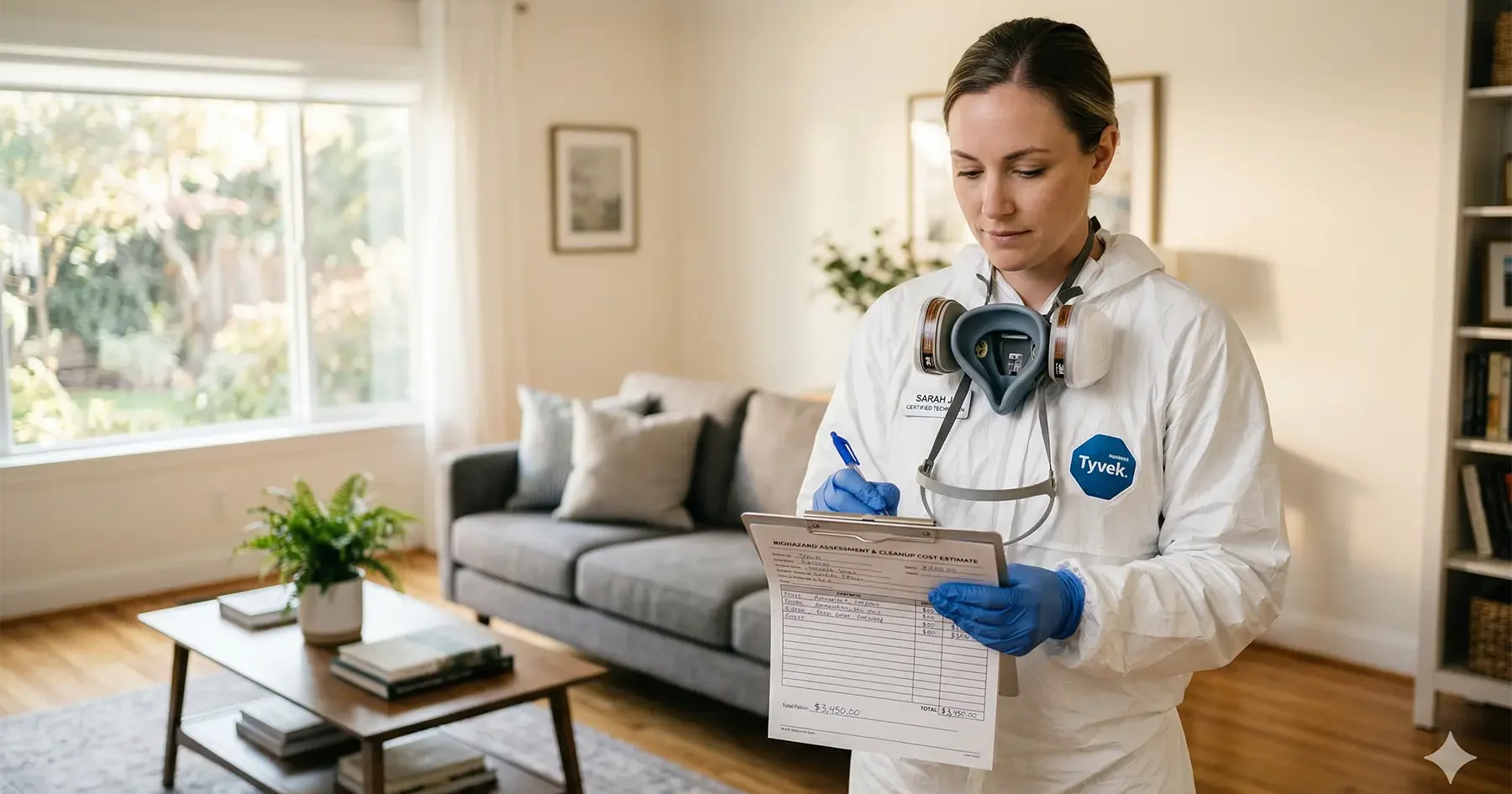
You called three biohazard cleanup companies and got quotes of $1,800, $4,200, and $6,500, for the same job. That spread isn't unusual. Biohazard cleanup pricing isn't arbitrary, but it does depend on a combination of factors that aren't always explained upfront.
This guide breaks down exactly how cleanup costs are calculated, walks through five real scenarios with worked estimates, and shows you how to account for what insurance covers, what financial assistance may be available, and whether your situation qualifies for a tax deduction.
If you want to skip ahead and run the numbers for your specific situation, use our free biohazard cleanup cost calculator. It takes about 60 seconds and generates a downloadable estimate you can send directly to your insurance adjuster.
The Four Variables That Determine Your Cost
Every biohazard cleanup estimate comes down to four things:
1. Service Type
The type of cleanup required is the biggest single factor. Crime scene cleanup (where a relatively small area may be affected) starts around $500 and typically runs $2,000-$6,000. Fentanyl decontamination of an entire structure, on the other hand, often runs $8,000-$20,000 or more because of the specialized testing required and the invisible nature of the contamination.
The baseline cost ranges for the most common services:
- Crime scene cleanup: $2,000-$6,000 typical
- Unattended death / decomposition: $3,000-$8,000 typical
- Suicide cleanup: $2,000-$7,000 typical
- Hoarding cleanup: $2,500-$8,000 typical
- Meth lab remediation: $5,000-$15,000 typical
- Fentanyl decontamination: $8,000-$20,000 typical
2. Size of the Affected Area
The area involved can cut a quote in half or double it. A single small room (bathroom, closet) reduces the base estimate by about 50%. A whole-home remediation can push the cost 2-2.5× the baseline for a standard room.
| Area Size | Cost Multiplier |
|---|---|
| Single small room (bathroom, closet) | 0.5× |
| Single large room (living room, garage) | 0.75× |
| 2-3 rooms | 1.0× (baseline) |
| 4+ rooms | 1.6× |
| Whole home or building | 2.2× |
3. Severity of Contamination
A mild situation (surface-level contamination, limited biological material) can cost 35% less than a moderate-severity job. Extreme contamination (heavy biological presence, long exposure time, or widespread chemical contamination) can push costs to 2× the baseline.
| Severity | Cost Multiplier |
|---|---|
| Mild: surface-level, contained | 0.65× |
| Moderate: visible, standard cleanup | 1.0× (baseline) |
| Severe, heavy, material replacement likely | 1.5× |
| Extreme, structural remediation needed | 2.0× |
4. Surface Types
Non-porous surfaces (tile, sealed concrete) can be thoroughly cleaned and disinfected without removal. Porous materials (carpet, unsealed wood, drywall) absorb biological matter and often must be removed entirely. If contamination has reached the subfloor, wall cavities, or insulation, costs jump significantly.
| Surface Type | Cost Multiplier |
|---|---|
| Hard / non-porous (tile, sealed concrete) | 0.8× |
| Mixed surfaces | 1.0× (baseline) |
| Mostly porous (carpet, unsealed wood) | 1.3× |
| Structural involvement (subfloor, drywall, insulation) | 1.8× |
The math is straightforward: multiply your service's base range by the size, severity, and surface multipliers. The examples below show exactly how this plays out in practice.
Five Real Scenarios With Worked Estimates
Scenario 1: Crime Scene: Bathroom, Mild, Tile
Situation: A crime occurred in a small bathroom. The contamination is surface-level and limited to tile and sealed grout. The property is a personal residence.
- Base range (crime scene cleanup): $2,000-$6,000
- Size (single small room): × 0.5
- Severity (mild): × 0.65
- Surfaces (non-porous tile): × 0.8
- Combined multiplier: 0.5 × 0.65 × 0.8 = 0.26
- Estimated range: $500-$1,600
Insurance: Homeowners insurance typically covers 65-90% of this type of loss, so out-of-pocket is likely $50-$560.
Scenario 2: Unattended Death: Bedroom, Severe, Carpet
Situation: A person was not discovered for several days. The affected area is a large bedroom with wall-to-wall carpet. The property is a rental.
- Base range (unattended death): $3,000-$8,000
- Size (single large room): × 0.75
- Severity (severe: heavy decomposition, likely carpet removal): × 1.5
- Surfaces (porous carpet): × 1.3
- Combined multiplier: 0.75 × 1.5 × 1.3 = 1.46
- Estimated range: $4,400-$11,700
Insurance: Landlord policies cover decomposition losses, typically 55-90%. Out-of-pocket may be $440-$5,265.
Tax note: As a rental property, cleanup costs are fully deductible as a business expense on Schedule E. Keep all invoices.
Scenario 3: Suicide, Living Room With Drywall Damage
Situation: Cleanup is needed in a living room where a firearm was involved. Contamination has penetrated drywall and the area behind it. The property belongs to a recently deceased estate.
- Base range (suicide cleanup): $2,000-$7,000
- Size (single large room): × 0.75
- Severity (moderate): × 1.0
- Surfaces (structural involvement: drywall affected): × 1.8
- Combined multiplier: 0.75 × 1.0 × 1.8 = 1.35
- Estimated range: $2,700-$9,500
Insurance: Most homeowners policies cover this at 60-85%. Out-of-pocket estimated at $405-$3,800.
VOCA: Some states include suicide in their crime victim compensation programs. Check your state's program.
Tax note: Estate cleanup expenses may be deductible as estate administration costs, consult an estate attorney.
Scenario 4: Meth Lab, Whole House, Extreme
Situation: A landlord discovered that tenants had been operating a meth lab. Testing confirmed contamination throughout the property, including the HVAC system. Full remediation and third-party clearance testing are required.
- Base range (meth lab cleanup): $5,000-$15,000
- Size (whole property): × 2.2
- Severity (extreme, structural and HVAC involved): × 2.0
- Surfaces (mixed, some structural involvement): × 1.0
- Combined multiplier: 2.2 × 2.0 × 1.0 = 4.4
- Estimated range: $22,000-$66,000
Insurance: Standard personal policies often exclude drug-manufacturing damage. Landlord policies vary: check your policy's exclusions. Some commercial umbrella policies cover this loss. Estimated coverage: 15-45%.
Tax note: As a rental property, documented remediation costs are deductible on Schedule E, which partially offsets the out-of-pocket cost.
Scenario 5: Hoarding Cleanup, 4+ Rooms, Severe
Situation: A family home requires full hoarding cleanup after a relative's passing. Animal waste and mold are present throughout four rooms. The property is going through estate settlement.
- Base range (hoarding cleanup): $2,500-$8,000
- Size (4+ rooms): × 1.6
- Severity (severe (animal waste, mold present): × 1.5
- Surfaces (mostly porous) carpet, upholstery): × 1.3
- Combined multiplier: 1.6 × 1.5 × 1.3 = 3.12
- Estimated range: $7,800-$25,000
Insurance: Hoarding is rarely covered by standard policies unless a separately covered event (like water damage) is involved. Out-of-pocket is likely the full amount.
The Three Numbers That Really Matter
The total estimate is only part of the picture. What you actually need to plan around is:
- The total estimated cost, what contractors will bill
- What your insurance will likely cover, based on your policy type and the type of incident
- Your out-of-pocket exposure, what you'll actually pay
Most families focus only on the first number and are blindsided by the third. Our cost calculator outputs all three side-by-side so you can plan accurately, and generates a formatted worksheet you can hand to your insurance adjuster on the same day you call.
Financial Assistance You May Not Know About
If the incident was a crime (homicide, assault, or in many states, suicide), you may qualify for state victim compensation funds under the federal VOCA (Victims of Crime Act) program. These funds are specifically designed to cover cleanup and remediation costs for crime victims and their families.
Key facts about VOCA victim compensation:
- Available in all 50 states and DC
- Does not require the offender to be caught or convicted
- Can cover cleanup costs that insurance won't
- Most families who qualify never apply because they don't know it exists
Our calculator automatically flags whether your situation may qualify, and links to a state-by-state victim compensation resource guide.
If It's a Rental or Business Property
Biohazard cleanup costs for rental properties, commercial properties, and estate properties are generally tax deductible:
- Rental property: Fully deductible as a rental business expense on Schedule E
- Business property: Fully deductible as an ordinary business expense on Schedule C or your corporate return
- Estate property: May be deductible as an estate administration expense, consult an estate attorney
For a personal residence, the 2017 Tax Cuts and Jobs Act significantly limited casualty loss deductions. In most cases, cleanup costs for a personal home are not tax deductible unless the property is located in a federally declared disaster area.
The calculator detects your property type and shows the applicable tax note automatically, along with a reminder to keep all documentation.
Get Your Personalized Estimate
The scenarios above are useful starting points, but your actual cost depends on the specifics of your situation. Our free biohazard cleanup cost calculator lets you enter your exact variables in about 60 seconds and returns:
- Your estimated cost range
- What insurance typically covers for your situation
- Your estimated out-of-pocket cost
- Whether you may qualify for victim compensation funds
- Tax deductibility information if applicable
- A downloadable PDF-ready worksheet formatted for insurance adjusters
Once you have your estimate, you can request free quotes from verified cleanup companies in your area and compare them against the expected range.