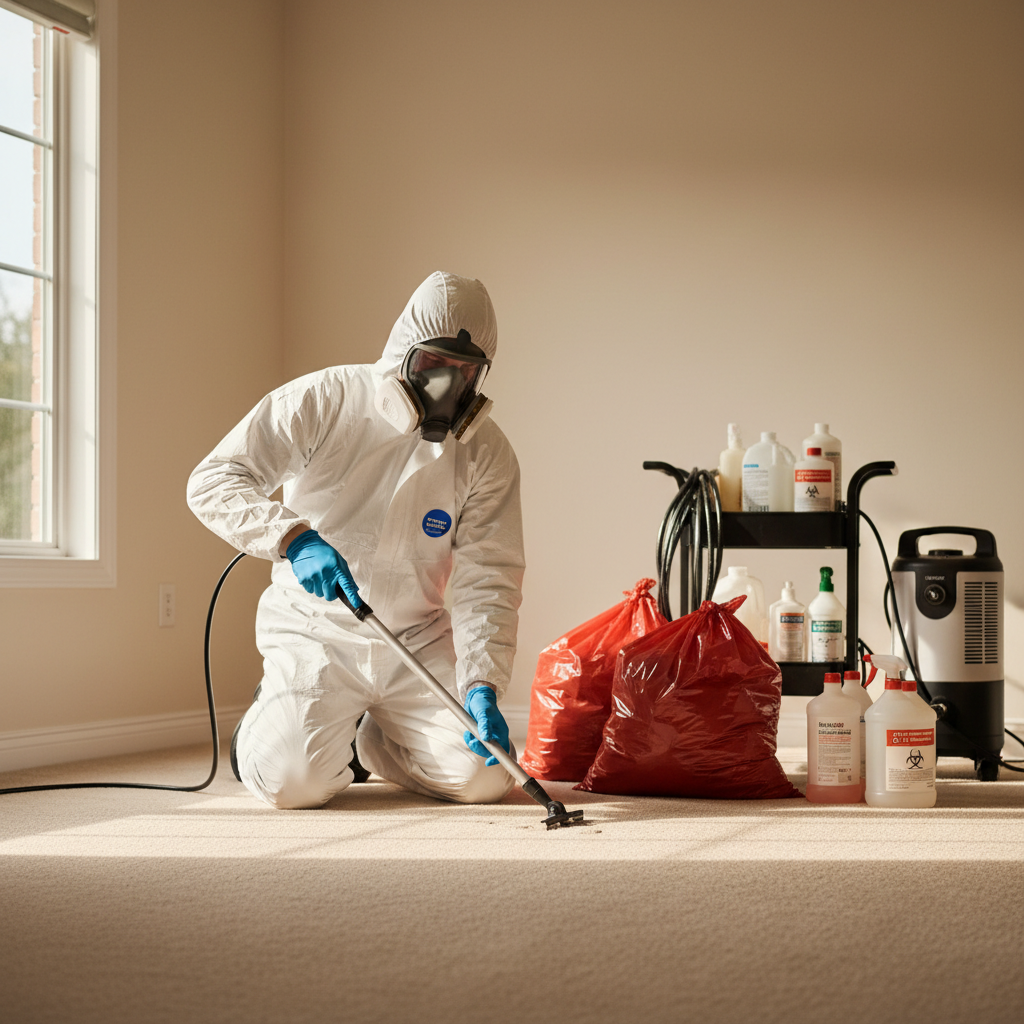
Crime scene cleanup costs between $1,500 and $25,000, with most jobs falling in the $3,000–$5,000 range. Homeowners and renters insurance typically covers biohazard remediation after a covered event, and all 50 states operate victim compensation programs funded by the federal Victims of Crime Act (VOCA) that may reimburse cleanup costs. You should never attempt to clean a crime scene yourself—OSHA’s Bloodborne Pathogens Standard (29 CFR 1910.1030) classifies blood and bodily fluids as regulated waste requiring professional handling.
Average Crime Scene Cleanup Costs in 2026
The national average for crime scene cleanup is approximately $4,000, though costs vary dramatically based on the type of incident and extent of contamination. Minor blood cleanup from a small area may cost as little as $1,500, while a severe homicide or unattended death requiring structural demolition and reconstruction can exceed $25,000.
Most crime scene cleanup companies charge between $150 and $600 per hour, with a typical crew of two to three technicians. A straightforward job may take 4–6 hours, while complex scenes with decomposition or multi-room contamination can require 2–3 full days.
ⓘ Get multiple quotes. Reputable companies provide free on-site estimates. Use our interactive cost estimator for a quick ballpark, then request quotes from certified companies in your area.
Cost Breakdown by Scenario Type
The type of incident is the single biggest factor in what you’ll pay. Here’s what to expect for the most common scenarios:
| Scenario | Typical Cost Range | Average | Timeline |
|---|---|---|---|
| Minor blood cleanup (accident, injury) | $500–$2,500 | $1,200 | 2–4 hours |
| Assault / violent altercation | $1,500–$4,000 | $2,500 | 4–8 hours |
| Homicide (handgun) | $2,000–$6,000 | $3,500 | 6–12 hours |
| Homicide (shotgun/rifle) | $3,000–$10,000 | $6,000 | 8–24 hours |
| Suicide | $2,500–$15,000 | $5,000 | 6–24 hours |
| Unattended death (recent, 1–3 days) | $2,000–$5,000 | $3,500 | 6–12 hours |
| Unattended death (advanced decomposition) | $5,000–$15,000 | $8,000 | 1–3 days |
| Multi-room / extensive scene | $8,000–$25,000 | $12,000 | 2–5 days |
Source: Aggregated from industry pricing data including Fixr.com, HomeGuide, Aftermath Services, and Bio Recovery (2025–2026).
⚠ Decomposition scenes cost significantly more. As one industry expert explains, “The extraction of decomposed organic material costs more than the extraction of blood. A shotgun suicide or a week-plus unattended death will typically be much more than a handgun homicide, with cost driven by two things: labor and personal protective equipment.”
Factors That Affect Crime Scene Cleanup Pricing
Understanding what drives costs helps you evaluate quotes and plan financially. Here are the key variables:
| Factor | Impact on Cost | Details |
|---|---|---|
| Size of affected area | ↑↑↑ Major | Measured by square footage, number of rooms, and vertical vs. horizontal spread. Larger areas = more labor, materials, and disposal. |
| Type of biohazard | ↑↑↑ Major | Blood only is less costly than decomposition fluids, which require more intensive remediation and odor treatment. |
| Structural penetration | ↑↑ Significant | Blood/fluids soaking into subfloor, concrete, drywall, or framing requires demolition and reconstruction ($3–$10/sq ft for flooring, $5,000–$20,000+ for full room rebuild). |
| Time since incident | ↑↑ Significant | Blood oxidizes and bonds to surfaces. Decomposition worsens exponentially, especially in warm weather. |
| Hazardous materials present | ↑ Moderate | Tear gas, pepper spray residue, fingerprint dust, or drug contamination add specialized cleaning steps. |
| Geographic location | ↑ Moderate | Higher cost-of-living areas (NYC, SF, LA) have higher rates. Rural areas may have travel surcharges. |
| After-hours / emergency response | ↑ Moderate | Weekend, holiday, or middle-of-the-night calls may carry a 15–30% premium. |
| Waste disposal requirements | ↑ Moderate | All biohazardous waste must be transported and disposed of at licensed facilities per state and federal regulations. |
Does Insurance Cover Crime Scene Cleanup?
In most cases, yes. The majority of homeowners insurance policies cover biohazard cleanup and remediation when the contamination results from a covered event such as a crime, suicide, unattended death, or medical emergency. You’ll typically pay your deductible ($500–$2,500) and insurance covers the remainder.
According to Aftermath Services, one of the nation’s largest biohazard remediation companies, “Most major homeowners insurance policies will cover the costs of crime cleanup or remediation services,” including not only the cleaning itself but also “any repairs or replacement of structural elements—flooring, carpet and pad, baseboards, drywall—that must be removed as part of the bioremediation and decontamination process.”
Coverage by Policy Type
| Policy Type | Crime Scene Cleanup | Structural Repairs | Key Notes |
|---|---|---|---|
| Homeowners (HO-3) | ✓ Usually covered | ✓ Usually covered | Typically under dwelling or “other structures” coverage. Deductible applies. |
| Renters (HO-4) | ✓ Often covered | ✗ Landlord’s responsibility | May cover personal property damage and temporary relocation (loss of use). |
| Landlord / Dwelling Fire | ✓ Usually covered | ✓ Usually covered | Property owner files the claim. Tenant’s belongings are not covered. |
| Commercial Property | ✓ Usually covered | ✓ Usually covered | May also cover lost income during cleanup under business interruption. |
| Condo (HO-6) | ✓ Often covered | Partial (unit interior) | HOA master policy may cover common areas. Check both policies. |
⚠ Watch for exclusions. Suicides or crimes committed by household members may be excluded from coverage. Self-inflicted injuries are sometimes treated differently. Always contact your insurance adjuster (not your agent) to confirm coverage before work begins—adjusters are more familiar with policy details.
Tips for Filing an Insurance Claim
For a detailed walkthrough of the claims process, see our Insurance Coverage Guide for Biohazard Cleanup.
State Victim Compensation Programs (VOCA)
If you or a family member is the victim of a violent crime, you may be eligible for financial assistance through your state’s Crime Victim Compensation Program. Every state, the District of Columbia, the U.S. Virgin Islands, and Puerto Rico operate victim compensation programs, and most are partially funded by the federal Victims of Crime Act (VOCA) through the Office for Victims of Crime (OVC).
According to the OVC, the federal government reimburses states for up to 75% of the amount they award to victims, creating a strong incentive for states to cover a broad range of crime-related expenses—including crime scene cleanup.
ⓘ A growing number of states explicitly cover crime scene cleanup. While coverage varies, the trend is expanding. States like New York, California, Ohio, Pennsylvania, Indiana, and North Carolina have specific provisions for cleanup reimbursement. See our state-by-state VOCA guide for full details.
State-by-State Victim Compensation Overview
| State | Program Max Award | Crime Scene Cleanup | Notable Details |
|---|---|---|---|
| California | $70,000 | ✓ Covered | Derivative victims (family members) eligible. Administered by CalVCB. |
| Texas | $50,000 | ✓ Covered | Includes cleanup of residence where crime occurred. Apply via Texas AG office. |
| New York | $30,000 | ✓ Up to $2,500 | Recent law change: anyone responsible for cleanup can seek reimbursement, not just residents. |
| Florida | $25,000 | ✓ Covered | Bureau of Victim Compensation under Florida AG. |
| Pennsylvania | $35,000 | ✓ Covered | Covers “reasonable and necessary costs” of cleaning blood, bodily fluids, and crime scene debris from a private residence. |
| Ohio | $50,000 | ✓ Covered | Administered by Ohio Court of Claims. Includes cleanup, repairs, and evidence replacement. |
| Illinois | $27,000 | ✓ Covered | Includes crime scene cleanup and securing the property. |
| Indiana | $15,000 | ✓ Covered | Crime scene cleanup eligible for crimes after July 1, 2022. Includes window/lock replacement. |
| North Carolina | $30,000 | ✓ Covered | Must use a certified biohazard cleanup company. Includes door/lock/window repair. |
| Michigan | $25,000 | ✓ Covered | Michigan Crime Victims Compensation Commission. |
| Georgia | $25,000 | ✓ Covered | Criminal Justice Coordinating Council administers claims. |
| Virginia | $25,000 | ✓ Covered | Workers’ Compensation Commission handles claims. |
| Washington | $50,000 | ✓ Covered | Department of Labor & Industries Crime Victims Program. |
| Colorado | $30,000 | ✓ Covered | Administered through judicial districts. |
| Arizona | $25,000 | ✓ Covered | Arizona Criminal Justice Commission. |
| Massachusetts | $25,000 | ✓ Covered | Attorney General’s Victim Compensation Division. |
| New Jersey | $25,000 | ✓ Covered | Victims of Crime Compensation Office. |
| Tennessee | $25,000 | ✓ Covered | Criminal Injuries Compensation Fund. |
| Maryland | $45,000 | ✓ Covered | Criminal Injuries Compensation Board. |
| Wisconsin | $40,000 | ✓ Covered | Crime Victim Compensation Program, Dept. of Justice. |
Note: Maximum award limits represent the total cap across all compensable expenses (medical, mental health, lost wages, funeral, cleanup, etc.), not a standalone limit for cleanup alone. Some states set separate sub-limits for specific categories. Contact your state’s program for exact cleanup-specific limits.
How to Apply for Victim Compensation
Payment Options & Financial Assistance
If insurance and victim compensation don’t fully cover your costs, you still have options:
📝 Payment Plans
Many crime scene cleanup companies offer interest-free payment plans or financing. Ask about this before work begins. Some will work with you on extended terms if you have a pending insurance or victim compensation claim.
📝 Nonprofit Assistance
Organizations like the National Compassion Fund and local victim advocacy groups sometimes provide grants for crime-related expenses. Your state’s victim advocate (usually through the DA’s office) can connect you with local resources.
📝 Property Owner Responsibility
If you’re a tenant, the property owner is typically responsible for structural remediation and restoring the unit to a habitable condition. Your landlord’s insurance should cover the structural cleanup.
📝 Civil Recovery
In many states, you can pursue civil action against the perpetrator to recover cleanup costs. This is a longer-term option, but it’s worth discussing with an attorney, especially for significant expenses.
Why Is Crime Scene Cleanup So Expensive?
Crime scene cleanup isn’t regular cleaning—it’s a highly regulated, specialized remediation service. Here’s what drives the cost:
Federal regulatory compliance. OSHA’s Bloodborne Pathogens Standard (29 CFR 1910.1030) requires that all blood and other potentially infectious materials (OPIM) be treated as regulated waste. Workers must have documented training, written exposure control plans, hepatitis B vaccinations, and access to post-exposure medical evaluation. Every crew member wears full PPE: Tyvek suits, respirators, eye protection, and double-layered nitrile gloves.
Hazardous waste disposal. Contaminated materials cannot go in a regular dumpster. As the EPA notes, all potentially infectious biomedical waste must be “packaged to prevent exposure,” labeled, transported by licensed haulers, and treated via incineration, autoclaving, or chemical disinfection before final disposal. These disposal costs alone can run hundreds to thousands of dollars per job.
Specialized equipment and chemicals. Professional-grade ATP testing, enzyme-based cleaners, hospital-grade disinfectants registered with the EPA, ozone generators, hydroxyl generators, HEPA air scrubbers, and thermal foggers are standard equipment. This isn’t a mop-and-bucket operation.
Health risks. The CDC identifies HIV, hepatitis B (HBV), and hepatitis C (HCV) as the three most significant bloodborne pathogens. According to CDC data, hepatitis C can survive on dry surfaces for up to 6 weeks. Cleanup technicians face occupational exposure risks that are reflected in insurance premiums, training requirements, and hazard pay.
Liability and insurance. Reputable companies carry general liability, pollution liability, and workers’ compensation insurance. These policies are expensive in the biohazard remediation industry, and that cost is passed through in pricing.
How to Reduce Your Out-of-Pocket Cost
Frequently Asked Questions
The property owner is almost always responsible for cleanup costs. If you’re a homeowner, that means you (but your insurance likely covers it). If you’re a tenant, your landlord is responsible for structural remediation. The perpetrator of the crime is not billed directly by cleanup companies, though you may pursue civil recovery later. Victim compensation programs exist specifically to help offset this burden for crime victims.
You should not. Beyond the serious health risks—the CDC warns that bloodborne pathogens like hepatitis C can survive on surfaces for up to 6 weeks—DIY cleanup can void your insurance claim, expose you to legal liability, and result in incomplete remediation. OSHA classifies blood and bodily fluids as regulated waste requiring specific handling, containment, and disposal procedures. Professional cleanup ensures the space is genuinely safe to occupy.
As soon as law enforcement releases the scene—ideally within 24–48 hours. Blood oxidizes and bonds to porous surfaces within hours. In warm conditions, decomposition accelerates rapidly, causing contamination to penetrate subfloors, drywall, and structural materials. Every day of delay increases the scope and cost of remediation. Most professional companies offer 24/7 emergency response.
Usually, yes. Most standard homeowners policies (HO-3) cover biohazard cleanup resulting from crimes, suicides, unattended deaths, and medical emergencies. Coverage typically includes both the remediation itself and structural repairs (carpet, subfloor, drywall). You’ll pay your deductible, and insurance covers the rest. Contact your insurance adjuster to confirm your specific coverage. See our insurance coverage guide for details.
Every state operates a Crime Victim Compensation Program, funded in part by federal VOCA dollars through the Office for Victims of Crime. These programs reimburse victims of violent crimes for out-of-pocket expenses including crime scene cleanup. You’ll need a police report and documentation of expenses. Most states have a 1–3 year filing deadline. Visit our state-by-state guide or the OVC directory to find your state’s program.
Yes. Reputable companies provide free on-site assessments and written estimates before any work begins. They should also be able to tell you whether your situation is likely covered by insurance or victim compensation, and help you navigate the claims process. Be wary of any company that pressures you to commit before providing a written estimate.
Look for companies with OSHA Bloodborne Pathogens training (required by federal law), proper state licensing for biohazard waste transport and disposal, and liability and pollution insurance. Industry certifications from organizations like ABRA (American Bio Recovery Association) or IICRC indicate additional professionalism. The company should also be able to provide proof of workers’ compensation insurance for their crew.
Possibly, but not always. A single claim for a crime that occurred at your property—where you are the victim—is unlikely to result in a significant premium increase with most insurers. The cost of cleanup ($3,000–$10,000+) almost always outweighs a potential premium increase. If you’re concerned, ask your adjuster about the impact before filing. Either way, don’t let premium concerns delay necessary biohazard remediation.
Find Certified Crime Scene Cleanup Companies Near You
Get connected with licensed, insured biohazard remediation professionals in your area. Compare quotes, verify certifications, and get help with insurance claims.