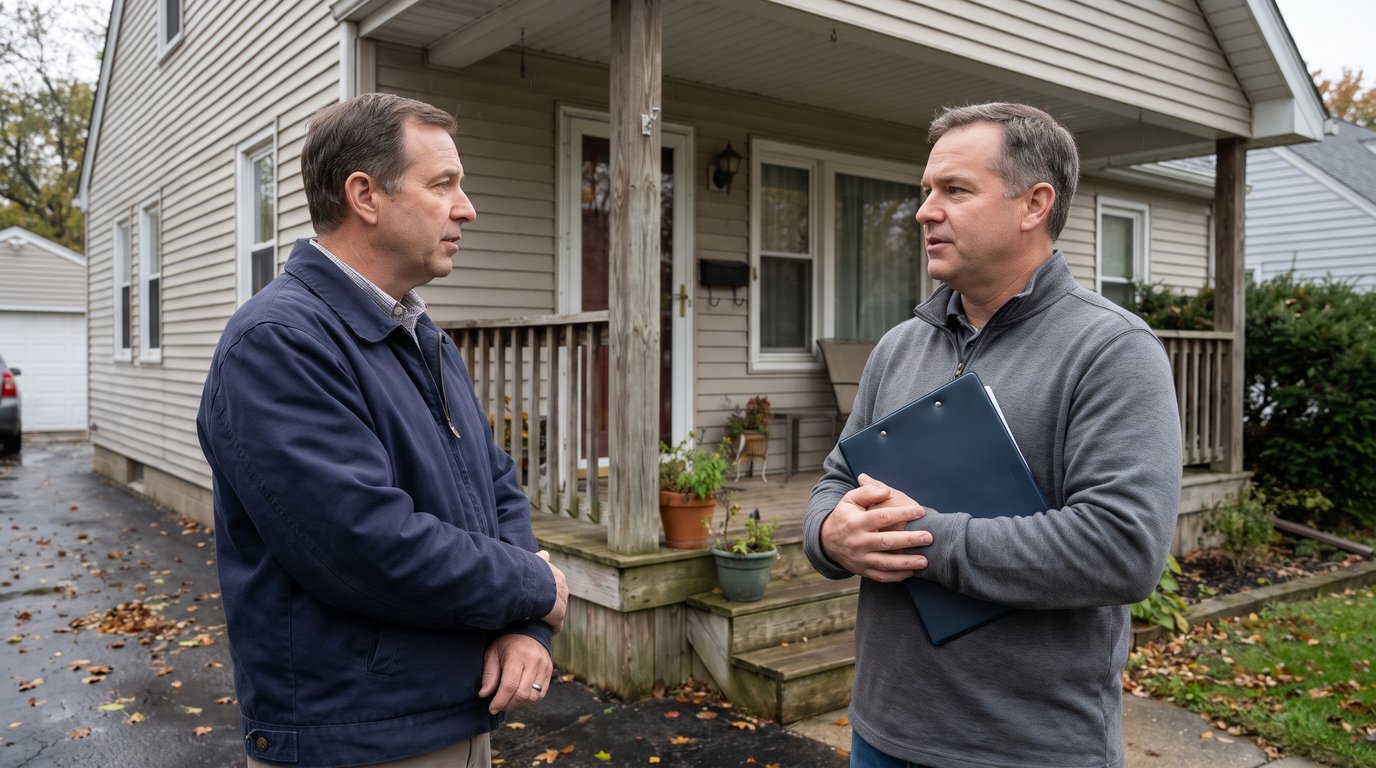
Adjusters approve what they can justify on paper: an itemized estimate plus the photos and records behind each line, sent before anyone asks for them. Where the policy covers the loss, a cleanup company can bill the carrier for the covered portion and collect the deductible from the homeowner. If you want the insurer to pay you directly, a direction to pay asks it to; an assignment of benefits transfers the claim benefits to you. Check state law first: Florida voids post-loss assignments on residential policies issued on or after January 1, 2023, and Louisiana bars soliciting or accepting them.
What a homeowners policy usually pays for
Coverage depends on the policy wording, and no state regulator we found has issued guidance on biohazard cleanup specifically. What you can work from is the structure of the most common form, the ISO HO-3. The Maryland Insurance Administration describes it this way: it "provides open peril coverage on the building and other structures," and "named-peril coverage for the contents of your home."
For a cleanup company, that split matters. Work on the structure, such as removing affected drywall or flooring, is tested against the policy's exclusions. Work on contents, such as cleaning a mattress or a couch, has to fit one of the listed perils. Expect more questions on the contents lines, and write them up separately so a denial of one does not hold up the rest.
Our insurance coverage guide and biohazard insurance claims guide explain coverage to homeowners in plain terms. Send families there before the first call with their carrier.
The records adjusters want
Timothy Hull, writing in R&R Magazine in 2019 about collecting from carriers, put it bluntly: "Items like moisture readings, daily site reports, employee rosters, and subcontractor bills are pretty standard today and necessary support to justify payment." And: "If you aren't already sending this information without a request, you're just asking for a delay in payment."
A biohazard claim packet
Hull's other advice costs nothing: ask the adjuster, "How would you like to see this presented in the estimate?" Carriers differ, and the answer saves a round of revisions.
On Levelset's public Q&A, one homeowner says a remediation company started work with no estimate, and the bill came to $7,200 against the $2,500 they expected. Another says a mitigation company's bill tripled from the estimate the insurer had approved, and the adjuster advised them not to pay the new invoice. Both homeowners were asking whether the company could file a lien. A written estimate signed before work starts prevents that fight.
Direct billing vs the homeowner paying first
With direct billing, you send the estimate and records to the carrier and work the claim with the adjuster, and the homeowner pays the deductible and anything the policy does not cover. With homeowner billing, the family pays you and files for reimbursement. Direct billing is easier on a grieving family, but the payment timeline is the carrier's, not yours.
Even with direct billing, the check may not be yours alone. The New Jersey Department of Banking and Insurance says claim checks "will likely be made payable jointly to you (the customer), and the mortgagee," and that some customers "receive the insurance funds in installments as the repair work progresses." The standard HO-3 form says the same in its own words: if a mortgagee is named in the policy, loss under Coverage A or B (the dwelling and other structures) "will be paid to the mortgagee and you, as interests appear." Ask at the start whether the home has a mortgage, and put the lender's name in your file.
Our job SOP, dispatch to walkthrough places this paperwork at step 5, before the crew starts.
Direction to pay vs assignment of benefits
These two forms get confused, and in two states the difference decides whether the paper is valid at all.
| Direction to pay | Assignment of benefits (AOB) | |
|---|---|---|
| What it does | Asks the insurer to pay the contractor directly, or to add the contractor as a payee on the check | Transfers the policyholder's post-loss claim benefits to the contractor |
| Who holds the claim | The policyholder stays the claimant | The contractor holds the assigned benefits and can sue the insurer to collect them |
| Defined in law? | No statute we found defines it | Yes, in Florida 627.7152 and Louisiana 22:1275 |
| Florida, residential policies issued on or after Jan. 1, 2023 | Risky if paired with any transfer of benefits (see below) | "void, invalid, and unenforceable" |
| Louisiana | Check with a Louisiana attorney | "null and void"; soliciting one is an unfair trade practice |
Florida
Section 627.7152(13) says a policyholder "may not assign, in whole or in part, any post-loss insurance benefit under any residential property insurance policy or under any commercial property insurance policy," for policies issued on or after January 1, 2023, and that any attempt "is void, invalid, and unenforceable." The law's definition of an assignment agreement reaches "any instrument by which post-loss benefits" are "assigned or transferred, or acquired in any manner, in whole or in part, to or from a person providing services," a list that includes "restoring" property and "mitigating against further damage to the property."
A direction to pay is not automatically safe. In January 2025, Florida's Fifth District Court of Appeal looked at a homeowner who signed a "Direction of Payment" telling the insurer to pay his roofer directly, then assigned his claim benefits to a company that was not a contractor, with any payment to follow the direction. Because the money had to pass through to the roofer, the court held that this "mandatory passthrough of benefits" placed the assignment "within the broad reach of section 627.7152," and the assignment was invalid because it did not meet that statute's requirements. The court did not rule on a direction to pay used alone. If you work in Florida, have a Florida attorney review your form before you use it.
Louisiana
Louisiana R.S. 22:1275 says: "A person shall not solicit or accept an assignment, in whole or in part, of any post-loss insurance benefit under a residential or commercial property insurance policy." An assignment agreement "is against public policy and is null and void," and a violation "is considered an unfair or deceptive trade practice."
When the number comes back low
Start with the cheapest fix and work up.
Low numbers often come from missing lines or missing proof. Send a supplement with the photo, the quantity and the receipt for each line the adjuster cut. Ask which lines were cut and why, in writing.
A public adjuster works for the policyholder, not you, and takes a share of the claim. Texas caps the fee: "Public adjusters can charge up to 10% of the total amount the company will pay for your claim." Florida caps it at 10% for claims on a declared state of emergency made within a year of the declaration, and 20% for all other claims, including emergency claims after that year, under section 626.854.
The standard HO-3 form says that if the two sides "fail to agree on the amount of loss, either may demand an appraisal of the loss." Each side picks an appraiser within 20 days, the two appraisers choose an umpire, and "A decision agreed to by any two will set the amount of loss." Appraisal settles the amount only. The Texas Supreme Court said "the scope of appraisal is damages, not liability." It will not turn a denied claim into a paid one.
Your own options are narrower: the claim belongs to the policyholder, and without a valid assignment you have no standing to sue the insurer on it. What you can always do is make the file so complete that the adjuster has nothing to cut.
Victim compensation as a second payer
After a violent crime, the state's crime victim compensation program may cover part of the cleanup. Do not count on it to fill a large gap. Cleanup limits are often far lower than the program's overall award limit:
| State | Crime scene cleanup limit | Source |
|---|---|---|
| Pennsylvania | $500 per crime scene | Pennsylvania Victims Compensation Assistance Program |
| Ohio | $750 per claim | R.C. 2743.51(T)(2) |
| California | $1,709 | California Victim Compensation Board |
| Texas | $2,250 | Texas Attorney General, crimes after July 14, 2016 |
Programs also tend to pay after insurance, not alongside it. The Texas Attorney General asks for "Proof that homeowners' or renters' insurance does not apply or has been exhausted." Our victim compensation table lists the cleanup limit for every state, including the states whose programs do not list cleanup at all.
The best time to meet an adjuster is before a claim. Our guide to delivering a capabilities sheet to adjusters covers the visit, and our page for insurance adjusters shows what they see when they look up a cleanup company.
Frequently Asked Questions
What is a direction to pay?
A direction to pay is a signed instruction from the policyholder asking the insurer to pay the contractor directly, or to add the contractor as a payee on the claim check. No statute we found defines it. It is different from an assignment of benefits, which transfers the claim benefits to the contractor.
Is a direction to pay legal in Florida?
Florida's assignment statute, section 627.7152, does not mention it. A Florida appeals court in 2025 held that an assignment requiring payment to follow a direction of payment to the homeowner's roofer was covered by the state's assignment statute, and was invalid because it did not meet that statute's requirements. The court did not rule on a direction to pay used alone. Have a Florida attorney review any form before you use it on a residential job.
Can a contractor take an assignment of benefits in Florida?
Not for post-loss benefits under residential or commercial property policies issued on or after January 1, 2023. Section 627.7152(13) makes such an assignment "void, invalid, and unenforceable."
Does homeowners insurance cover biohazard cleanup?
It depends on the cause and the policy wording. The common HO-3 form covers the building on an open-peril basis and contents only for named perils. Our insurance coverage guide covers the details for homeowners.
How much do public adjusters charge?
Fees vary by state. Texas caps the fee at 10% of what the insurer pays. Florida caps it at 10% for emergency-declared events in the first year and 20% otherwise.
What does an appraisal clause decide?
Only the amount of loss. Each side picks an appraiser, the two pick an umpire, and agreement by any two sets the amount. Whether the loss is covered is a separate question.
Sources: Florida Statutes 627.7152 (2026); Holding Insurance Companies Accountable v. American Integrity, Fla. 5th DCA, 5D2023-2810 (January 3, 2025); Louisiana R.S. 22:1275; ISO HO 00 03 05 11 homeowners form, Maine Bureau of Insurance copy; Maryland Insurance Administration, homeowners insurance guide; New Jersey Department of Banking and Insurance, insurance proceeds and your mortgage; R&R Magazine, Ways to Avoid Accounts Receivable Battles with Insurance Carriers (Timothy Hull, February 6, 2019); Texas Department of Insurance, public adjusters; Florida Statutes 626.854 (2026); State Farm Lloyds v. Johnson, Texas Supreme Court (2009); Ohio R.C. 2743.51; Pennsylvania Commission on Crime and Delinquency, Victims Compensation manual (2025); California Victim Compensation Board, crime scene cleanup providers; Texas Attorney General, crime scene cleanup reimbursement; Levelset Q&A, mitigation bill vs approved estimate; Levelset Q&A, remediation with no estimate.
Let adjusters and families find you first
List your cleanup company free on BioCleaners Directory. People searching your area call you directly.