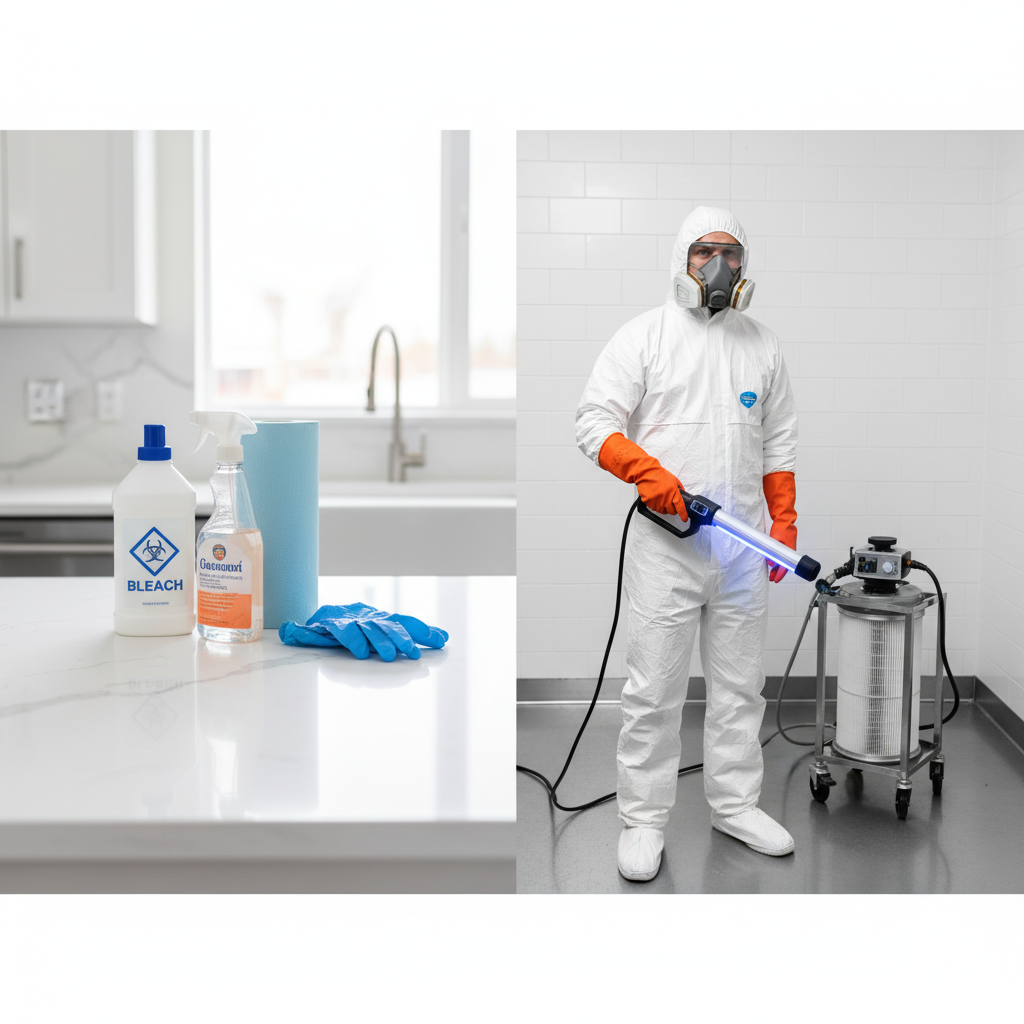
Small blood spills from a known, healthy source on a hard surface — think a nosebleed, a kitchen cut, or a child’s scraped knee — can be safely cleaned at home with disposable gloves, soap and water, and a 1:10 bleach solution. Everything else requires more caution. Blood from an unknown source, blood that has soaked into carpet or wood, blood in a workplace, or any volume larger than what a few paper towels can handle moves into territory where professional biohazard cleanup is either legally required or the only safe option. The decision comes down to three factors: whose blood it is, how much there is, and what surface it’s on.
Decision Flowchart: DIY or Call a Pro?
Use this decision table to quickly determine whether a blood cleanup situation is safe to handle yourself. Start at the top and work down — the first “No” answer means you should call a professional.
| Question | If Yes | If No |
|---|---|---|
| Do you know whose blood it is? | Continue to next question ↓ | ✗ Call a professional. Unknown blood = Universal Precautions apply. Treat as potentially infectious. |
| Is the person known to be free of bloodborne diseases? | Continue to next question ↓ | ✗ Call a professional. Known or suspected HIV, Hep B, or Hep C requires certified decontamination. |
| Is the blood on a non-porous surface? (tile, sealed concrete, metal, glass, laminate) | Continue to next question ↓ | ✗ Call a professional. Blood in carpet, wood, grout, fabric, or mattress cannot be reliably disinfected. |
| Can a few paper towels absorb all of it? (roughly < 2 tablespoons) | Continue to next question ↓ | ✗ Call a professional. Larger volumes increase pathogen load and surface penetration risk. |
| Is this a residential setting? (not a workplace, school, or public facility) | Continue to next question ↓ | ✗ Follow OSHA BBP protocols. Workplace blood cleanup is regulated by 29 CFR 1910.1030. |
| Are there NO sharps present? (no broken glass, needles, or sharp objects) | ✓ Safe for DIY cleanup with proper PPE and disinfection (see steps below). | ✗ Call a professional. Sharps increase needlestick/puncture risk dramatically. |
If you are hesitating on any of these questions, err on the side of caution. The risk of bloodborne pathogen exposure is not something you can undo. A professional blood cleanup for a small area typically costs $500–$1,500 — far less than the medical costs and anxiety of a potential Hepatitis B or C exposure.
Blood Volume Thresholds
The amount of blood matters more than most people realize. Volume determines pathogen load, surface penetration depth, and whether cleanup requires professional-grade equipment.
| Volume | Examples | DIY Safe? | Key Considerations |
|---|---|---|---|
| A few drops (< 1 tsp) | Paper cut, small scrape, nosebleed drip | ✓ Yes | Minimal pathogen load. Gloves + bleach solution handles this easily. |
| Small spill (1 tsp – 2 tbsp) | Moderate nosebleed, kitchen knife cut, child’s injury | ✓ Yes (known source, hard surface) | Use the full 6-step DIY protocol. More surface area to disinfect. |
| Moderate spill (2 tbsp – 1 cup) | Deep laceration, significant wound, dental bleeding | ⚠ Caution | DIY possible on hard surfaces from known source with full PPE. Consider calling a pro for peace of mind. |
| Large volume (1 cup+) | Traumatic injury, major wound, surgical complication | ✗ No | High pathogen load. Likely surface penetration. Splash risk during cleanup. Professional cleanup recommended. |
| Pooled blood / saturation | Unattended death, violent crime, major trauma | ✗ No | Requires professional biohazard remediation. Material removal, structural decontamination, regulated waste disposal. |
How to Safely Clean Up Blood Yourself
For small spills that pass the decision flowchart above, follow this CDC-aligned protocol:
Put On Disposable Gloves
Nitrile exam gloves are preferred (no latex allergy risk). Put them on before touching anything. Even when cleaning your own blood, building this habit matters.
Absorb Visible Blood
Use disposable paper towels to blot (not wipe) the blood. Wiping spreads contamination over a larger area. Place used towels directly into a plastic bag as you go.
Clean the Surface with Soap and Water
This step removes organic material. It is essential because disinfectants are inactivated by blood proteins. If you skip this step and apply bleach directly to blood residue, the bleach attacks the blood proteins instead of disinfecting the surface — and the pathogens survive.
Apply Disinfectant and Wait
Apply a 1:10 bleach solution (1 part household bleach to 10 parts water) to the cleaned surface. The critical part: let it sit for at least 10 minutes. This contact time is what actually kills pathogens. Spraying and immediately wiping provides minimal disinfection.
Wipe and Dispose
After the 10-minute contact time, wipe up the bleach solution with fresh paper towels. Place all contaminated materials (towels, gloves, plastic sheeting) into the plastic bag. Seal the bag.
Final Cleanup
Remove gloves by peeling them off inside-out (this keeps contaminated surfaces contained). Place gloves in the sealed bag. Double-bag everything and dispose in an outdoor trash container. Wash hands with soap and warm water for at least 20 seconds — even though you wore gloves.
Mix bleach solutions fresh each time. Diluted bleach loses effectiveness over 24 hours due to chemical breakdown. Pre-mixed solutions sitting under your sink may not have sufficient concentration to kill bloodborne pathogens. The bleach itself should be standard household bleach with 5.25%–6.15% sodium hypochlorite — check the label.
Required Supplies for DIY Blood Cleanup
Having the right supplies on hand before a blood spill happens makes the difference between a safe cleanup and a panicked one. Here is what you need:
Essential (Must Have)
- Disposable nitrile gloves — at least 2 pairs (in case one tears)
- Household bleach — 5.25%–6.15% sodium hypochlorite, non-expired
- Paper towels — a full roll
- Plastic bags — sealable, heavy-duty
- Spray bottle — for mixing bleach solution
- Soap — any dish soap or hand soap
Recommended (Better Protection)
- Safety glasses or goggles — protects eyes from splash
- N95 mask — reduces inhalation risk
- Disposable shoe covers — prevents tracking contamination
- Enzyme-based cleaner — for blood on porous surfaces (as a supplement, not a substitute for professional help)
- Absorbent granules — for larger spills (solidifies liquid for easier pickup)
- Flashlight — blood splatters in hard-to-see places
Pre-assembled blood cleanup kits are available for $30–$120 and include disposable PPE, absorbent powder, disinfectant, red biohazard bags, and instructions. They are a good option for workplaces, vehicles, and homes where blood cleanup might be needed. However, a kit does not replace training or make porous-surface cleanup safe — it only equips you for small, hard-surface spills.
What Disinfectants Actually Work
Not all cleaning products kill bloodborne pathogens. Many popular household cleaners provide zero protection against HIV, Hepatitis B, or Hepatitis C. Here is what works and what does not:
| Product | Kills HIV? | Kills HBV? | Kills HCV? | Contact Time | Notes |
|---|---|---|---|---|---|
| Bleach (1:10 dilution, 5.25% NaOCl) | ✓ | ✓ | ✓ | 10 minutes | CDC gold standard. Must clean blood off first. Mix fresh daily. |
| EPA tuberculocidal disinfectants | ✓ | ✓ | ✓ | 5–10 min (per label) | Hospital-grade. Check EPA List S for specific products. |
| Accelerated hydrogen peroxide (0.5%+) | ✓ | ✓ | ✓ | 1–5 minutes | Professional formulations only. NOT standard 3% drugstore peroxide. |
| Phenolic disinfectants | ✓ | ✓ | ✓ | 10 minutes | Strong odor. Requires ventilation. |
| Isopropyl alcohol (70%) | ✓ | ⚠ Limited | ⚠ Limited | 10 minutes | Evaporates too fast for reliable contact time on surfaces. Not recommended for blood cleanup. |
| All-purpose cleaners (Lysol spray, Windex, etc.) | ✗ | ✗ | ✗ | N/A | Clean but do not disinfect against BBPs. Not on EPA List S. |
| Hydrogen peroxide (3% drugstore) | ⚠ Weak | ✗ | ✗ | N/A | Insufficient concentration. Bubbles on blood but does not kill HBV/HCV. |
| Hand sanitizer (on surfaces) | ✗ | ✗ | ✗ | N/A | Formulated for hands, not surfaces. Evaporates immediately. |
Spraying disinfectant directly onto blood does not work. The CDC explicitly states that germicides, including bleach, are “substantially inactivated in the presence of blood.” You must: (1) absorb and remove visible blood, (2) clean with soap and water, then (3) apply disinfectant to the cleaned surface. Skipping steps 1 and 2 means the pathogens survive regardless of which disinfectant you use.
The Porous Surface Problem
The single biggest factor that separates safe DIY cleanup from professional-only situations is surface porosity. Blood on a porous surface is fundamentally different from blood on a hard surface — and it cannot be handled the same way.
| Surface Type | Examples | DIY Disinfection Possible? | Why |
|---|---|---|---|
| Non-porous | Tile, sealed concrete, glass, stainless steel, laminate, sealed hardwood | ✓ Yes | Blood sits on the surface. Disinfectant makes full contact with contamination. |
| Semi-porous | Unsealed wood, grout lines, painted drywall | ⚠ Partial | Blood partially absorbs. Surface disinfection may not reach absorbed pathogens. Professional assessment recommended. |
| Porous | Carpet, carpet padding, unfinished wood, fabric, mattress, upholstery, insulation | ✗ No | Blood absorbs deep into material. Surface-applied disinfectant cannot reach absorbed pathogens. Material must be removed and replaced. |
| Sub-surface | Concrete subfloor under carpet, plywood subfloor, wall cavity behind drywall | ✗ No | Blood penetrates through top surface into structural materials. Requires professional remediation with possible structural demolition. |
This is why professional biohazard companies often need to remove carpet, padding, sections of subfloor, and even portions of drywall during blood cleanup. Surface cleaning leaves pathogens trapped in the material where they can remain infectious for days to weeks (HBV: 7+ days; HCV: up to 6 weeks).
When Professional Cleanup Is Mandatory
Certain situations always require professional biohazard cleanup, regardless of how confident you feel about DIY:
⚠ Always Call a Professional For:
OSHA Definitions: What Counts as a Biohazard
Understanding OSHA’s definitions helps clarify when blood crosses the line from “cleanup” to “biohazard remediation”:
| OSHA Term | Definition | What It Means for You |
|---|---|---|
| Blood | Human blood, human blood components, and products made from human blood | Any human blood, regardless of quantity, is regulated in a workplace context. |
| Other Potentially Infectious Materials (OPIM) | Semen, vaginal secretions, CSF, synovial fluid, pleural fluid, peritoneal fluid, pericardial fluid, amniotic fluid, saliva in dental procedures, any body fluid visibly contaminated with blood, unfixed human tissue | Blood mixed with other body fluids does not reduce the biohazard classification — it increases it. |
| Regulated Waste | Liquid/semi-liquid blood or OPIM; items caked with dried blood that can release material during handling; contaminated sharps; pathological waste | Contaminated cleanup materials (towels, gloves, absorbents) become regulated waste in workplace settings and require labeled, leak-proof disposal. |
| Exposure Incident | Specific contact with blood/OPIM through eyes, mouth, non-intact skin, or needle/sharp | Any blood contact during cleanup that reaches your eyes, mouth, or broken skin is a reportable exposure incident requiring medical follow-up. |
| Universal Precautions | Treating all human blood as if infectious for HIV, HBV, and HCV | You never assume blood is safe based on who it came from or how old it appears. |
OSHA’s BBP standard applies to employer-employee relationships, not homeowners cleaning their own homes. If you are cleaning up blood in your own home from a family member’s minor injury, OSHA does not regulate you. However, the science behind OSHA’s requirements still applies — the same pathogens, the same survival times, the same disinfection requirements. Following OSHA protocols at home is smart practice, not legal obligation.
Cost Comparison: DIY vs. Professional
| Approach | Cost | What You Get | Limitations |
|---|---|---|---|
| DIY basic supplies (gloves, bleach, paper towels) | $10 – $30 | Surface disinfection of small spills on hard surfaces | No porous material remediation. No regulated waste disposal. No documentation. No post-cleanup verification. |
| Pre-assembled blood cleanup kit | $30 – $120 | PPE, absorbent powder, disinfectant, biohazard bags, instructions | Same limitations as basic DIY. Better equipped but same scope constraints. |
| Professional — small contained spill | $500 – $1,500 | OSHA-trained techs, EPA disinfectants, regulated waste removal, certificate of decontamination | Full remediation for the scope involved. |
| Professional — moderate area with porous materials | $1,500 – $5,000 | Material removal (carpet, padding), subfloor treatment, full disinfection, waste disposal, documentation | Full remediation for the scope involved. |
| Professional — large area / trauma scene | $3,000 – $12,000+ | Structural remediation, material demolition and replacement, HVAC check, post-remediation testing, insurance coordination | Full remediation for the scope involved. |
Most homeowner’s insurance policies cover professional blood cleanup for sudden, accidental events — crime scenes, traumatic injuries, and unattended deaths. Professional companies provide the documentation your insurer requires. Many families who attempt DIY cleanup to “save money” later discover they could have filed an insurance claim that covered the full cost of professional remediation. Check your policy before deciding.
Common DIY Mistakes That Create More Danger
Even well-intentioned DIY blood cleanup can go wrong. These are the mistakes professionals see most often — and the ones that lead to contamination, illness, or failed remediation:
⚠ Mistakes to Avoid
Frequently Asked Questions
How much blood is considered a biohazard?
From a scientific standpoint, any amount of human blood can potentially carry bloodborne pathogens. OSHA does not define a minimum volume threshold — under Universal Precautions, all human blood is treated as potentially infectious. In practical terms, most people draw the line at blood that exceeds what paper towels can easily absorb, blood from an unknown source, or blood on porous surfaces. Any of those conditions warrants professional assessment.
Can I clean up blood with just hot water?
No. Hot water can help remove the visible stain, but water alone — even boiling water — does not reliably kill bloodborne pathogens on environmental surfaces. You need a chemical disinfectant (bleach 1:10, or EPA-registered tuberculocidal product) with adequate contact time. Hot water is useful as part of the cleaning step (removing organic material before disinfecting), but it is not a substitute for disinfection.
Does hydrogen peroxide kill blood-borne diseases?
Standard 3% hydrogen peroxide from the drugstore does not reliably kill HBV or HCV. Professional-grade accelerated hydrogen peroxide products (0.5%+ in specialized formulations) are effective, but these are not the same as the brown bottle from the pharmacy. For DIY blood cleanup, stick with household bleach at a 1:10 dilution — it is more effective, more widely available, and cheaper.
Is it safe to clean up my own blood?
Generally yes. If you are cleaning your own blood from a minor injury on a hard surface, the infectious disease risk to you is zero (you cannot infect yourself with your own pathogens). Still, using gloves and bleach is good practice — it builds the habit of proper blood cleanup technique, and it ensures the surface is actually disinfected for anyone else who might contact it later.
What should I do if blood gets in my eyes during cleanup?
Flush your eyes immediately with clean running water or saline for at least 15 minutes. Then seek medical evaluation promptly. If the blood source is unknown or from a person with known bloodborne disease, inform the healthcare provider — post-exposure prophylaxis (PEP) for HIV should be started within 72 hours, and HBV treatment (HBIG) within 24 hours.
Can a landlord charge me for blood cleanup?
If the blood resulted from your actions or your guests’ actions (not a crime committed against you), the landlord may deduct professional cleanup costs from your security deposit or bill you for remediation. If the blood resulted from a crime you were a victim of, many states have victim compensation programs that cover cleanup costs — and some states prohibit landlords from charging crime victims for cleanup. Check your state’s victim compensation program.
How long is blood dangerous on a surface?
Hepatitis B remains infectious for at least 7 days on dry surfaces. Hepatitis C can survive up to 6 weeks at room temperature. HIV degrades within hours to days on surfaces but can survive up to 42 days in a syringe. The only way to make blood safe is proper disinfection — time alone is not enough. See our detailed guide on bloodborne pathogen survival times.
Sources: OSHA 29 CFR 1910.1030 — Bloodborne Pathogens Standard; CDC Guideline for Disinfection and Sterilization; EPA List S — Antimicrobial Products Effective Against Bloodborne Pathogens; CDC Hepatitis B Clinical Overview; Doerrbecker et al., J Infect Dis 2013 (PMC3969546).
Not Sure If It’s Safe to Clean Yourself?
When in doubt, get a professional assessment. BioCleaners Directory connects you with licensed biohazard cleanup companies who can evaluate the situation, handle the cleanup safely, and provide documentation for insurance claims. Free quotes, no obligation.