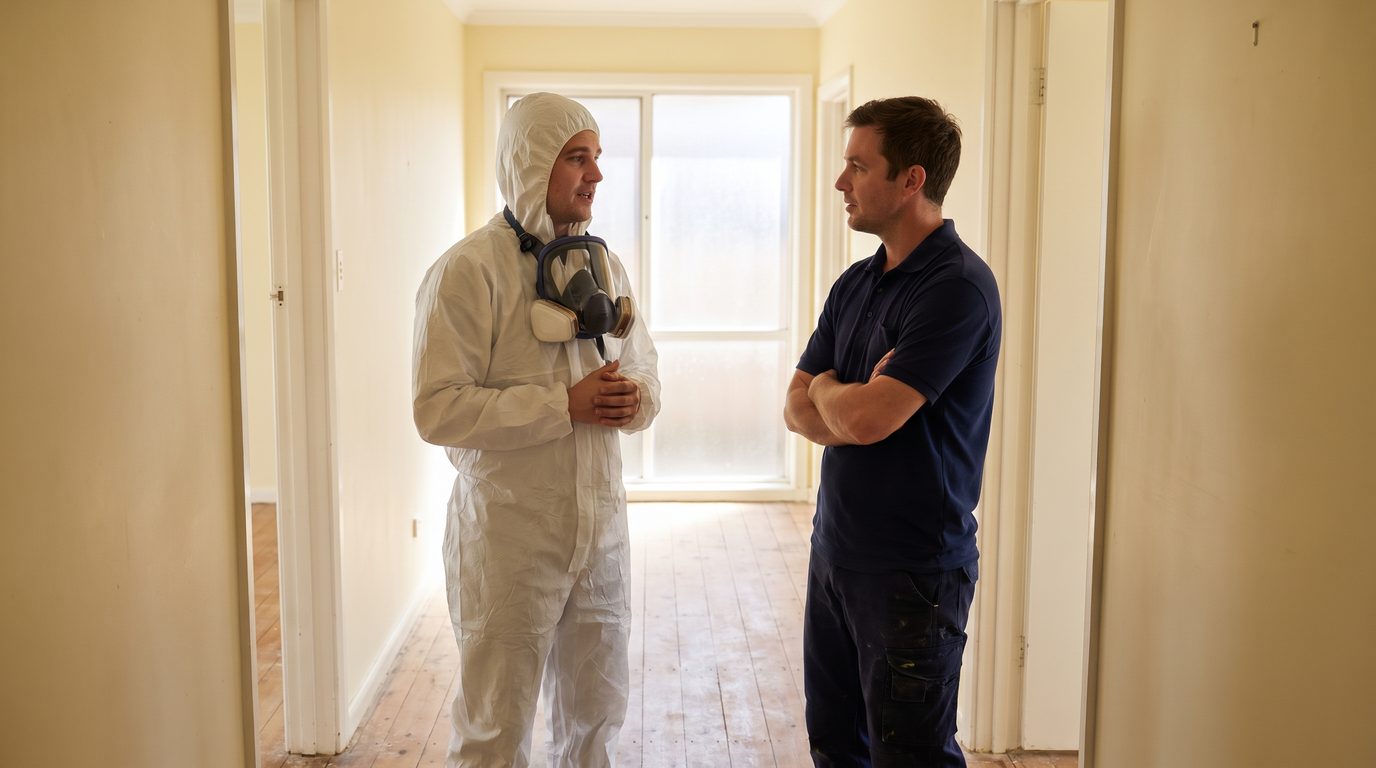
No, not for routine crime and trauma scene cleanup. In a 2019 letter to a biohazard remediation company, OSHA said HAZWOPER training applies "only to operations covered by the standard." For a home or business with no declared emergency, the rule that always applies is the Bloodborne Pathogens standard (29 CFR 1910.1030). HAZWOPER does apply when your crew works a declared hazardous-substance emergency or the post-emergency cleanup, or a site a government agency recognizes as an uncontrolled hazardous waste site. Separately, states such as Kentucky, Oregon and Washington require the 40-hour course for meth lab decontamination workers.
Crime scene cleanup certification: required vs sold
No federal license exists for crime scene cleanup. What OSHA requires is training tied to the hazards on the job, and for blood and body fluids that means the Bloodborne Pathogens standard. Training vendors sell much more than that, and some of their ads say HAZWOPER is mandatory for biohazard work. In a July 2024 R&R Magazine column, Barry Rice wrote that training ads "claim HAZWOPER training is needed for Biohazard/Crime Scene cleanup and fentanyl cleanup work."
For a remediation company cleaning with no emergency declared, OSHA's 2019 letter says it must follow the OSHA standards that apply to its work, and it names standards that may apply: personal protective equipment (1910.132), respiratory protection (1910.134), hazard communication (1910.1200) and, for workers exposed to blood, bloodborne pathogens (1910.1030).
| Training | Who requires it | When it applies |
|---|---|---|
| Bloodborne Pathogens (1910.1030) | Federal OSHA | Every job with blood or other potentially infectious materials. Annual refresher. |
| PPE (1910.132) | Federal OSHA | Whenever the hazard assessment calls for protective gear |
| Respiratory protection (1910.134) | Federal OSHA | Whenever a tech wears a respirator |
| Hazard communication (1910.1200) | Federal OSHA | Whenever crews use hazardous chemicals, including disinfectants |
| HAZWOPER 40 / 24 / 8-hour (1910.120) | Federal OSHA | Only operations inside its scope (next section) |
| State trauma scene registration | Some states, including California and Georgia | Crime and trauma scene cleanup in those states |
| State meth or drug lab credential | Some states | Drug lab decontamination in those states. Several require the 40-hour HAZWOPER course. |
| IICRC courses and the S540 standard | Voluntary industry standard | Not a legal requirement |
The five HAZWOPER scope paragraphs
HAZWOPER (29 CFR 1910.120) covers five kinds of work, listed in paragraph (a)(1). If a job fits none of them, HAZWOPER's training rules do not reach it. Here is each one, in the standard's words, with how often a biohazard company runs into it.
| Paragraph | What it covers | Biohazard company? |
|---|---|---|
| (a)(1)(i) | "Clean-up operations required by a governmental body..." at "uncontrolled hazardous waste sites" | Rarely: only at a site a government body has identified as an uncontrolled hazardous waste site |
| (a)(1)(ii) | "Corrective actions involving clean-up operations at sites covered by the Resource Conservation and Recovery Act" | Rarely |
| (a)(1)(iii) | "Voluntary clean-up operations at sites recognized by Federal, state, local or other governmental bodies as uncontrolled hazardous waste sites" | Sometimes: encampments an agency recognizes as hazardous waste sites (2021 letter). Kentucky's OSHA program also places former meth labs here. |
| (a)(1)(iv) | Operations at "treatment, storage, and disposal (TSD) facilities" | No, unless you run one |
| (a)(1)(v) | "Emergency response operations for releases of, or substantial threats of releases of, hazardous substances" | Only during a declared emergency |
One detail matters for this trade. The standard's definition of a hazardous substance includes "Any biological agent and other disease-causing agent." So blood can bring a job into HAZWOPER. What decides it is the type of operation, a covered site or a declared emergency response, not the type of mess.
What OSHA has said in writing
OSHA answers questions about its standards in letters of interpretation. Four of them settle this question.
A company that cleans up after homicides, suicides and unattended deaths asked whether the Bloodborne Pathogens standard covered its crews. OSHA's answer: "Yes, the Bloodborne Pathogens standard would be applicable to the cleanup work done by your employees." The letter does not mention HAZWOPER.
"The training requirements in OSHA's HAZWOPER standard apply only to operations covered by the standard." With no emergency declared, the letter points to PPE, respirators, hazard communication and bloodborne pathogens. It sends declared emergencies to paragraph (q)(6) and post-emergency cleanup to (q)(11).
With no emergency declared, "the remediation employer would need to comply with only those OSHA standards that apply to its operations." Contractors who arrive after the post-emergency workers have left, to do more cleanup, deep cleaning, repairs or demolition, "do not fall under the HAZWOPER standard," even when the work may still involve exposure to blood. The letter also says that where two standards overlap, "the provision that is more protective of employee health and safety applies."
This one goes the other way. Cleanup of homeless encampments "would fall under the scope of the HAZWOPER standard" under paragraph (a)(1)(iii) "if the site is recognized by a governmental body as an uncontrolled hazardous waste site." The letter counts biological agents as hazardous substances, "including blood."
Read together, the letters give one rule. A private client's home or business after a death, with no emergency declared, is a bloodborne pathogens job. A site a government agency has recognized as an uncontrolled hazardous waste site is a HAZWOPER job, even when the hazard is blood.
The rule that applies to every scene
The Bloodborne Pathogens standard "applies to all occupational exposure to blood or other potentially infectious materials." For a cleanup company, that is every trauma scene. Its core duties:
- A written Exposure Control Plan.
- Training when first assigned to tasks with exposure, and "At least annually thereafter."
- The hepatitis B vaccine offered "within 10 working days of initial assignment."
- PPE, labeling, regulated waste handling and post-exposure follow-up.
Our bloodborne pathogens compliance guide covers each duty in detail, and the OSHA 300 log guide covers recording needlesticks and exposures.
When HAZWOPER does apply
Four situations put a biohazard crew inside HAZWOPER:
- A declared emergency, or the cleanup right after it. Responding to a release, or a substantial threat of a release, of hazardous substances falls under paragraph (q)(6), per OSHA's 2019 letter. Post-emergency cleanup after the emergency is declared over falls under (q)(11). Crews who arrive after the post-emergency workers have left do not.
- A government-recognized hazardous waste site. Cleanup that a government body requires, or voluntary cleanup, at a site a government body has identified as an uncontrolled hazardous waste site, as in the 2021 encampment letter.
- Where bloodborne and HAZWOPER rules overlap. OSHA's 2020 letter, quoting the Bloodborne Pathogens standard's preamble, names three scenarios: cleanup at hazardous waste sites involving regulated waste, RCRA-permitted incinerators that burn infectious waste, and response to an emergency caused by an uncontrolled release of regulated waste, such as a transportation accident.
- Drug lab work where the state requires it. Covered next.
If the job is a residence or a business, the client hired you directly, neither the owner nor a government agency has declared an emergency, no agency has recognized the site as a hazardous waste site, and it is not a drug lab in a state that requires the course, none of these apply.
Meth and drug lab work
This is where HAZWOPER most often becomes a legal requirement for a cleanup company, through state law rather than federal OSHA. At least three states put it in writing:
| State | What the rule says |
|---|---|
| Kentucky | "Forty (40) hour HAZWOPER Certification for all personnel performing decontamination services" on meth-contaminated properties, plus annual 8-hour refresher certificates (401 KAR 101:010). Kentucky's Division of Waste Management says the state's OSHA program, KyOSH, "considers employers whose employees perform decontamination and/or cleanup work of former methamphetamine laboratories to fall under the scope of the required HAZWOPER certification." |
| Oregon | "All drug lab site workers and supervisors must have successfully completed at least 40 hours of OSHA-required" HAZWOPER training, plus a "current eight hour refresher" (Oregon Health Authority). |
| Washington | "Complete the forty-hour Hazardous Waste Operations (HAZWOPER) training" before the state's drug lab worker course (Department of Health). |
Where a state has no drug lab program, EPA's Voluntary Guidelines for Methamphetamine and Fentanyl Laboratory Cleanup (revised 2021) set the floor: "Contractors who have not been certified in a similar program should, at a minimum, complete the 40-hour HAZWOPER training." The guidelines are voluntary, but a client or a health department may hold you to them. Check the state rules before you bid. Our state licensing guide lists permits and contacts by state.
40-hour vs 24-hour vs 8-hour refresher
When HAZWOPER does apply, the hours depend on the role.
| Course | Who needs it | Rule |
|---|---|---|
| 40 hours off site + 3 days supervised field experience | General site workers at covered cleanup sites | 1910.120(e)(3)(i) |
| 24 hours off site + 1 day field experience | Workers on site only occasionally for a limited task, and regular workers in fully monitored areas below exposure limits where respirators are not needed. Anyone required to wear a respirator needs the full 40 hours. | 1910.120(e)(3)(ii)-(iv) |
| 8 hours every year | Everyone above, as a refresher | 1910.120(e)(8) |
| 8 hours (operations level, defensive) | Emergency responders who contain a release from a distance | (q)(6), per OSHA's 2019 letter |
| 24 hours (technician level, offensive) | Emergency responders who stop the release | (q)(6), per OSHA's 2019 letter |
The 40-hour course alone does not meet 1910.120(e)(3)(i). The standard also requires "a minimum of three days actual field experience" under a trained, experienced supervisor. An online certificate covers the classroom part only.
What IICRC S540 covers
ANSI/IICRC S540 is the industry's trauma and crime scene cleanup standard. The current version is the second edition, from 2023. It "assumes that all scenes have been released by law enforcement or regulatory agencies," and it sets procedures from inspection through waste disposal and confirmation of cleaning. The public summary of S540 says nothing about OSHA training hours. It is a voluntary industry standard, and it does not replace the OSHA rules above.
That makes IICRC training a good way to show clients and adjusters that you follow a published standard. It does not take the place of bloodborne pathogens training, and it does not make HAZWOPER apply.
Why vendors say HAZWOPER is required
The 40-hour course is a product, and "required" sells better than "sometimes required." Some training ads present the course as required for all biohazard and crime scene work, without pointing to the standard's scope paragraphs or OSHA's letters.
Buy it anyway if you take any of the work in the four situations above. Meth lab decontamination is the most common reason. Government-contracted encampment cleanup is another. If your work is residential and commercial trauma cleanup for private clients, spend the training budget on bloodborne pathogens, respiratory protection and your exposure control plan first.
Job type to training: a checklist
| Job | Always | Add HAZWOPER? |
|---|---|---|
| Unattended death, homicide or suicide in a private home | BBP, PPE, respirators if worn, hazard communication | No |
| Blood cleanup in a business, no emergency declared | Same | No |
| Homeless encampment cleanup for a city | Same | Yes, if the agency recognizes it as an uncontrolled hazardous waste site |
| Meth lab decontamination in KY, OR or WA | Same, plus the state credential | Yes, 40-hour plus annual refresher |
| Meth lab in a state with no program | Same | EPA guidelines say 40-hour at minimum |
| Responding to a declared hazardous-substance release | Same | Yes, under (q)(6) |
Our launch sequence guide puts permits, training and insurance in order. Once you are open, claim your free listing so families and property managers searching your area can call you directly.
Frequently Asked Questions
Is HAZWOPER required for biohazard cleanup?
Not for routine biohazard cleanup in homes and businesses. OSHA's 2019 and 2020 letters say a remediation company working with no declared emergency follows only the OSHA standards that apply to its work, such as bloodborne pathogens, PPE, respiratory protection and hazard communication. HAZWOPER applies to declared emergencies and the post-emergency cleanup that follows, government-recognized uncontrolled hazardous waste sites, and drug lab work in states that require it.
What certification do you need to be a crime scene cleaner?
No federal license exists. OSHA requires bloodborne pathogens training for anyone exposed to blood, plus PPE, respirator and hazard communication training where those apply. Some states, including California and Georgia, require trauma scene cleanup companies to register with the state, some license drug lab decontamination, and some require permits to haul medical waste.
How long does HAZWOPER certification last?
The standard sets no expiration date for the initial course, but 1910.120(e)(8) requires "eight hours of refresher training annually." OSHA says a worker who misses the refresher should take the next available course, and after a long lapse the employer decides case by case whether more retraining, up to repeating the initial course, is needed.
Does OSHA require certification for crime scene cleaners?
OSHA requires training, not a certification card. The Bloodborne Pathogens standard requires training when a worker is first assigned to tasks with exposure and "At least annually thereafter," and the employer has to keep training records for 3 years.
Is 24-hour HAZWOPER enough for meth lab cleanup?
Not in Kentucky, Oregon or Washington, which require the 40-hour course. In other states, EPA's voluntary guidelines name the 40-hour course as the minimum for contractors without a state certification.
Does HAZWOPER cover blood?
It can. The standard counts biological agents as hazardous substances, and OSHA's 2021 letter says that includes blood. What triggers HAZWOPER is the type of operation, such as a declared emergency response or cleanup at a site a government agency recognizes as an uncontrolled hazardous waste site.
Sources: OSHA letter of interpretation, May 22, 2007; OSHA letter of interpretation, Sept. 6, 2019; OSHA letter of interpretation, Dec. 15, 2020; OSHA letter of interpretation, July 30, 2021; 29 CFR 1910.120, HAZWOPER; 29 CFR 1910.1030, Bloodborne Pathogens; OSHA letter of interpretation, Mar. 12, 1993 (missed refreshers); Kentucky 401 KAR 101:010; Kentucky Energy and Environment Cabinet, meth lab contractor certification; California Department of Public Health, trauma scene waste practitioners; Georgia HB 417 (2020); Oregon Health Authority, drug lab contractors; Washington Department of Health, drug lab worker certification; EPA, Voluntary Guidelines for Methamphetamine and Fentanyl Laboratory Cleanup (revised August 2021); IICRC, ANSI/IICRC S540; R&R Magazine, Applying OSHA's HAZWOPER Standard to Restoration Work (July 15, 2024).
Run a crime scene cleanup company?
List it free on BioCleaners Directory. Families and property managers call you directly, and you set your services and service area.