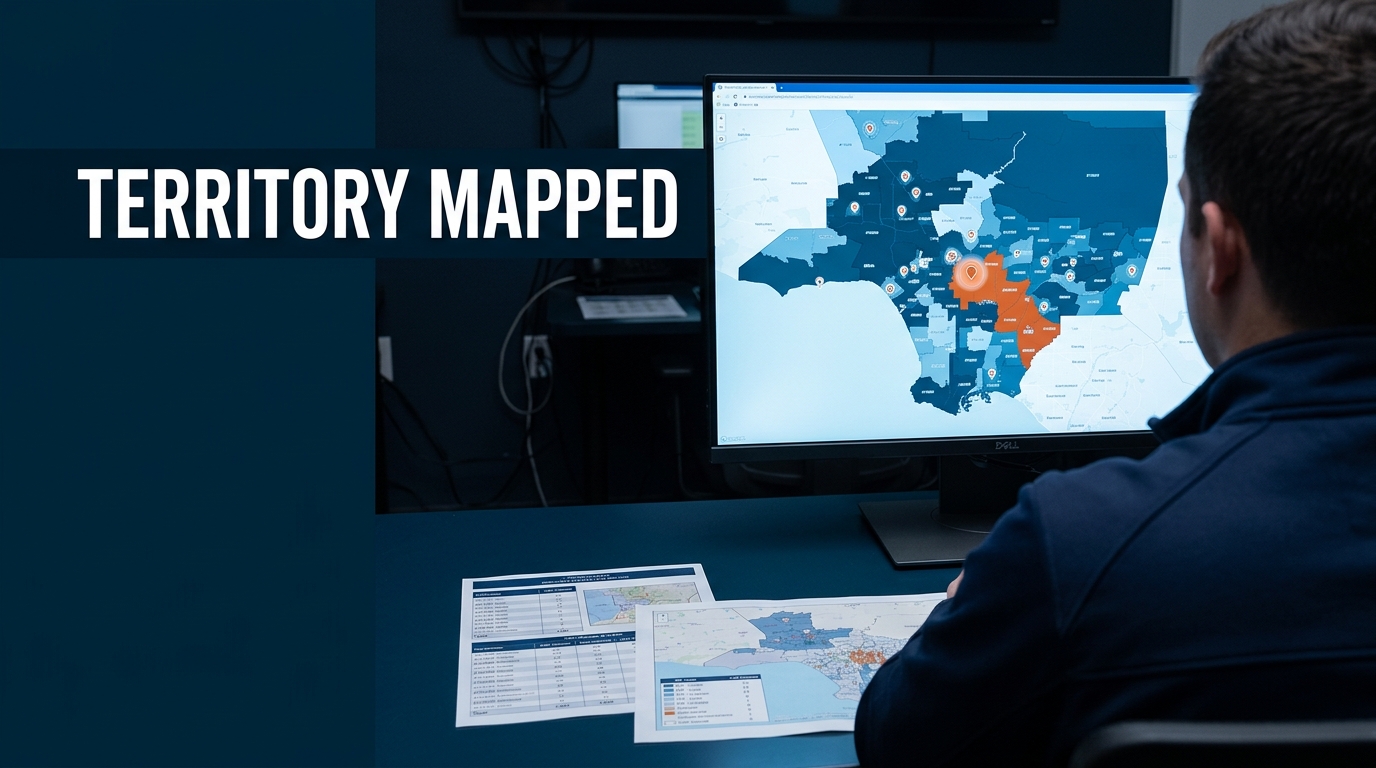
In the fall of 2026, one independent biohazard cleanup operator sat down with call volume records and a spreadsheet of ZIP-level demand data and drew three new service territories. No franchise agreement. No investor deck. No outside capital of any kind. The process took weeks, not months, and it produced a map that pointed directly at markets where real call demand existed and licensed competitors were thin or absent.
Call volume data paired with ZIP-level demand gaps lets an independent biohazard operator identify underserved markets without franchise fees, investor capital, or guesswork about where demand actually lives.
The franchise route is not the only route. That is the blunt point this operator's approach makes. Joining an established biohazard brand costs real money upfront. Bio-One's franchise fee alone sits at sixty thousand dollars, with total startup investment running as high as two hundred twenty-one thousand, plus a seven-and-a-half percent royalty on every dollar of gross revenue afterward. Steri-Clean's fee ranges from forty thousand to eighty thousand. Those numbers are not wrong for the operators who want a corporate framework, training systems, and brand recognition in exchange. But they do represent a permanent, ongoing tax on every job you run, and they require you to accept a territory someone else drew.
Why Call Volume Data Beats a Hunch
Traditional territory selection in service businesses tends to follow population density maps, competitor locations, or a general sense that a nearby county seems underserved. Those inputs are not useless, but they are indirect. They measure things that correlate with demand rather than demand itself.
Call volume data is different. When someone dials for biohazard cleanup, they are expressing an immediate, specific need. That call represents a real job at a real address, right now. Aggregated across ZIP codes over time, those calls produce a picture of where demand is consistent, where it is growing, and where the number of calls going unanswered or routed to distant providers reveals a gap. That gap is what the operator in this case was mapping.
Directories like BioCleaners Directory, built specifically for the bio-restoration and biohazard cleanup industry, index operators by ZIP code and state. A consumer searching for cleanup in a specific area who finds no local result, or only one result with no reviews and a long drive time, is signaling a demand gap in plain language. When that pattern repeats across multiple ZIP codes within a county or regional cluster, the shape of an underserved territory starts to appear.
Reading the Map: How the Three Territories Took Shape
The operator did not start by picking three places they liked or three counties adjacent to their current base. They started by identifying where calls were coming from that they could not efficiently serve, and then cross-referencing that against directories and local provider counts by ZIP.
The process involved three inputs working together.

- Inbound call records, sorted by originating ZIP code, showing where demand was concentrated and where callers were going to competitors or finding no one.
- Directory presence data, showing which ZIPs had zero or one listed provider versus three or more, and whether those listings were active and current.
- Drive-time radius analysis, overlaying the demand gaps against the operator's existing location to identify which gaps were close enough to serve without a second facility.
Three territories emerged from that overlap. Each one showed consistent inbound call demand, thin provider presence in the directory layer, and a drive time the operator could absorb with existing equipment and staff. None of the three required a new physical location to launch into. That kept startup costs close to zero in the traditional capital sense.
The Demand Gap Concept in Plain Terms
Biohazard calls are not discretionary. Unattended death scenes, trauma cleanups, hoarding situations with biological material, sewage events in occupied units - none of those wait for a provider who is forty-five minutes away or unavailable at 9 PM. Callers who cannot reach a local, responsive operator either go without service longer than they should or reach out to a regional or national brand that routes a crew from a distant location and charges accordingly. Either way, the gap is costing someone something.
For the operator mapping expansion, that cost is the opening. A competitor who is consistently too far away or consistently slow to respond is not really holding the territory. The directory data makes that visible in a way that a simple count of registered companies never would.
Bootstrapped Expansion and What It Actually Requires
Scaling a biohazard operation without outside capital does not mean scaling slowly. It means scaling deliberately. The operator who mapped these three territories was not starting from scratch in each one. They were extending existing capacity - the same trained crew, the same equipment and PPE inventory, the same insurance and regulatory compliance - into markets where that capacity was absent.
The investments required were specific and manageable. Updated listings in the directory for each target ZIP. Local referral outreach to coroners, property managers, and law enforcement contacts in each territory. Response time commitments that the operator could actually keep based on drive-time data. Those are not expensive line items. They are time and attention applied with a map in hand.
Intent-Based Selection Versus Demographic Guessing
One reason this approach produces cleaner results than demographic-based territory selection is that it skips a layer of inference. Demographic models assume that certain population characteristics predict demand for biohazard services. Age distribution, income levels, housing density - those are proxies, and proxies carry error.
Call volume is not a proxy. It is the demand signal itself. A ZIP code that generated forty inbound calls for biohazard cleanup over a twelve-month period, with one listing in the directory and no visible response infrastructure, is not a territory you are guessing about. It is a territory you can measure. That measurability is what makes the expansion defensible when you are not backed by a franchise system providing its own market analysis.
Franchise systems offer structure, and that structure has real value. But the market intelligence that justifies a territory selection in a franchise system is not necessarily more accurate than what an independent operator can build from call data and directory coverage. In some cases it is less accurate, because franchise territories are often drawn at the county level for administrative convenience, not based on actual call patterns within that county.
What Other Independent Operators Can Apply Right Now
The methodology this operator used is not proprietary. The data inputs - call records, directory listings, drive-time tools - are available to any operator running an active biohazard business. The discipline required is analytical rather than financial. You are asking a different set of questions about your market before you commit crew time and equipment to a new area.
Starting with BioCleaners Directory as a baseline for provider coverage by ZIP is practical for operators in any state. The directory is national, organized by ZIP and state, and built specifically for the bio-restoration industry. A search of your adjacent ZIP codes will tell you quickly whether the listing landscape is crowded or sparse. Combined with your own call records, that search produces a starting map in an afternoon.
The operator who mapped three territories in fall 2026 did not wait for permission from a franchisor or a check from an investor. They used the data that was already sitting in their call logs and matched it against the directory gap that was visible to anyone willing to look. Three territories came from that exercise. The royalty on those territories goes to no one but themselves.