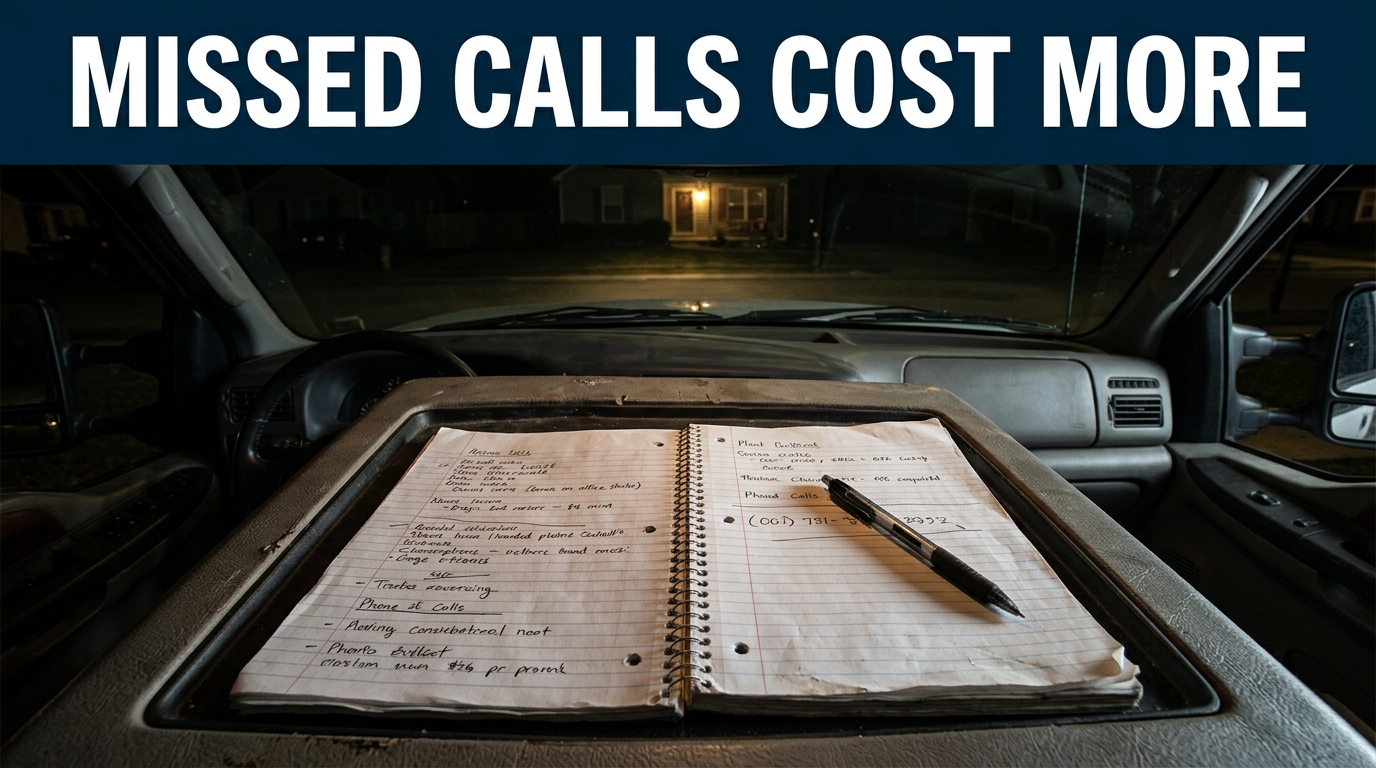
A biohazard cleanup call that goes unanswered, or a follow-up that never happens, does not just vanish quietly. It converts into revenue for whoever picks up next. For operators still running their dispatch and lead tracking on spiral notebooks, shared spreadsheets, or memory, this is happening every month, and the dollar amount is almost certainly larger than what a CRM subscription would cost for the entire year.
One missed follow-up call in the biohazard cleanup industry can represent $500 to $2,000 or more in lost job revenue, plus the downstream referrals that job would have generated. A CRM subscription typically costs far less per month than a single dropped lead.
The Actual Math Most Operators Never Run
Here is a calculation worth doing on paper. Take your average job ticket. For unattended death, hoarding, or trauma cleanup, that number often sits between $800 and $3,000 depending on scope and region. Now estimate how many inbound inquiries your operation gets in a month, and how many of those never get a second contact attempt after the first call or voicemail.

Industry data from service-business research consistently shows that around 80 percent of sales require five or more follow-up contacts, and that nearly half of all operators give up after one attempt. If your tracking system is a notebook or a spreadsheet, the odds that a lead you tagged 'call back Thursday' actually gets called Thursday are not high. So take your average ticket, multiply by the number of leads you realistically drop each month, and compare that figure to a $50-to-$150 CRM subscription. The math resolves quickly and it does not favor the notebook.
Spreadsheets Do Not Ring Phones at 2 AM
Biohazard work does not come in during business hours. A family that discovers an unattended death is not calling at noon on a Tuesday. Calls arrive late at night, on weekends, and across holiday weekends when most operators are already stretched. Manual tracking systems have a structural flaw in this context: they require a person to remember something, find the right page, and then act on it at the right time. That chain breaks constantly under fatigue and volume.
A CRM stores the lead, timestamps the contact, and sends a reminder regardless of what time it is or how many other jobs are active. A notebook does none of that. The comparison is not really about cost preference. It is about which system can hold information reliably when a human cannot.
What Manual Tracking Actually Costs Per Year
Solo operators and small teams often avoid CRM software because the monthly fee feels like a discretionary expense. That framing is backwards. Manual tracking has a cost too, it just gets categorized as normal business loss rather than a line item. Consider this framework applied to a single operator:
- Average job value: $1,200
- Dropped or forgotten leads per month: 2 (a conservative estimate for any operator handling 15 or more inquiries monthly)
- Monthly revenue lost to missed follow-ups: $2,400
- Annual revenue lost: $28,800
- Annual cost of a mid-tier CRM: $600 to $1,800
That gap is not a rounding error. It is a self-imposed penalty that compounds quietly because nobody in the operation is measuring it. Operators who think of themselves as business owners rather than just technicians recognize this pattern immediately. The ones who struggle to grow often have excellent field skills and terrible systems, and the systems are what scale.
The Hidden Tax on Every Job You Already Do
There is a subtler cost beyond the directly missed call. When a lead reaches you after finding your listing on a directory like BioCleaners Directory, they are already partway toward a decision. They searched by ZIP code or state, found your name, and made contact. That is warm traffic. Failing to follow up on a warm inquiry is not the same as never having the lead at all. You have already spent effort on the marketing presence that generated the contact. Dropping the follow-up means the acquisition cost was paid and the revenue was not collected.
Multiply that by repeat behavior across twelve months and the loss is structural, not incidental.
Beyond the Invoice: What One Lost Call Costs Long-Term
A missed follow-up does not cost only what is on that one job estimate. Biohazard clients who feel ignored during an already difficult situation do not call back and they do not refer. The property manager who called about a unit cleanup and never heard from you again will have a different operator's number saved in her phone by next month. The funeral home that tried to send you a referral and got no response will route future work elsewhere.
Referral networks in this industry are tight. Restoration contractors, property managers, law enforcement liaisons, and medical examiners' offices all route work based on reliability. One dropped call does not just cost the immediate job. It can cost every job that caller would have sent over the next several years. That figure is not trackable, which is precisely why operators underestimate it.
Why the Most Reliable Operators Treat CRM as Infrastructure
A working van is not optional. A phone is not optional. For operators who want to compete at any meaningful scale, a system that tracks every lead, timestamps every contact attempt, and flags overdue follow-ups is also not optional. The operators building durable businesses in this industry treat lead management the same way they treat equipment maintenance. It is not glamorous, but skipping it has a predictable outcome.
CRM adoption in service industries consistently correlates with higher close rates, better client retention, and more predictable revenue. That is not because the software is magic. It is because the software removes the single biggest failure point in most small operations: human memory under pressure.
The Cognitive Load Nobody Accounts For
Solo operators especially tend to run their entire pipeline in their heads. Call came in at 7 PM, said to call back in the morning, wrote it on the back of an estimate form that is now in the truck. This is not a character flaw. It is a system design problem. Human memory degrades under fatigue, and biohazard work is physically and emotionally demanding in ways that most service jobs are not. Expecting recall to function perfectly after a trauma scene cleanup at the end of a ten-hour day is unrealistic.
The cognitive load of tracking everything manually also bleeds into job quality. Mental bandwidth spent trying to remember who to call next is bandwidth not spent on the work in front of you. Offloading that to software costs a monthly fee. Keeping it in your head costs focus, accuracy, and revenue.
What to Do With This
Operators listed on BioCleaners Directory are already visible to people actively searching for biohazard cleanup by ZIP code and state. That visibility generates contacts. Whether those contacts become jobs depends entirely on what happens after the first ring.