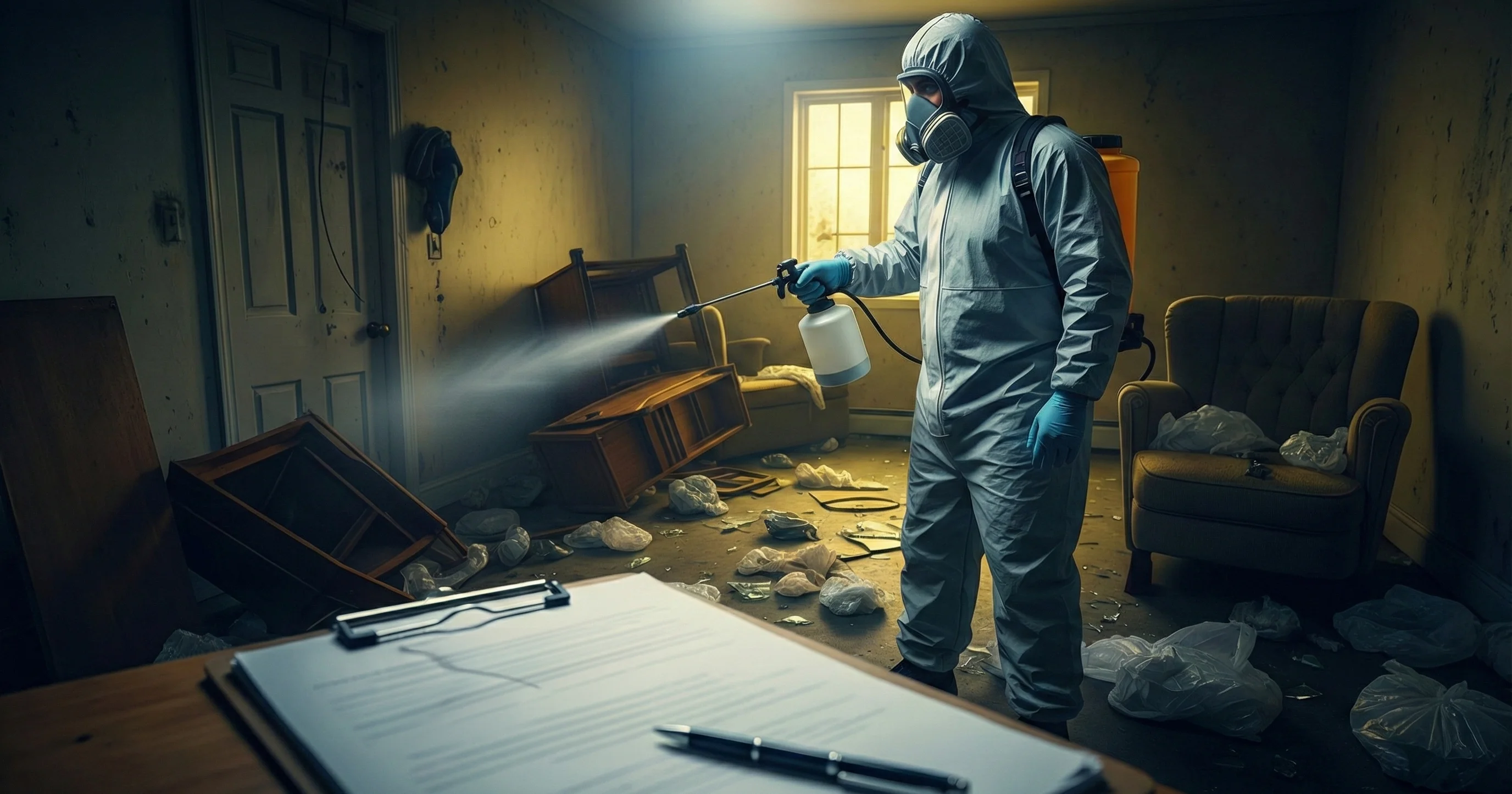
Does Homeowners Insurance Cover Biohazard Cleanup?
The short answer is usually yes, but the type of policy you hold, how the claim is filed, and which exclusions apply determine everything. Getting this right can mean the difference between a covered claim and a five-figure out-of-pocket bill.
By BioCleaners Directory EditorialFebruary 22, 2026
Most standard homeowners policies do cover biohazard and crime scene cleanup when the event is sudden and accidental: a crime, traumatic accident, or unexpected death. Coverage is typically excluded for meth lab decontamination, hoarding without a distinct covered event, and gradual contamination. Your policy type (HO-3, HO-5, landlord policy), and how the claim is described to your adjuster are the two most decisive factors in your outcome.
Your Policy Type Determines Your Baseline Coverage
Not all homeowners insurance is the same. Before any event-specific details come into play, the type of policy you hold sets your baseline position. Here is how each type maps to biohazard coverage:
HO-3 PolicyMost Common
✓ Generally Favorable
The most widely sold policy. Provides open-peril coverage on your home's structure, everything not explicitly excluded is covered. Since a traumatic event is rarely listed as an exclusion, cleanup is typically covered. Watch: personal belongings are on named-peril basis, so verify biohazard is listed for contents.
HO-5 PolicyStrongest Coverage
✓ Best Position
Like HO-3 but provides open-peril coverage on both the structure and your personal belongings. Contaminated furniture, mattresses, and personal items are more likely to be covered, and paid at replacement cost value rather than depreciated value.
HO-4 Renter's Insurance
⚠ Covers Personal Property Only
Covers the renter's belongings, not the building or cleanup costs for the property. If you're renting, your landlord's policy covers structural remediation. Your HO-4 may cover contaminated personal items. Call your landlord immediately: the property cleanup is their responsibility.
Landlord Policy (DP-3)Rental Property
✓ Reliable Coverage
Most DP-3 policies cover biohazard cleanup following unattended deaths, crimes, or traumatic events involving tenants. Typical limits: $5,000-$25,000 depending on policy and endorsements. Document everything from the moment of discovery. Your paper trail is your claim.
ⓘ Condo Owners (HO-6)
Your HO-6 covers your unit's interior and belongings, but not the building's common structure. If contamination spreads to common areas or adjacent units, the condo association's master policy becomes involved. Notify both your insurer and your condo association on the same day.
The Policy Language That Decides Your Claim
Rather than taking your agent's word for it, read your policy. Three sections matter: your Covered Perils or Insuring Agreement, your Exclusions, and any endorsements. Here is the language that controls coverage:
Policy Language
What It Means for Your Claim
Verdict
"Sudden and accidental"
The most critical phrase. A traumatic event (a crime, sudden death, accident) qualifies. A slow-developing situation (gradual sewage leak, developing mold, long-term hoarding) does not. If your event was sudden, you're in coverage territory.
Works for you
"Vandalism and malicious mischief"
Covers property damage including biological contamination resulting from a break-in or violent crime on your property. If your home was the scene of a crime, look for this named peril.
Works for you
"Intentional acts by the insured"
Events caused by the homeowner or a household member are excluded. Events caused by third parties (intruders, visitors) are treated differently and generally covered.
Works against you
"Pollution exclusion"
Some insurers apply broad pollution exclusions to biological contamination and attempt to use them to deny biohazard claims. These denials are frequently challenged successfully on appeal, courts have not consistently accepted this interpretation for biological events.
Contested, worth appealing
"Illegal activities exclusion"
Used to deny meth lab and drug manufacturing cleanup. This exclusion is solid and very difficult to challenge when drugs were manufactured on the premises with the homeowner's knowledge.
Works against you
"Gradual deterioration / lack of maintenance"
Excludes contamination that developed over time through neglect. The key question insurers ask: could this have been prevented with reasonable property maintenance?
Works against you
Biohazard cleanup endorsement
Some carriers offer this as an add-on that explicitly names biohazard remediation as covered. If you don't have this, your coverage depends on the open-peril framework and event circumstances.
Strongest if available
Sewage backup rider
Standard policies exclude sewage damage. This rider adds it back. Without it, sewage backup, even a sudden one, is likely denied as a biohazard claim because the standard policy exclusion is explicit.
Only if you added it
What Is Almost Never Covered
✖ Standard Exclusions in Biohazard Claims
✗
Meth lab / drug lab decontamination. The intentional illegal activity exclusion is effectively airtight here. If drugs were manufactured in the property with the homeowner's knowledge, standard coverage does not apply. If you purchased a home not knowing it was a former drug lab, you're in a legal gray area, consult an attorney before assuming coverage or exclusion.
✗
Hoarding without a distinct covered event. Hoarding develops gradually, which disqualifies it under the "sudden and accidental" framework. However, if a hoarding situation resulted in a structural collapse or fire, events that are covered perils, the cleanup may be partially covered as a consequence of that covered event. The hoarding conditions themselves remain excluded.
✗
Gradual sewage backup without a rider. A sudden pipe burst may be covered. A long-term backup situation you failed to address is maintenance-excluded. If you haven't added a sewage/water backup endorsement, assume sewage backup is not covered regardless of circumstances.
✗
Intentional events caused by household members. If the event involves a family member or co-resident who intentionally caused the biohazard situation, expect the intentional acts exclusion to be applied. Note: suicide is treated inconsistently. Some policies cover suicide cleanup under the sudden and accidental framework; others don't. Review your specific policy language.
✗
Deferred maintenance and neglect. If an insurer can demonstrate that the biohazard resulted from your failure to maintain the property, they will apply the maintenance exclusion. Document your maintenance history: it matters at claim time.
How to File a Biohazard Cleanup Insurance Claim: Step by Step
The claims process is one where sequence and preparation directly affect outcomes. Follow this order.
1
Call the claims line, not your agent
Your insurance agent sold you the policy. Your adjuster approves the claim. These are different people with different roles. Always call the main claims line to open a claim and request an adjuster be assigned. Your agent has limited authority to interpret or approve coverage.
Have ready: your policy number, the type of event (crime, unattended death, accident: be factual and brief), when it occurred, and the current status of the property.
2
Start cleanup immediately. Do not wait for approval
You do not need a claim number or pre-authorization to begin biohazard cleanup. Your policy likely contains a duty-to-mitigate clause requiring you to take reasonable steps to prevent further damage. Delaying cleanup while waiting for insurance approval worsens contamination, and gives your insurer grounds to dispute the additional cost that accrued during the delay.
Start cleanup as soon as law enforcement releases the scene. Pursue the claim simultaneously.
3
Document everything before cleanup begins
Before any work starts: photograph all affected areas from multiple angles, collect any police reports or official documentation from first responders, and note the discovery date and approximate time of the event. For decomposition claims, the gap between death and discovery is central to the scope, document it precisely.
4
Choose your own cleanup company, steering is illegal
Your insurer cannot legally require you to use their preferred vendor. This is called "steering" and is prohibited under insurance regulations. You have the right to select any licensed, certified biohazard cleanup company, and your insurer must pay for professional-quality service from a qualified provider.
Why this matters: insurance company preferred vendors are often general restoration companies (primarily water and fire damage) with limited biohazard specialization. A specialized biohazard company will produce better outcomes and, critically, better documentation for your claim.
5
Collect the right documentation from your cleanup company
A professional biohazard company will provide what your adjuster needs. Confirm upfront they will provide all of the following:
✓ Required Documentation for Your Claim
✓
Itemized invoice: broken down by labor hours, materials, PPE, and waste disposal. Lump-sum invoices are frequently challenged.
✓
Before-and-after photographs, of all affected areas. Required by most adjusters and essential for scope verification.
✓
Biohazardous waste manifest, documents exactly what was removed and transported to a licensed disposal facility. Confirms scope of contamination.
✓
Certificate of Decontamination, ideally from an independent industrial hygienist. This is the most important document. Insurance adjusters frequently require it before closing a claim. Without it, expect delays or reduction.
6
Submit a complete claim package, and follow up in writing
Send your adjuster a complete package: the event documentation, itemized invoice, before-and-after photographs, waste manifest, and certificate of decontamination. Request written confirmation of receipt and a timeline on the coverage determination.
All communications after the initial call should be by email. This creates a paper trail that protects you if coverage is disputed. Keep every email, every determination letter, and every denial notice.
What to Do If Your Claim Is Denied
Denial is not final. Insurance companies deny biohazard claims for various reasons (some legitimate, some not), and policyholders who appeal with the right approach frequently succeed.
1
Get the denial in writing with the specific policy language cited
You are legally entitled to a written explanation citing the exact policy provision the insurer relied on. Demand it in writing if it isn't provided automatically. Vague verbal denials are not acceptable, and are not actionable.
2
Review the denial against your actual policy language
Read the specific exclusion cited. Is the insurer's interpretation reasonable? Many denials incorrectly apply pollution exclusions or maintenance exclusions to sudden biohazard events. If the cited exclusion doesn't cleanly match your situation, the denial may be worth challenging.
3
File a formal internal appeal
Write a formal appeal letter citing the policy language that supports your claim, characterizing the event accurately (sudden, accidental, caused by a third party), and attaching any additional documentation. Request an independent internal review by someone other than the original adjuster.
4
Hire a public adjuster
A public adjuster is a licensed professional who represents your interests, not the insurer's. They typically charge 10-15% of the claim settlement, but expertise in contested claims frequently results in higher payouts even after their fee. For biohazard claims over $5,000 that have been denied, a public adjuster consultation is almost always worth the cost.
5
File a complaint with your state insurance commissioner
Every state has an insurance commissioner whose office investigates complaints against insurers. Filing a formal complaint puts the denial on record and often triggers reconsideration, insurers know that patterns of improper denials attract regulatory action. Find your state's department through the NAIC at naic.org.
6
Consult a bad faith insurance attorney
If your insurer denied without valid reason, delayed unreasonably, or misrepresented your policy, this may constitute bad faith under your state's insurance law. Many bad faith insurance attorneys take cases on contingency, meaning no upfront cost. A one-hour consultation is worth getting for any denial over $10,000.
State-Specific Notes: California, Florida, and Texas
These three states account for the highest volume of biohazard cleanup insurance claims in the country. Each has specific provisions, consumer protections, or victim assistance programs worth knowing.
CA
California
California law explicitly prohibits insurance company steering. The California Department of Insurance (CDI), enforces this actively. California also requires disclosure of a death on a property within the past three years at time of sale, making your certificate of decontamination a legally significant document for future transactions.
ProgramCalifornia Victim Compensation Board (CalVCB), up to $3,000 for crime-related cleanup when insurance doesn't fully cover it. victims.ca.gov
FL
Florida
Florida has one of the country's highest rates of unattended deaths (large elderly population, many living alone). Insurers here have a history of applying broad pollution exclusions to biohazard claims, courts have not consistently accepted this. Florida requires specific registration for biohazard cleanup companies; verify your provider's Florida DOH registration.
ProgramFlorida Bureau of Victim Compensation, allows cleanup costs to be submitted directly by the cleanup company, not only the victim.
TX
Texas
Texas operates a particularly accessible Crime Victims' Compensation (CVC), Program. Notably, licensed cleanup companies can submit bills directly to the CVC for reimbursement, victims do not need to pay out of pocket first. Coverage requires proof that homeowners or renter's insurance doesn't apply or has been exhausted.
ProgramTX CVC Program via Office of the AG, direct billing by cleanup providers. texasattorneygeneral.gov
ⓘ All 50 States Have Victim Compensation Programs
For events involving violent crime, every state has some form of victim compensation program that may cover cleanup costs when insurance falls short. Scope varies significantly. Find your state's program through the National Association of Crime Victim Compensation Boards at nacvcb.org.
Questions to Ask Your Agent Before You Ever Need to File
The time to understand your coverage is before a crisis, not during one. Call your agent with these specific questions, and get the answers confirmed in writing by email.
📝 Your Coverage Verification Checklist
?Does my policy cover biohazard cleanup following a traumatic death, violent crime, or accident on my property?
?Is there a specific dollar limit on biohazard remediation, and what is it?
?Is sewage backup covered under my current policy, or do I need a separate rider?
?Does my policy contain a pollution exclusion, and has your company successfully paid biohazard claims under similar policies?
?Can I choose my own biohazard cleanup company, or am I required to use a preferred vendor?
?What specific documentation does your claims department require to process a biohazard remediation claim?
?Does my policy cover post-remediation testing and the certificate of decontamination from an independent hygienist?
⚠ Get It in Writing
An email confirmation from your agent of what your policy covers is worth considerably more than a verbal assurance. If the agent can't confirm coverage in writing, ask for a written coverage summary from the home office. What your agent believes your policy covers and what the claims department will actually pay are sometimes different, and the claims department wins that argument.
If Insurance Doesn't Cover It
When insurance falls short through denial, exclusion, or coverage limits, several paths remain:
State crime victim compensation programs exist in all 50 states for events involving violent crime. Find yours at nacvcb.org.
Payment plans from cleanup companies are common, many legitimate providers structure deferred arrangements for clients navigating insurance uncertainty.
Direct billing options, some companies begin work and bill insurance directly, with any gap billed to the client only after the claim resolves. Ask upfront.
Municipal assistance programs. Some cities and counties maintain funds for cleanup assistance for low-income residents or seniors. Contact your local police department's victim services unit for referrals.
Frequently Asked Questions
Should I call my insurance agent or adjuster about a biohazard claim?
Always call the main claims line to open a claim and ask for an adjuster to be assigned. Your agent sold you the policy but does not approve or deny claims. That is the adjuster's authority. Your agent's verbal assurance about coverage means nothing if the adjuster later interprets the policy differently.
Do I need a claim number or pre-authorization before cleanup starts?
No. Biohazard cleanup should begin as soon as law enforcement releases the scene. You do not need prior insurance authorization. Most policies actually require you to mitigate damage promptly, delaying cleanup while waiting for approval can give your insurer grounds to dispute costs that accrued during the delay.
Can my insurance company tell me which cleanup company to use?
No. Requiring you to use a specific vendor, called steering, is prohibited. You have the right to choose any licensed, certified biohazard cleanup company. Your insurer must cover the cost of professional-quality service from a qualified provider of your choosing.
What is a certificate of decontamination and why does my adjuster require it?
A certificate of decontamination is a formal document, ideally from an independent industrial hygienist, confirming through testing that the property is clear of detectable biological contamination. Insurance adjusters require it to confirm that cleanup was complete and professionally certified. It also serves as legal documentation if you later sell the property and are required to disclose the prior event.
Will filing a biohazard cleanup claim raise my homeowners insurance rates?
It may. Most insurers factor claim history into renewal pricing. A single claim may have minimal impact. For landlords with multiple properties, weigh the claim amount against potential rate increases or non-renewal over a multi-year period, for smaller claims, out-of-pocket payment sometimes makes financial sense when rate impact is considered.
Does suicide cleanup count as a covered "sudden and accidental" event?
It depends on your specific policy. Some policies cover suicide cleanup under the sudden and accidental framework (the event was sudden, even if intentional on the part of the deceased). Others have explicit exclusions for death by suicide. Review your policy's specific language, and if coverage is unclear, open a claim and let the adjuster determine coverage. You can always decline to pursue if the coverage determination is unfavorable.
Find a Verified Provider Near You
The cleanup company you choose affects your insurance outcome directly. BioCleaners Directory lists verified, certified providers whose documentation practices are built for insurance claim success.
Free to use • No account required • Available 24/7
Find Biohazard Cleanup Services Near You
Need professional biohazard or crime scene cleanup? Browse verified companies by state to compare services, read reviews, and get free quotes from local professionals.