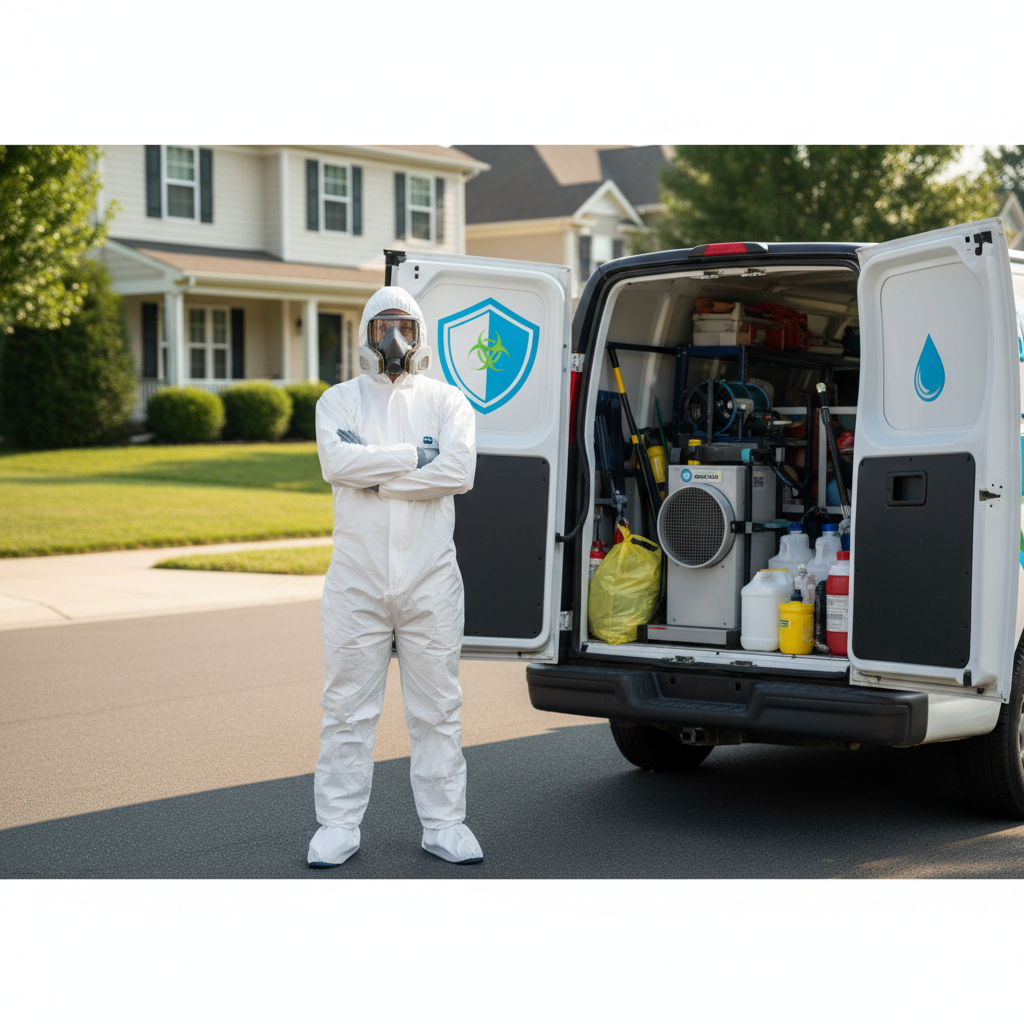
A legitimate biohazard cleanup company will have OSHA bloodborne pathogens training, carry $1M+ in liability insurance, provide a written scope of work before starting, and never pressure you to sign on the spot. The most important certifications to look for are ABRA membership, IICRC certification, and state-specific licensing. Avoid any company that quotes a price without seeing the scene, demands full payment upfront, or cannot provide proof of insurance and training credentials.
Why Choosing the Right Company Matters
Biohazard cleanup is not regular cleaning. It involves bloodborne pathogens, chemical hazards, and contamination that can cause serious illness or death if handled improperly. The wrong company can leave behind invisible contamination that puts future occupants at risk—and exposes you to legal liability.
Unlike water damage restoration or general cleaning, biohazard remediation is lightly regulated in most states. That means the barrier to entry is low, and the range of quality between companies is enormous. Some operators buy a van, print business cards, and start advertising without any formal training. Others invest tens of thousands of dollars in certifications, equipment, and ongoing education.
This guide helps you tell the difference.
Certifications and Training to Look For
No single national license is required for biohazard cleanup in the United States. However, several certifications and training programs serve as reliable indicators of competence and professionalism.
| Certification / Training | Issuing Organization | What It Covers | Importance |
|---|---|---|---|
| OSHA Bloodborne Pathogens Standard (29 CFR 1910.1030) | OSHA (Dept. of Labor) | Safe handling of blood and bodily fluids, PPE requirements, exposure control plans | Essential — Federal law requires this for any worker handling blood |
| OSHA HAZWOPER (40-hour) | OSHA (Dept. of Labor) | Hazardous waste operations, emergency response, chemical safety | Essential for drug contamination and chemical biohazards |
| ABRA Membership | American Bio Recovery Association | Industry standards, code of ethics, best practices for bio-recovery | Highly recommended — The primary industry trade association |
| IICRC Certifications | Institute of Inspection, Cleaning and Restoration Certification | Various: TCST (trauma/crime scene), ODOR (odor control), WRT (water restoration) | Highly recommended — Gold standard for restoration industry |
| State-Specific Licensing | Varies by state | Some states require specific licenses for biohazard, meth decon, or infectious waste transport | Required where applicable — Check your state’s requirements |
| Infectious Waste Transporter License | State environmental agency | Legal authorization to transport biohazardous waste to approved disposal facilities | Required in most states — Disposal without this is illegal |
| EPA Lead-Safe Certification | EPA | Safe work practices in pre-1978 buildings where remediation may disturb lead paint | Required for older properties |
Ask for copies of actual certificates, not just claims. A reputable company will email you their OSHA training records, ABRA membership status, and insurance certificate of coverage within minutes of being asked. If a company hesitates or says they’ll “get back to you,” move on.
Certified vs. Uncertified: What You Risk
The difference between a certified professional and an uncertified operator is not just a piece of paper—it directly affects the safety and completeness of the cleanup.
| Factor | Certified Company | Uncertified Operator |
|---|---|---|
| Training | OSHA, HAZWOPER, IICRC, ongoing annual education | Self-taught, YouTube, or minimal training |
| Equipment | ATP testing, hydroxyl generators, industrial-grade disinfectants, negative air machines | Consumer-grade cleaning products, basic PPE |
| Insurance | $1M–$5M general liability, workers’ comp, professional liability | Often uninsured or underinsured |
| Waste disposal | Licensed transport to approved facilities, manifest documentation | May dispose of biohazardous waste illegally (dumpsters, drains) |
| Clearance testing | ATP or culture testing to verify decontamination is complete | Visual inspection only (“looks clean”) |
| Documentation | Detailed remediation reports, before/after photos, clearance certificates | Minimal or no documentation |
| Insurance billing | Experienced with Xactimate, direct billing to insurance carriers | Cannot work with insurance; cash only |
| Legal protection | Work meets regulatory standards; documentation protects you in court | No defensible standard of care; you absorb legal risk |
| Health risk to occupants | Contamination verified as eliminated before re-occupancy | Residual contamination possible; no verification |
If an uncertified operator misses contamination and a future occupant contracts Hepatitis B, HIV, or another bloodborne illness, you—the property owner—face the lawsuit. Hiring a certified professional with documented clearance testing is your strongest legal defense.
Red Flags That Should Disqualify a Company
During a biohazard emergency, it is tempting to hire the first company that answers the phone. Resist that urge. These red flags indicate a company you should avoid:
✗ Pricing Red Flags
- Quotes a firm price over the phone without seeing the scene
- Demands full payment before work begins
- Cash-only payments, no invoicing
- Price is dramatically lower than other quotes (cutting corners)
- No written estimate or scope of work
- Charges by the hour with no cap or estimate
✗ Credibility Red Flags
- Cannot provide proof of OSHA training or insurance
- No business license, physical address, or verifiable references
- No company vehicle or branded equipment
- Sends untrained day laborers instead of certified technicians
- Pressure tactics: “This price is only good today”
- Claims “no permits needed” without checking local requirements
✗ Process Red Flags
- Plans to use household cleaning products (bleach, Lysol)
- No mention of ATP testing or clearance verification
- Does not discuss waste disposal procedures
- No personal protective equipment visible
- Cannot explain their decontamination process step by step
✗ Communication Red Flags
- Unreachable after initial contact
- Vague about timeline, process, or expectations
- Refuses to provide references from past clients
- No written contract or terms of service
- Dismissive of your questions or concerns
15 Questions to Ask Before Hiring
Use this list during your initial phone call or on-site consultation. A professional company will answer all of these confidently and without hesitation.
“Are your technicians OSHA-trained in bloodborne pathogens? Can you provide certificates?”
This is non-negotiable. Federal law requires this training for anyone handling blood or bodily fluids. If they hesitate, end the conversation.
“What is your general liability insurance coverage? Can you send a certificate of insurance?”
Look for $1 million minimum. The certificate should name your property specifically if your insurer requires it.
“Do you carry workers’ compensation insurance?”
Without workers’ comp, you could be liable if a crew member is injured on your property during cleanup.
“Are you a member of ABRA or hold IICRC certifications?”
Not every good company has these, but their presence signals commitment to industry standards.
“How do you dispose of biohazardous waste? Are you a licensed transporter?”
Waste must be transported in approved containers to licensed disposal facilities. Ask for the name of their disposal facility.
“Will you provide a written scope of work and estimate before starting?”
Never approve work without a written document detailing exactly what will be done, what materials will be removed, and the total cost or cost range.
“Do you perform clearance testing after cleanup? What method do you use?”
ATP (adenosine triphosphate) testing or culture testing verifies surfaces are actually decontaminated, not just visually clean.
“How quickly can you respond? Do you offer 24/7 emergency service?”
Biohazards worsen rapidly. Companies serving your area should arrive within 2–4 hours for emergencies.
“Do you work directly with insurance companies?”
Experienced companies handle insurance claims routinely, using industry-standard software (Xactimate) to document and bill.
“Can you provide references from similar jobs?”
Ask for references from situations similar to yours—crime scene, unattended death, drug contamination, etc.
“What PPE does your crew use on site?”
Expect: Tyvek suits, N95 or P100 respirators, nitrile gloves, boot covers, and eye protection at minimum.
“What cleaning agents and equipment do you use?”
Hospital-grade disinfectants, enzyme-based cleaners, hydroxyl generators, HEPA vacuums, and negative air machines are standard professional tools.
“Will you provide before-and-after documentation?”
Photos, remediation reports, and clearance certificates protect you legally and support insurance claims.
“What is your payment structure?”
Reputable companies bill after completion, accept multiple payment methods, and can bill insurance directly. Never pay 100% upfront.
“What happens if additional contamination is discovered during cleanup?”
A professional company will contact you immediately, explain what they found, provide a revised scope and estimate, and wait for your approval before proceeding.
What to Expect From Estimates
A professional biohazard cleanup estimate should be thorough, transparent, and provided before any work begins.
What a Good Estimate Includes
Get estimates from at least 2–3 companies. This is not about finding the cheapest price—it is about comparing scope, thoroughness, and professionalism. The most detailed estimate usually comes from the most experienced company. If one estimate is dramatically lower than the others, that company is likely cutting corners on safety or materials removal.
How Biohazard Cleanup Pricing Works
Biohazard cleanup pricing is driven by the type and severity of contamination, not just the square footage.
| Pricing Factor | How It Affects Cost | Typical Range |
|---|---|---|
| Type of biohazard | Blood cleanup is less complex than decomposition or chemical contamination | $1,000 – $30,000+ |
| Affected area size | Single room vs. multiple rooms or entire structure | Multiplies base cost |
| Material removal | Carpet only vs. subfloor, drywall, insulation removal | $500 – $5,000 per room |
| Decomposition stage | Fresh (1–2 days) vs. advanced (weeks–months) | Doubles or triples cost |
| Chemical contamination | Meth/fentanyl require specialized decon + clearance testing | $5,000 – $30,000+ |
| HVAC involvement | Contamination in ductwork requires duct cleaning or replacement | $1,000 – $5,000 add-on |
| Clearance testing | ATP, culture, or chemical testing to verify decontamination | $200 – $1,500 per round |
| Emergency response | After-hours, weekend, or holiday service | 25–50% premium |
| Geographic location | Urban areas cost more; rural areas may have travel fees | 10–30% variance |
Insurance Billing: What to Know
Many biohazard situations are covered by homeowner’s, renter’s, or landlord insurance policies. Here is how the billing process typically works:
File a Claim Immediately
Contact your insurance company as soon as possible after discovering the biohazard. Provide basic details: what happened, when, and the extent of contamination. Get a claim number.
Choose a Company That Works With Insurance
Experienced biohazard companies use Xactimate—the same estimating software insurance adjusters use—to create line-item documentation. This dramatically speeds up claim approval.
The Company Documents Everything
Before, during, and after photos. Detailed scope of work. Material lists. Time logs. All formatted for insurance review.
Direct Billing or Reimbursement
Some companies bill your insurance directly (you pay only your deductible). Others require you to pay and then submit for reimbursement. Ask about this before hiring.
Adjuster Review
Your insurance adjuster reviews the documentation and either approves the claim, requests additional information, or negotiates the amount. An experienced cleanup company knows how to work through this process efficiently.
Do not wait for insurance approval before starting cleanup. Biohazards worsen every hour, and most policies require you to mitigate damage promptly. Delaying cleanup to wait for an adjuster can actually give your insurer grounds to reduce the claim. Start work, document everything, and file simultaneously.
Response Times: What’s Reasonable
Biohazard situations are time-sensitive. Here is what to expect from professional companies:
| Response Metric | Industry Standard | What to Accept |
|---|---|---|
| Phone answered | Live answer 24/7 | Voicemail with <30 min callback |
| On-site arrival (emergency) | 1–2 hours | Up to 4 hours in rural areas |
| On-site arrival (non-emergency) | Same day | Within 24 hours |
| Estimate provided | During initial visit | Within 24 hours of visit |
| Work begins | Immediately after approval | Within 24 hours of approval |
What to Expect During Cleanup
Understanding the professional biohazard cleanup process helps you evaluate companies and know what you are paying for.
Assessment and Documentation
The crew surveys the entire affected area, documents current conditions with photos and notes, identifies all contaminated materials, and creates the remediation plan.
Containment
Plastic sheeting, negative air machines, and sealed barriers isolate the contaminated area from the rest of the structure. This prevents cross-contamination.
Removal
Contaminated materials (carpet, padding, drywall, subfloor sections, personal items) are removed and placed in approved biohazard containers for disposal.
Cleaning and Disinfection
All surfaces are cleaned with hospital-grade disinfectants and enzyme-based cleaners that break down biological material at the molecular level. This is not a single pass—multiple rounds of cleaning and disinfection are standard.
Odor Treatment
If applicable, odor removal using hydroxyl generators, ozone machines, or thermal fogging eliminates residual odors that cleaning alone cannot address.
Clearance Testing
ATP testing, culture testing, or chemical testing (for drug contamination) verifies that decontamination meets established safety standards.
Final Documentation
You receive a complete remediation report: before/after photos, materials removed, cleaning agents used, clearance test results, and waste disposal manifests.
Frequently Asked Questions
Is biohazard cleanup regulated by the government?
Partially. OSHA regulates worker safety (bloodborne pathogens training is federally required). The EPA regulates waste disposal. Some states have additional licensing requirements for biohazard remediation, meth decontamination, or infectious waste transport. However, there is no single national license required to operate a biohazard cleanup business, which is why vetting companies carefully is so important.
How much does biohazard cleanup cost?
Costs range from $1,000 for minor blood cleanup to $30,000+ for drug decontamination or advanced decomposition. The average biohazard cleanup runs $3,000–$8,000. Get estimates from 2–3 companies and compare scope, not just price. See our detailed cost guide for breakdowns by situation.
Does insurance cover biohazard cleanup?
Often, yes. Homeowner’s, renter’s, and landlord policies typically cover crime-related biohazard cleanup and unattended death remediation. Drug contamination and hoarding are usually excluded. Always file a claim immediately and hire a company experienced with insurance billing.
Can I clean up a biohazard myself?
It is strongly discouraged and potentially illegal. Blood and bodily fluids can contain HIV, Hepatitis B, Hepatitis C, and other bloodborne pathogens. Without proper training, equipment, and disposal methods, you risk your health and create legal liability. OSHA considers blood and bodily fluids regulated waste that requires specific handling protocols.
How do I verify a company’s certifications?
ABRA membership can be verified at americanbiorecovery.org. IICRC certifications can be checked at iicrc.org. For OSHA training, ask for copies of individual technician training certificates. For insurance, request a certificate of insurance (COI) naming you as an additional insured.
What if I need cleanup immediately and can’t vet companies thoroughly?
At minimum, verify three things before hiring: (1) OSHA bloodborne pathogens training, (2) liability insurance of $1M+, and (3) a written estimate before work starts. These three checks take less than 15 minutes and eliminate the worst operators. Use our directory to find pre-vetted companies in your area for faster hiring.
Find Vetted Biohazard Cleanup Companies Near You
Every company in our directory has been verified for licensing, insurance, and professional certifications. Compare providers, read reviews, and get free quotes.